
Enhanced channel changing within multi-channel communication systems
a communication system and channel technology, applied in the field of communication systems, can solve the problems of complex messaging involved in the process, inability to make channel changes, and inefficient codeword sizes,
- Summary
- Abstract
- Description
- Claims
- Application Information
AI Technical Summary
Benefits of technology
Problems solved by technology
Method used
Image

Examples
Embodiment Construction
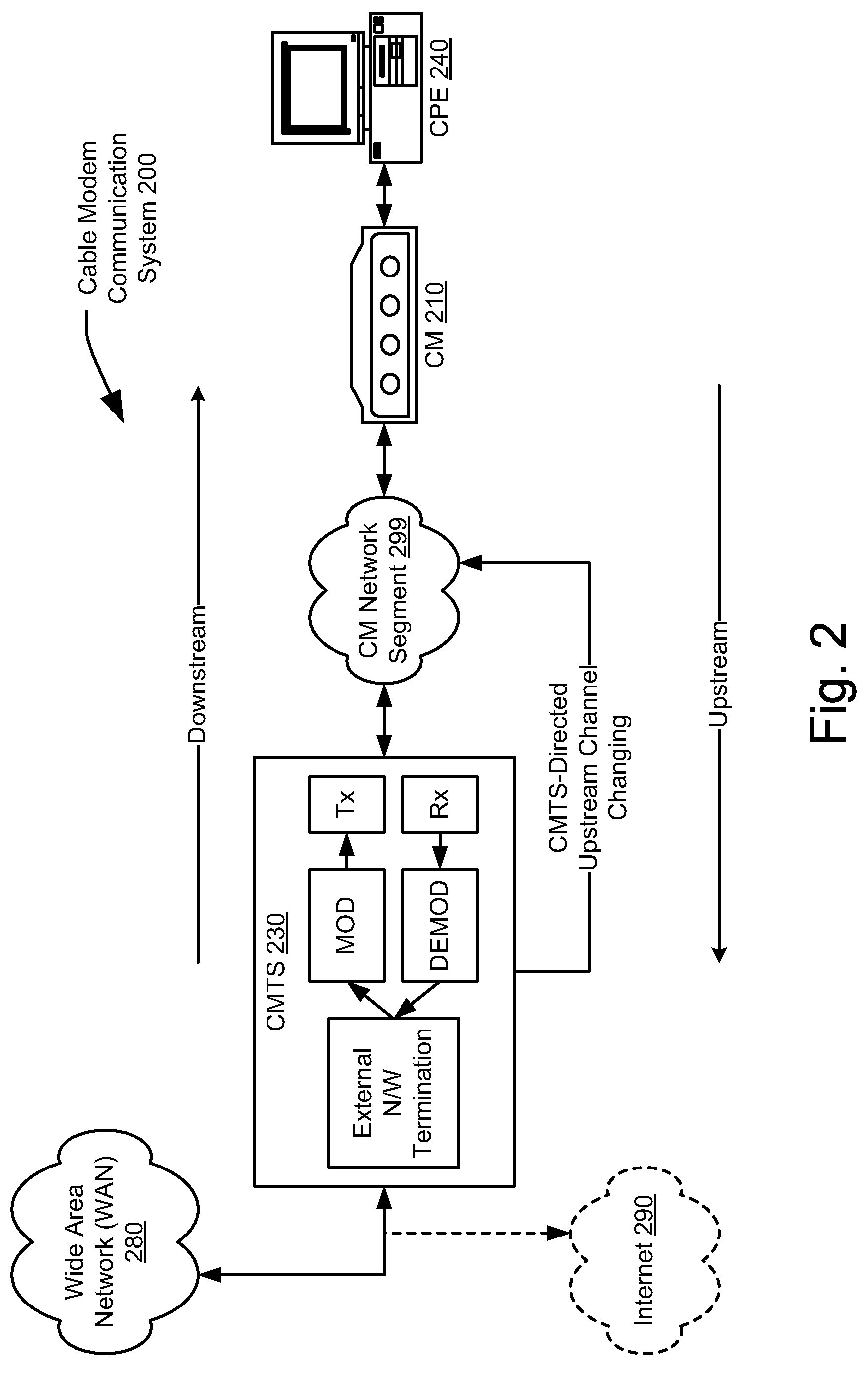
[0045]The present invention seeks to address the deficiencies of the prior art by providing methods for performing channel changes while maintaining acceptable quality of real-time services (ideally, zero jitter and zero packet loss). The present invention does this by providing an intermediate channel (or channels) as a “stepping stone” between the channel the CM is currently operating on and the channel on which it is ultimately desired that the CM operate. This allows the CM to perform the channel change in relatively small steps, each of which may be taken without the need for an immediate re-initialization process. Once the CM has been moved to such an intermediate channel, the CMTS may provide it with a maintenance opportunity at a convenient time, during which adjustments may be made to the CM's timing offset, transmit pre-equalizer coefficients, et al. These adjustments bring the CM's operating parameters closer to those needed for successful operation on the ultimate destin...
PUM
 Login to View More
 Abstract
Description
Claims
Application Information
 Login to View More