
METHODS FOR DAMAGING CELLS USING EFFECTOR FUNCTIONS OF ANTI-EphA4 ANTIBODIES
a technology of antiepha4 antibodies and effector functions, which is applied in the field of damaging cells using the effector function of antiepha4 antibodies, can solve the problems of poor prognosis of this malignancy, poor response to current therapeutic methods, and no identified tumor markers that allow reliable screening, and achieve the effect of enhancing the immunogenic properties
- Summary
- Abstract
- Description
- Claims
- Application Information
AI Technical Summary
Benefits of technology
Problems solved by technology
Method used
Image

Examples
Embodiment Construction
[0167]Hereinafter, the present invention is described in detail with reference to Examples. However, materials, methods and such described therein only illustrate aspects of the invention and in no way are intended to limit the scope of the present invention. As such, materials, methods and such similar or equivalent to those described therein may be used in the practice or testing of the present invention.
Cell Line:
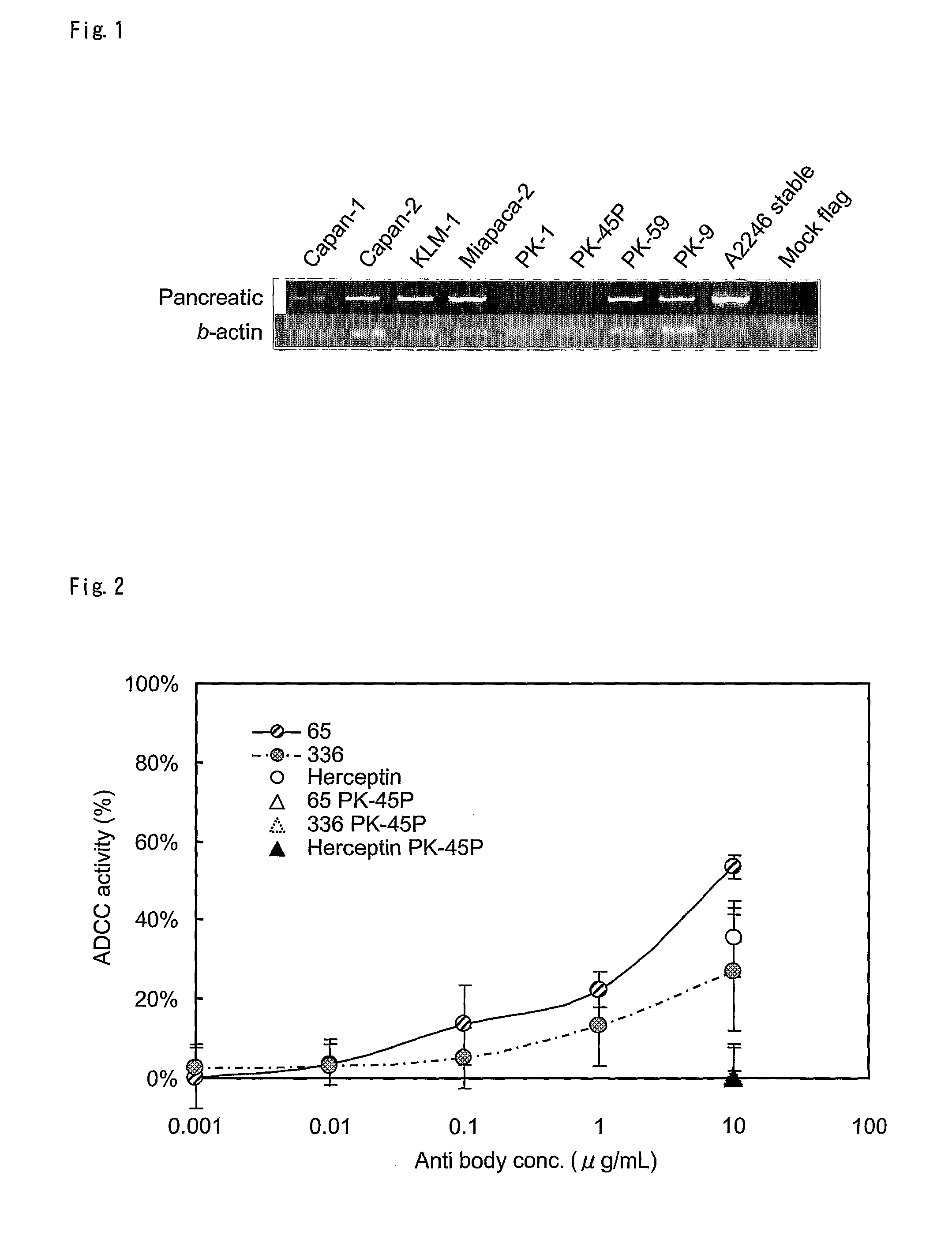
[0168]Human colon or pancreatic cancer cell lines were propagated as a monolayer in an appropriate medium with 10% fetal bovine serum. The cell lines used in the experiment are shown in Table 1.
TABLE 1Pancreatic cancer Cell lineCell lineMediumPlace obtainedPK-45PRPMI + 10%FBSTKG*1; TKG 0493PK-59RPMI + 10%FBSTKG*1; TKG 0492KLM-1RPMI + 10%FBSTKG*1; TKG 0490Capan-1RPMI + 10%FBSATCC; HTB-79 Capan-2McCoy*3 + 10%FBSATCC; HTB-80 Miapaca-2E-MEM*2 + 10%FBSHSRRB; JCRB0070PK-1RPMI + 10%FBSTKG*1; TKG 0239PK-9RPMI + 10%FBSTKG*1; TKG 0240*1Institute of Development, Aging and Cancer, T...
PUM
| Property | Measurement | Unit |
|---|---|---|
| weight | aaaaa | aaaaa |
| volume | aaaaa | aaaaa |
| volume | aaaaa | aaaaa |
Abstract
Description
Claims
Application Information
 Login to View More