
Polyethlene glycol modifications of thymosin alpha-1
a technology of polyethylene glycol and thymosin, which is applied in the field of polyethylene glycol modifications of thymosin alpha-1, can solve the problems of high cost and frequent injection, and achieve the effects of improving bioavailability, potent immuno enhancement activity, and prolonging the effect of in vivo effectiveness
- Summary
- Abstract
- Description
- Claims
- Application Information
AI Technical Summary
Benefits of technology
Problems solved by technology
Method used
Image

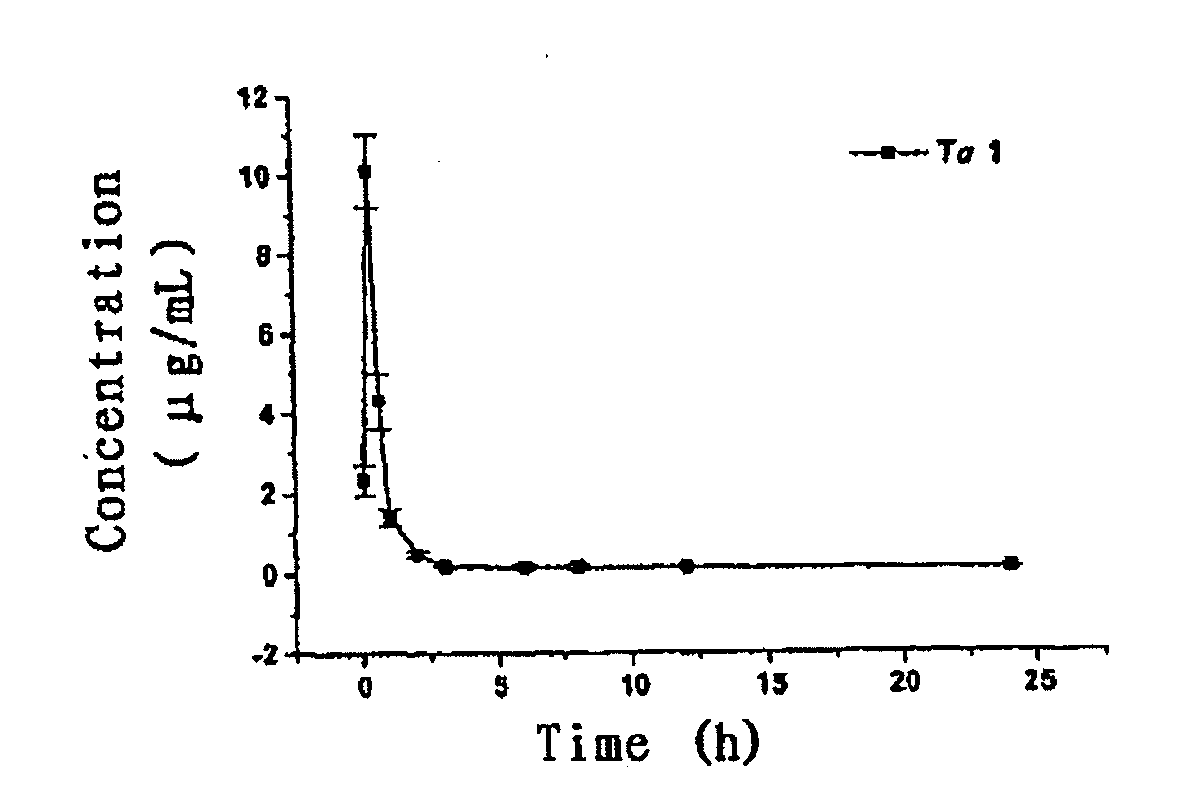
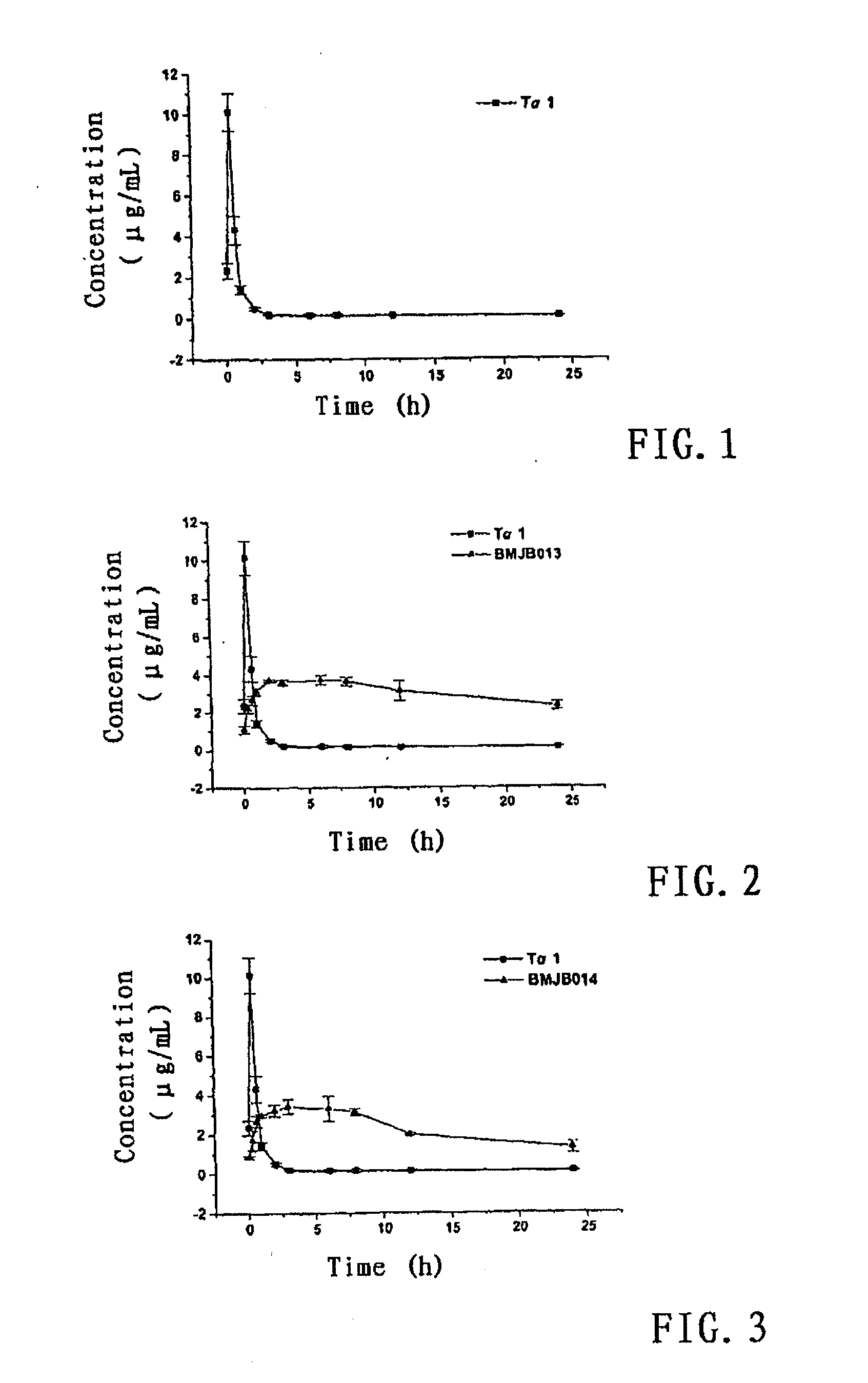
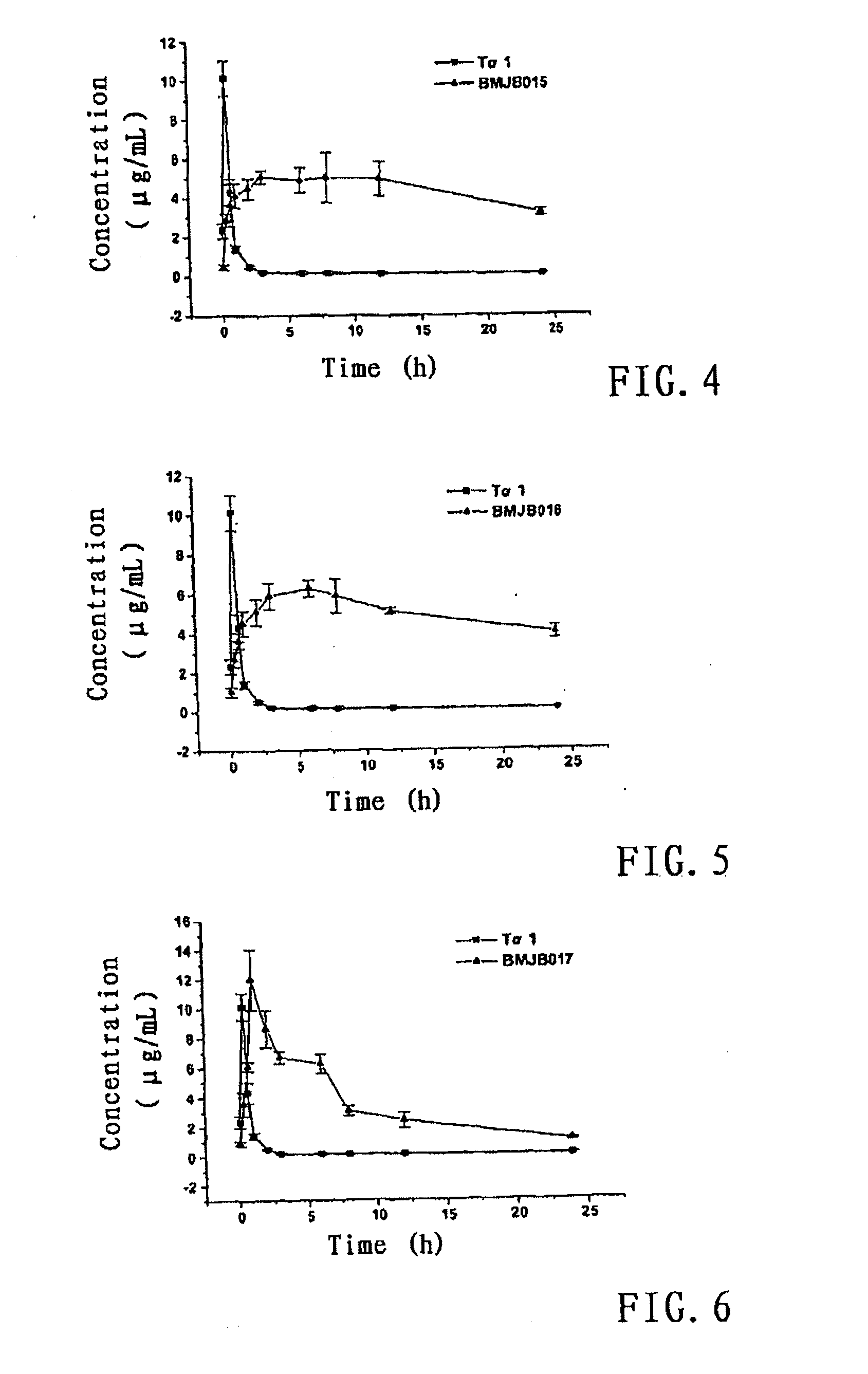
Examples
example 1
Ac-[Cys5(mPEG5000-MAL)]Tα1 (BTJB005)
[0092]1.1 The synthesis of Ac-[Cys5]Tα1
[0093]Synthesize [Cys5]Tα1 by using solid-phase polypeptide synthesis: Wang resin 100 mg was used as solid phase carrier, Fmoc-AA-OH (1-10 times of Wang resin load) was used as starting material, and DCC (1-10 times of Wang resin load) and HOBt (1-10 times of Wang resin load) were used as condensing agent. The amino acids were coupled according to the sequence of Tα1 except that the Val5 was replaced by Cys5, giving rise to side chain fully protected Ac-[Cys5]Tα1 resin. After drying the resin, cleavage was performed by TFA at room temperature for 20-200 minutes. Filter off the resin and add ethyl ether to precipitate, giving rise to white solid. Dissolve the whit solid in water, and then lyophilize it, giving rise to 161 mg white solid. Purify the solid by RP-HPLC, and analyze it by ESI-MS. [M]2+ peak: 1551.0 (theoretical value: 3098).
[0094]1.2 The synthesis of Ac-[Cys5(mPEG5000-MAL)]Tα1
[0095]Dissolve the pur...
example 2
Ac-[Cys8(mPEG5000-MAL)]Tα1 (BMJB008)
[0097]Use the same method as described in Example 1.1 to synthesize Ac-[Cys8]Tα1, giving rise to crude peptide 116 mg. Purify it by RP-HPLC and analyze it by ESI-MS. [M]2+ peak: 1543.0 (theoretical value: 3083).
[0098]Use the same method as described in Example 1.2 to synthesize Ac-[Cys8(mPEG5000-MAL)]Tα1. Purify the product by HPLC and lyophilize it, giving rise to 16.9 mg white solid with a yield of 37.1%.
[0099]Use MALDI-TOF-MS to analyze Ac-[Cys8(mPEG5000-MAL)]Tα1. There are several peaks around 8247, the difference of molecular weight between adjacent two peaks are about 44, which is the typical structural characteristic of polyethylene glycol.
example 3
Ac-[Cys11(mPEG5000-MAL)]Tα1 (BMJB011)
[0100]Use the same method as described in Example 1.1 to synthesize Ac-[Cys11]Tα1, giving rise to crude peptide 143 mg. Purify it by RP-HPLC and analyze it by ESI-MS. [M]3+ peak: 1034.9 (theoretical value: 3098).
[0101]Use the same method as described in Example 1.2 to synthesize Ac-[Cys11(mPEG5000-MAL)]Tα1. Purify the product by HPLC and lyophilize it, giving rise to 21.4 mg white solid with a yield of 28.9%.
[0102]Use MALDI-TOF-MS to analyze Ac-[Cys11(mPEG5000-MAL)]Tα1. There are several peaks around 8282, the difference of molecular weight between adjacent two peaks are about 44, which is the typical structural characteristic of polyethylene glycol.
PUM
| Property | Measurement | Unit |
|---|---|---|
| chemical structure | aaaaa | aaaaa |
| primary structure | aaaaa | aaaaa |
Abstract
Description
Claims
Application Information
 Login to View More