
Implantable medical device charging apparatus having both parallel and series resonators
a charging apparatus and medical device technology, applied in the field of implantable medical devices, can solve the problems of inconvenient patient compliance, inconvenient replacement of batteries for implantable medical devices, and errors in data communication, so as to reduce noise and radiation, less precise, and less reliable
- Summary
- Abstract
- Description
- Claims
- Application Information
AI Technical Summary
Benefits of technology
Problems solved by technology
Method used
Image

Examples
Embodiment Construction
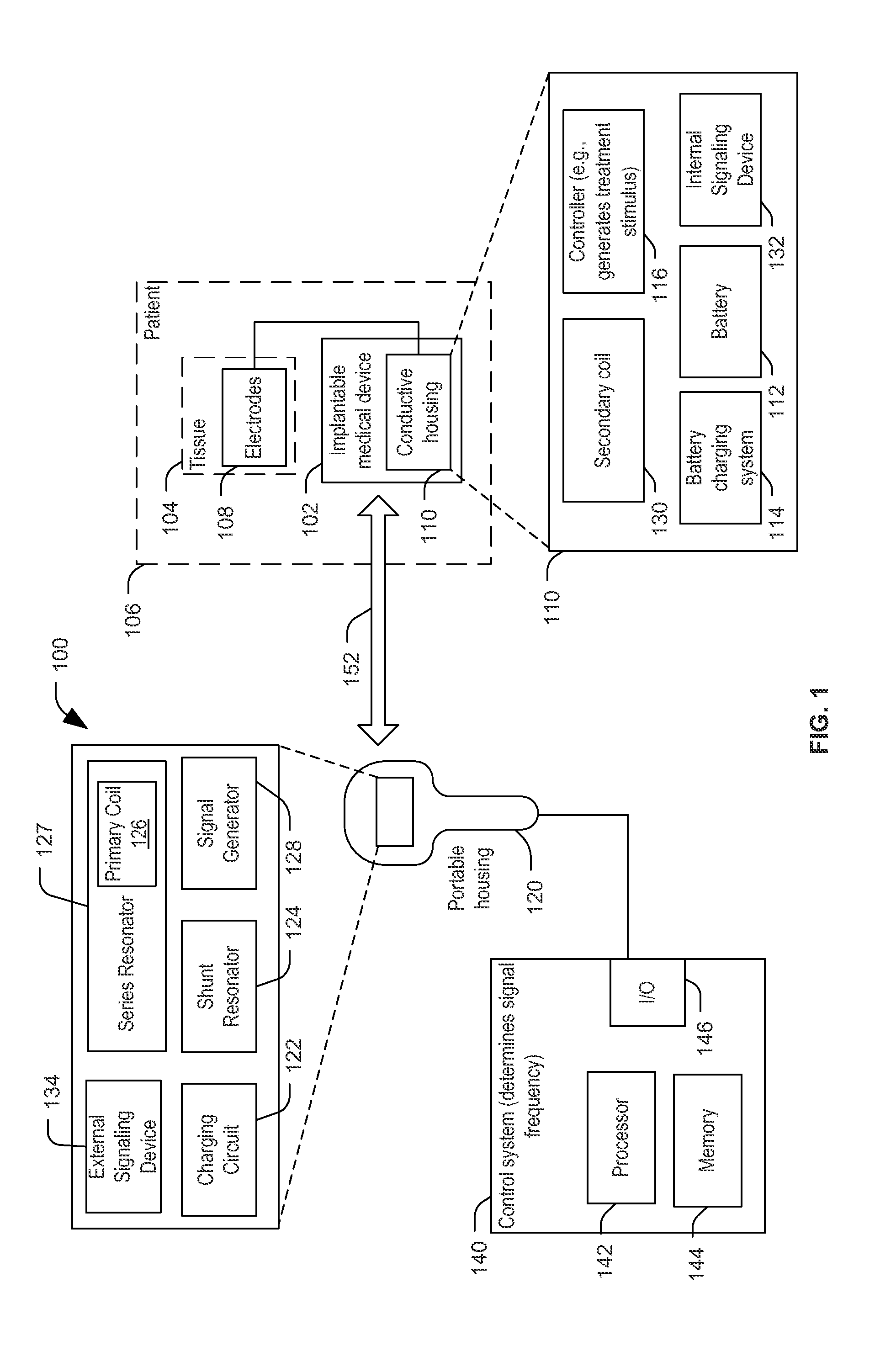
[0017]FIG. 1 is a block diagram of a particular embodiment of an implantable medical device 102 and an external device 100. In a particular embodiment, the external device 100 is an implantable medical device charging apparatus configured to charge the implantable medical device 102. In another particular embodiment, the external device 100 is a device that is configured to communicate data with the implantable medical device 102 and that includes a component (e.g., an implantable medical device charging apparatus) to charge the implantable medical device 102.
[0018]The implantable medical device 102 may be adapted to be surgically implanted in a patient 106 to provide therapy, to monitor one or more conditions, for another purpose, or any combination thereof. In a particular embodiment, the implantable medical device 102 may be coupled to one or more electrodes 108 and may be adapted to deliver electrical stimulus to tissue 104 of the patient 106 via the electrodes 108. In a particu...
PUM
| Property | Measurement | Unit |
|---|---|---|
| frequency | aaaaa | aaaaa |
| frequency | aaaaa | aaaaa |
| frequency | aaaaa | aaaaa |
Abstract
Description
Claims
Application Information
 Login to View More