
HLA Class II Deficient Cells, HLA Class I Deficient Cells Capable of Expressing HLA Class II Proteins, and Uses Thereof
a technology deficient cells, applied in the field of hla class ii deficient cells and hla class i deficient cells capable of expressing hla class ii proteins, can solve the problems of time-consuming, expensive, and time-consuming process of human pluripotent stem cells and their derivatives
- Summary
- Abstract
- Description
- Claims
- Application Information
AI Technical Summary
Benefits of technology
Problems solved by technology
Method used
Image

Examples
example 1
Construction of Human Embryonic Stem Cells with Knockout Mutation in RFXANK Gene
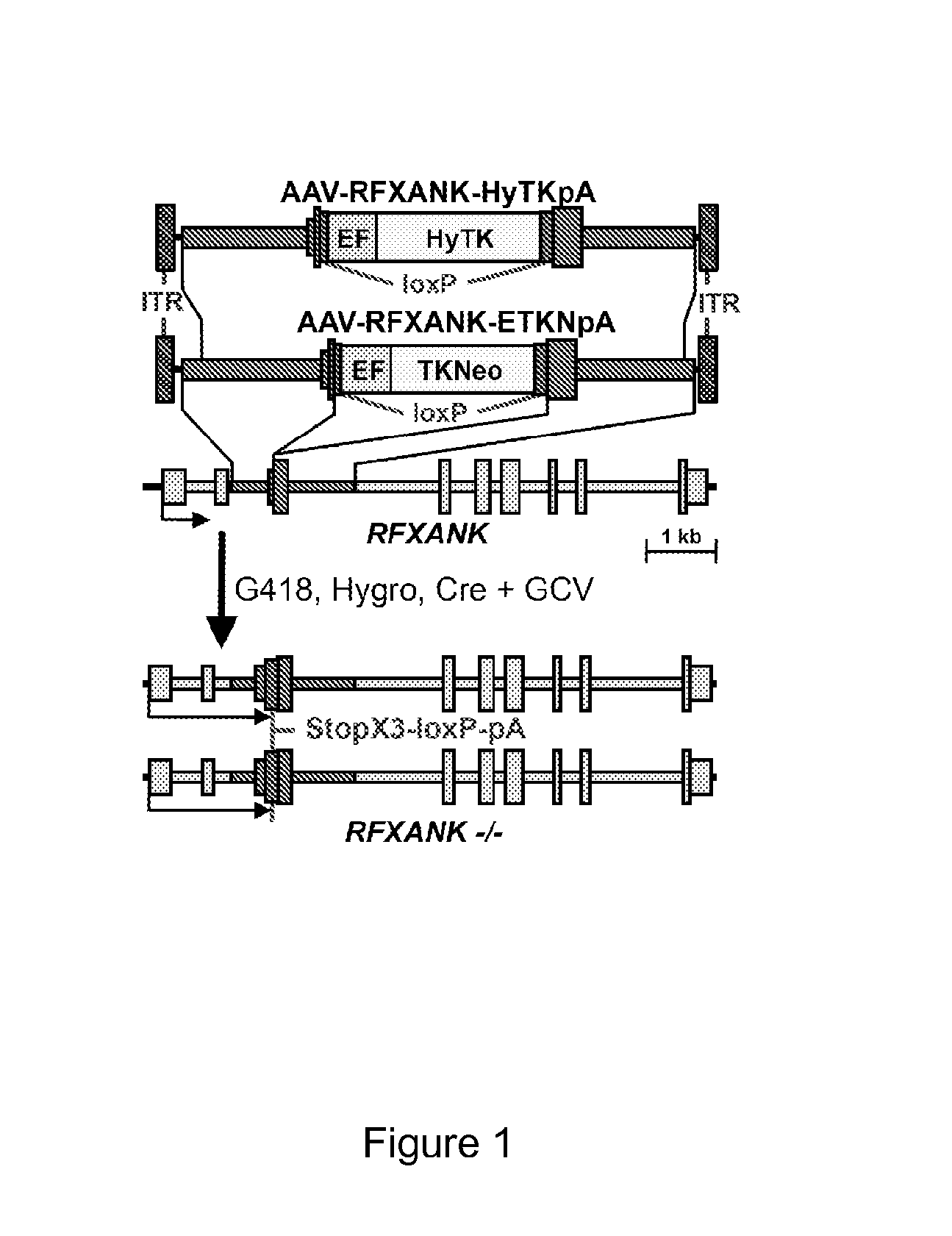
[0092]FIG. 1 shows the structure of exemplary two adeno-associated virus (AAV) gene targeting vectors, designed to insert either a TKNeo (AAV-RFXANK-ETKNpA) or HyTK (AAV-RFXANK-HyTK) gene controlled by an EF1alpha promoter (EF) into exon 3 of the RFXANK gene, which is also shown below the vectors. Selection of vector-infected cells with G418 or hygromycin (Hygro) allows one to isolate cells targeted by the TKNeo or HyTK vectors respectively. Subsequent expression of Cre recombinase and selection with gancyclovir (GCV) then allows one to isolate clones that have removed the TKNeo or HyTK genes, leaving behind two inactivated RFXANK alleles with stop codons in all 3 reading frames, a loxP site, and a polyadenylation site (StopX3-loxP-pA). LoxP is the recombination site for Cre recombinase. ITR is a vector inverted terminal repeat. Similar vectors could be designed to target other genes.
[0093]The AAV-RFXANK...
PUM
| Property | Measurement | Unit |
|---|---|---|
| Length | aaaaa | aaaaa |
| Immunogenicity | aaaaa | aaaaa |
Abstract
Description
Claims
Application Information
 Login to View More