
Passive-matrix display and tiling display
- Summary
- Abstract
- Description
- Claims
- Application Information
AI Technical Summary
Benefits of technology
Problems solved by technology
Method used
Image

Examples
embodiment
Overall Configuration (Tiling Display)
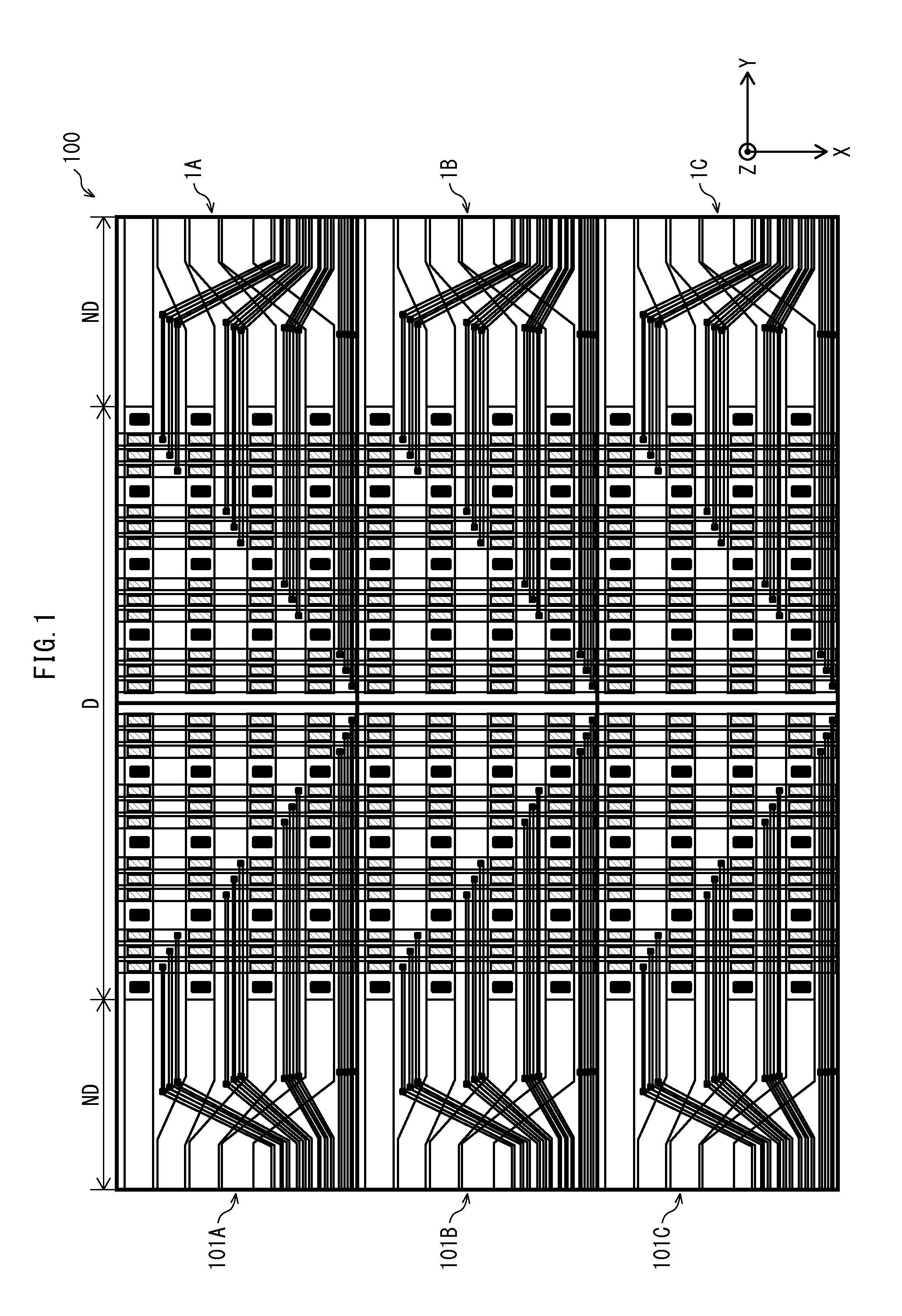
[0037]First, a tiling display 100 pertaining to the Embodiment is described with reference to FIG. 1. The tiling display 100 is shown as a total of six aligned displays, including passive-matrix displays 1A, 1B, and 1C and passive-matrix displays 101A, 101B, and 101C manufactured with line symmetry with respect to the X-axis of the other displays.
[0038]Region D of FIG. 1 indicates a display region having a periphery at an outermost edge of the light-emitting layer, and regions ND indicate non-display regions, each made up of a signal retrieval unit, neighbouring the display region. The signal retrieval units are thus disposed at one end along the Y-axis, in a unidirectional wiring configuration that enables the non-display region ND to be arranged at the ends of the display with respect to the Y-axis. As a result, the display regions D of the six displays are perceived as being one display, enabling the realization of a display for large-scale d...
PUM
 Login to View More
 Abstract
Description
Claims
Application Information
 Login to View More