

Microfluidic devices for the rapid detection of analytes
a microfluidic device and analyte technology, applied in the direction of instruments, laboratory glassware, material electrochemical variables, etc., can solve the problems of poor detection limits, few paper poc devices have been successfully commercialized, and failure to produce trustworthy paper poc devices
- Summary
- Abstract
- Description
- Claims
- Application Information
AI Technical Summary
Benefits of technology
Problems solved by technology
Method used
Image

Examples
example 1
annel Paper Analytical Devices (HC-PADs)
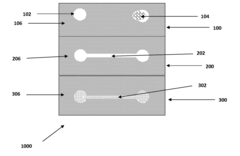
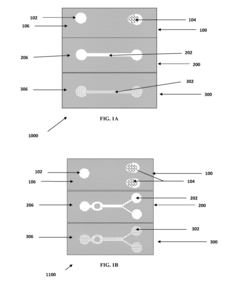
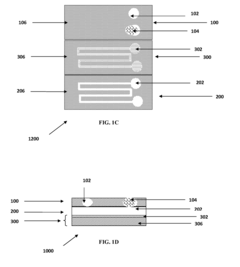
[0091]A microfluidic paper analytical device (μPAD) that relies on flow in hollow channels (HC) to transport fluids was fabricated. The flow rate of a solution in the hollow channel is enhanced by up to a factor of 7 relative to fluid flow rate through a paper-filed channel of the same dimensions. The HC-PAD does not require external equipment, such as a syringe pump, to force the liquid into the channel. The high flow rate of the liquid reduces analysis times and also makes it possible to use large fluidic networks. The microfluidic device can multiplex numerous assays without being compromised by the speed of fluid flow.
[0092]Materials and Methods
[0093]Chemicals and Materials.
[0094]Erioglaucine disodium salt was purchased from Acros Organics. Phosphate-buffered saline (PBS), 10× solution, 30% HCl, and Whatman grade 1 chromatographic paper were obtained from Fisher Scientific. Glucose oxidase (GOx) from Aspergillus niger (type X-S), peroxidas...
example 2
emistry and Mass Transfer in Hollow-Channel Paper Analytical Devices
[0113]This example analyses electrochemical and fluidic processes in paper-based analytical devices (PADs) having hollow channels (HC-PADs). The HC-PADs exhibit electrochemical and hydrodynamic behavior similar to traditional glass and plastic microfluidic electrochemical devices. Removal of the cellulose fibers from the channels results in rapid mass transfer. The flow rate within the channel was quantified by electrochemical methods for pressures ranging from 0.3 mbar to 4.5 mbar. Voltammetry and amperometry were applied under flow and no-flow conditions and yielded reproducible electrochemical signals that can be described by classical electrochemical theory as well as finite-element simulations. The results shown here provide new and highly quantitative insights into the mass transfer and electrochemical properties of HC-PADs.
[0114]Materials and Methods
[0115]Chemicals and Materials.
[0116]Ferrocenemethanol (FcMeO...
PUM
 Login to View More
 Abstract
Description
Claims
Application Information
 Login to View More