
Distributed energy storage system
a technology of distributed energy and storage system, which is applied in the direction of power installations, transportation and packaging, sustainable transportation, etc., can solve the problems of increasing drag, reducing the efficiency of the aircraft during flight, and increasing drag
- Summary
- Abstract
- Description
- Claims
- Application Information
AI Technical Summary
Benefits of technology
Problems solved by technology
Method used
Image

Examples
Embodiment Construction
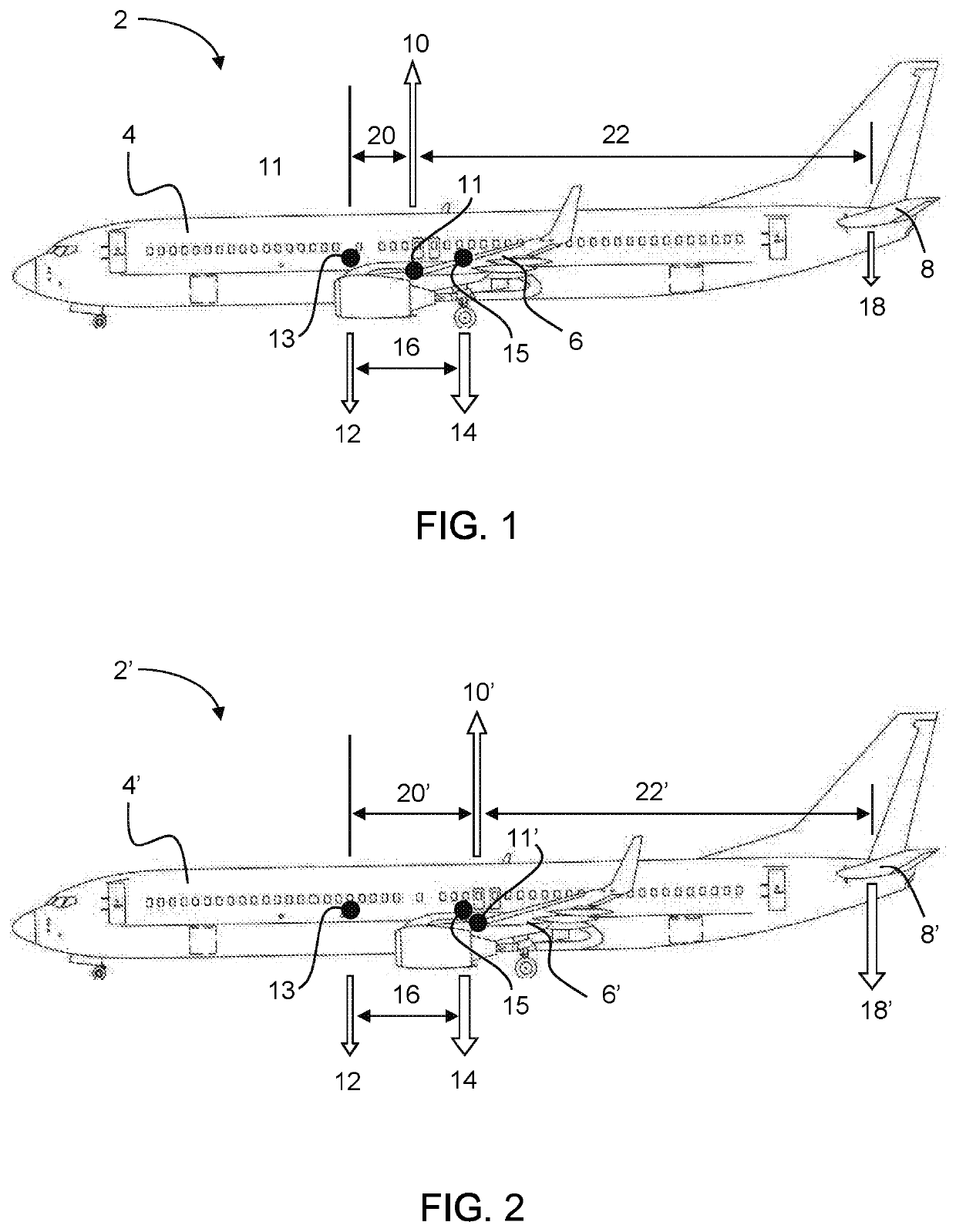
[0030]FIG. 1 shows a side view of a loaded passenger aircraft 2. The aircraft briefly comprises a fuselage 4, a wing 6 and a horizontal stabiliser or tail 8. Lift 10 is generated predominantly by the wing 6, and can be considered to act at a longitudinal position 11 towards the leading edge of the wing 6. The position of this centre of lift 11 can be assumed to be fixed.
[0031]The lift 10 is required to overcome the aircraft weight 12 and payload weight 14 which are indicated separately in FIG. 1. The centre of gravity (CG), for the unloaded aircraft will be fixed, so the aircraft CG 13, through which the aircraft weight 12 acts, will not move.
[0032]The longitudinal distance between the centre of lift 11 and the aircraft CG 13 is known as the static margin. In the illustrated example, the aircraft CG 13 is ahead of the centre of lift 11, so the aircraft 2 is said to have a positive static margin.
[0033]The CG for the payload may vary depending on how the aircraft is loaded, but its lo...
PUM
 Login to View More
 Abstract
Description
Claims
Application Information
 Login to View More