
Enhancing temporal and spatial resolution and correcting data anomalies of remote sensed data for estimating high spatio-temporal resolution vegetation indices
a technology of vegetation index and spatial resolution, applied in image enhancement, image analysis, instruments, etc., can solve the problems of low temporal and/or spatial resolution of satellite data, drones generally require technical expertise, and spatial resolution does not match across various satellites, so as to achieve high spatio-temporal resolution and enhance temporal and spatial resolution
- Summary
- Abstract
- Description
- Claims
- Application Information
AI Technical Summary
Benefits of technology
Problems solved by technology
Method used
Image

Examples
Embodiment Construction
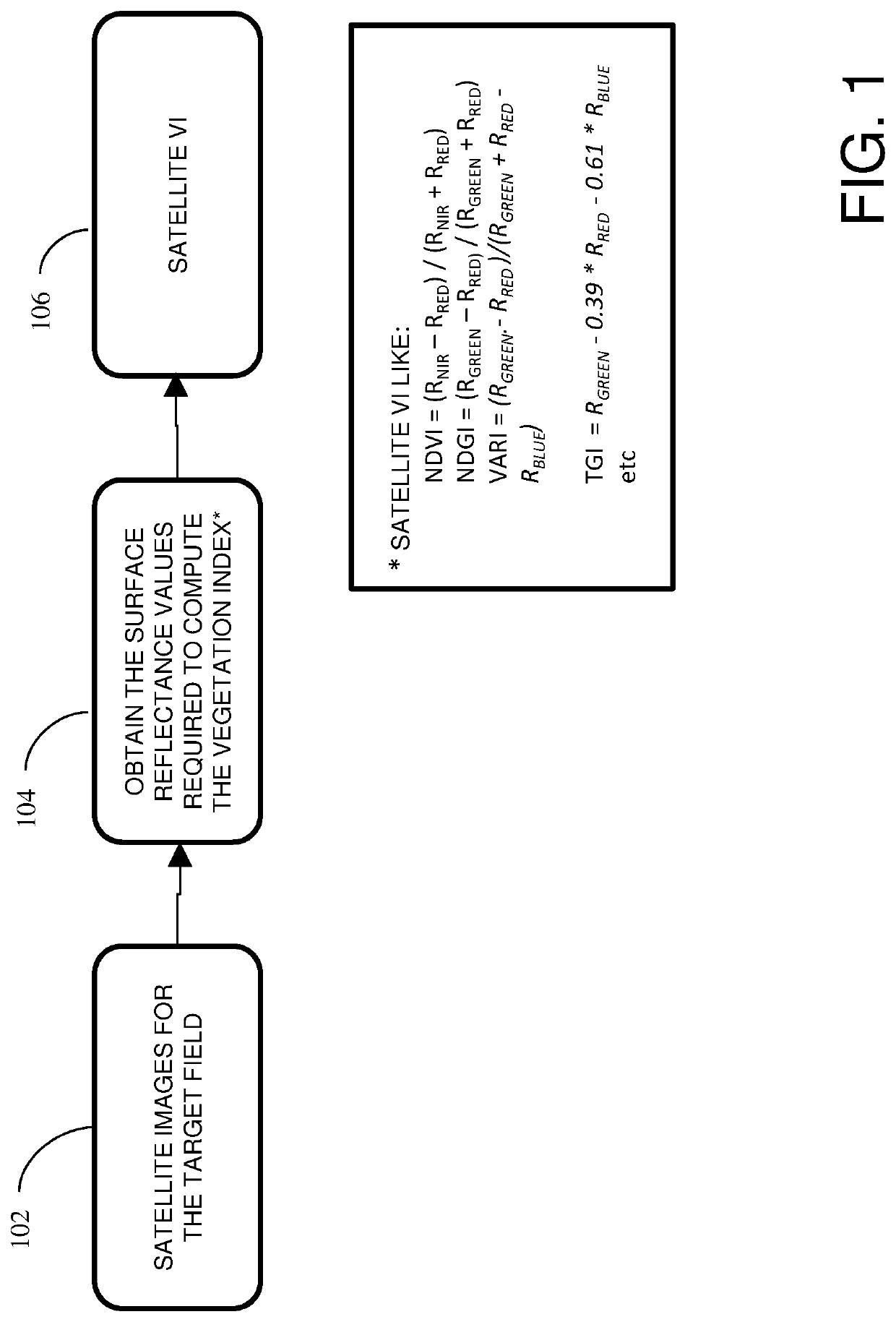
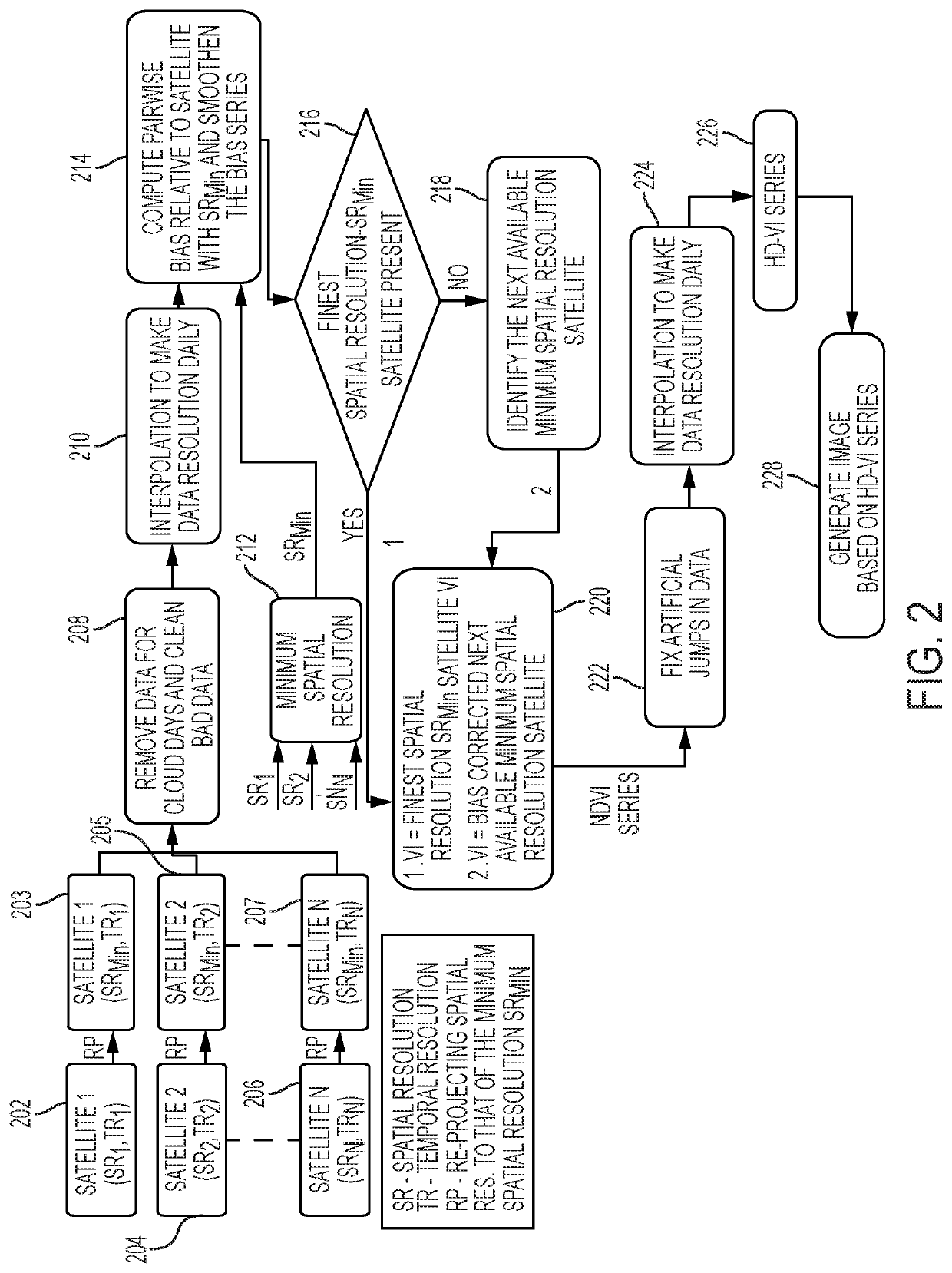
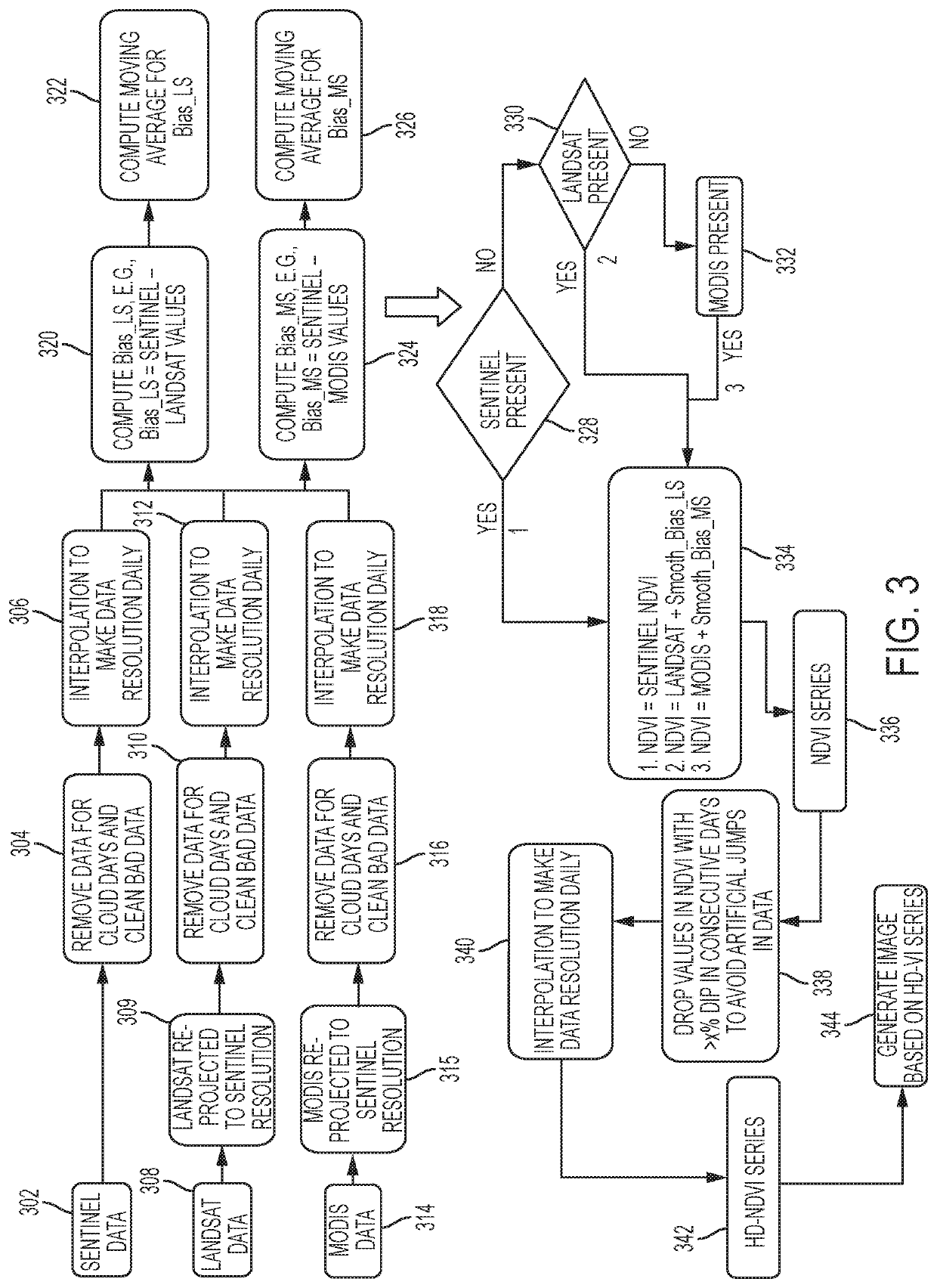
[0015]A system, method, computer program product and techniques in some embodiments provide a blending algorithm, which brings together remote sensed data from a plurality of satellites (e.g., aforementioned satellites) and derive high spatial and temporal resolution NDVI termed High Definition Normalized Difference Vegetation Index (HD-NDVI) at the fine spatial resolution of that satellite data, which has the minimum (finest but minimum in value) spatial resolution among the plurality of satellites and the finest (e.g., daily) temporal resolution.
[0016]Briefly, spatial resolution refers to the size of a pixel. For instance, an image with spatial resolution of 10 meters means that one pixel on the image represents an area or region of 10 by 10 meters on the ground, for example, Earth's surface. Temporal resolution refers to the frequency of visits or how often a satellite visits the same area or region (e.g., collect data of that region), for instance, the time between two subsequen...
PUM
 Login to View More
 Abstract
Description
Claims
Application Information
 Login to View More