
Muir-torre-like syndrome in Fhit deficient mice
a mouse and fhit technology, applied in the field of tumor biology, can solve the problems that fhit is not accepted as a tumor suppressor universally, and achieve the effects of reducing increasing the tumor formation rate, and increasing the proliferation ra
- Summary
- Abstract
- Description
- Claims
- Application Information
AI Technical Summary
Benefits of technology
Problems solved by technology
Method used
Image

Examples
Embodiment Construction
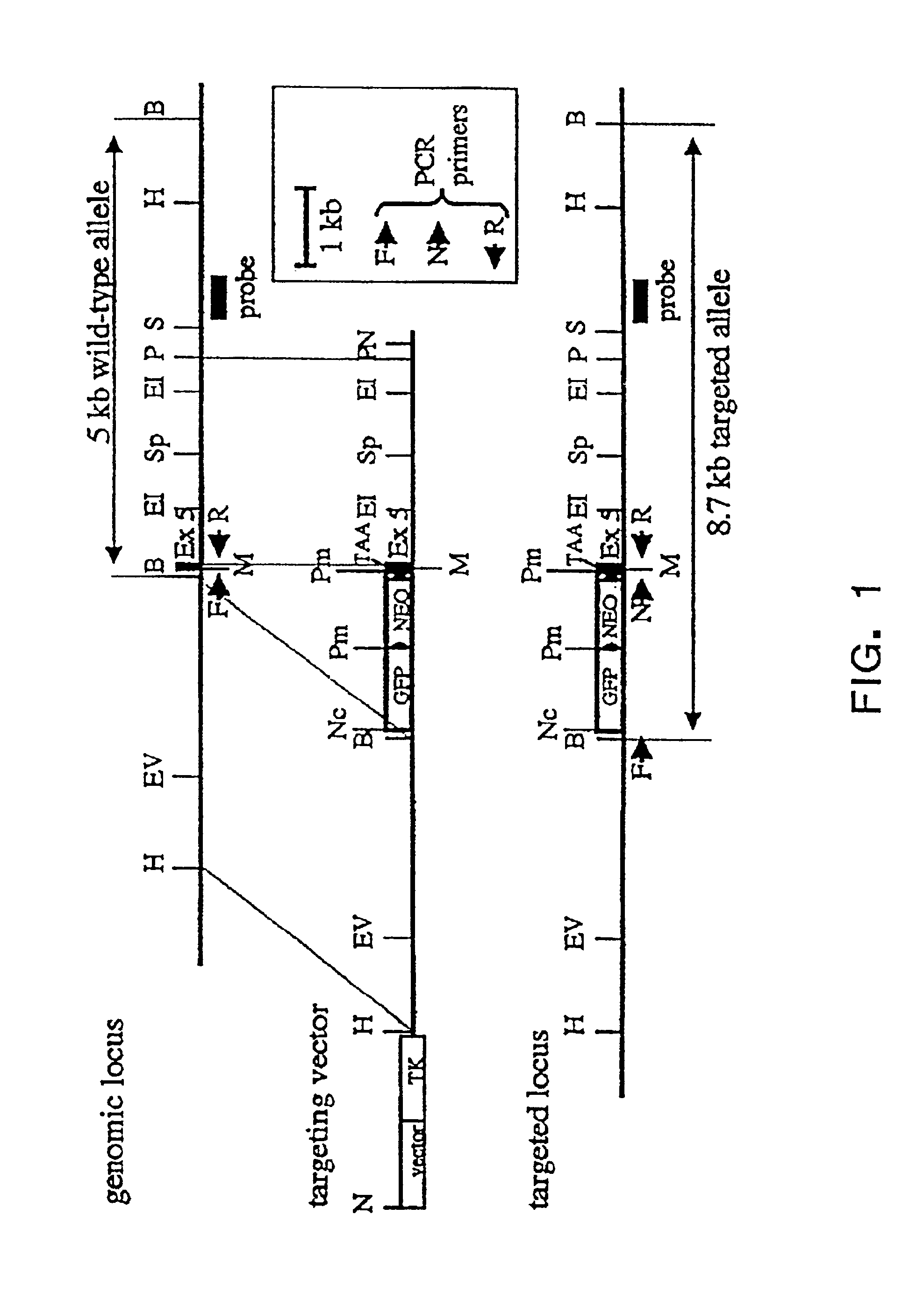
[0025]The murine FHIT locus (FIG. 7; Pekarsky et al., 1998, Cancer Res. 58:3401-3408; Glover et al., 1998, Cancer Res. 58:3409-3414) is similar to its human homolog (U.S. Pat. No. 5,928,884), encompasses a common fragile site, and is altered in murine cancer cell lines. To define the role of FHIT protein in cancer development, a strain of Fhit + / − mice was established. The frequency of carcinogen-induced tumor formation in FHIT + / + and + / − mice was compared using the established N-nitrosomethylbenzylamine (NMBA) esophageal / gastric cancer model (Fong and Magee, 1999, Cancer Letters 143:63-69).
[0026]Upon bioactivation, NMBA produces benzaldehyde and an electrophilic methylating agent (Labuc and Archer, 1982, Cancer Res. 42:3181-3186), which methylates DNA, resulting in the formation of the promutagenic, adduct 06-methylguanine (O6-meG) (Fong et al., 1979, Int. J. Cancer 23:679-682). NMBA was reported to induce both esophageal and forestomach tumors when administered by gavage or in th...
PUM
| Property | Measurement | Unit |
|---|---|---|
| temperature | aaaaa | aaaaa |
| temperature | aaaaa | aaaaa |
| pH | aaaaa | aaaaa |
Abstract
Description
Claims
Application Information
 Login to View More