
Antenna device and mobile communication terminal equipped with antenna device
a mobile communication terminal and antenna technology, applied in the direction of resonant antennas, elongated active elements, substation equipment, etc., can solve the problems of increased power supply loss, difficulty in principle in setting the impedance value of the balance power supply type antenna, and inability to adjust the impedance value of the balance-imbalance converter. , to achieve the effect of simple construction
- Summary
- Abstract
- Description
- Claims
- Application Information
AI Technical Summary
Benefits of technology
Problems solved by technology
Method used
Image

Examples
first embodiment
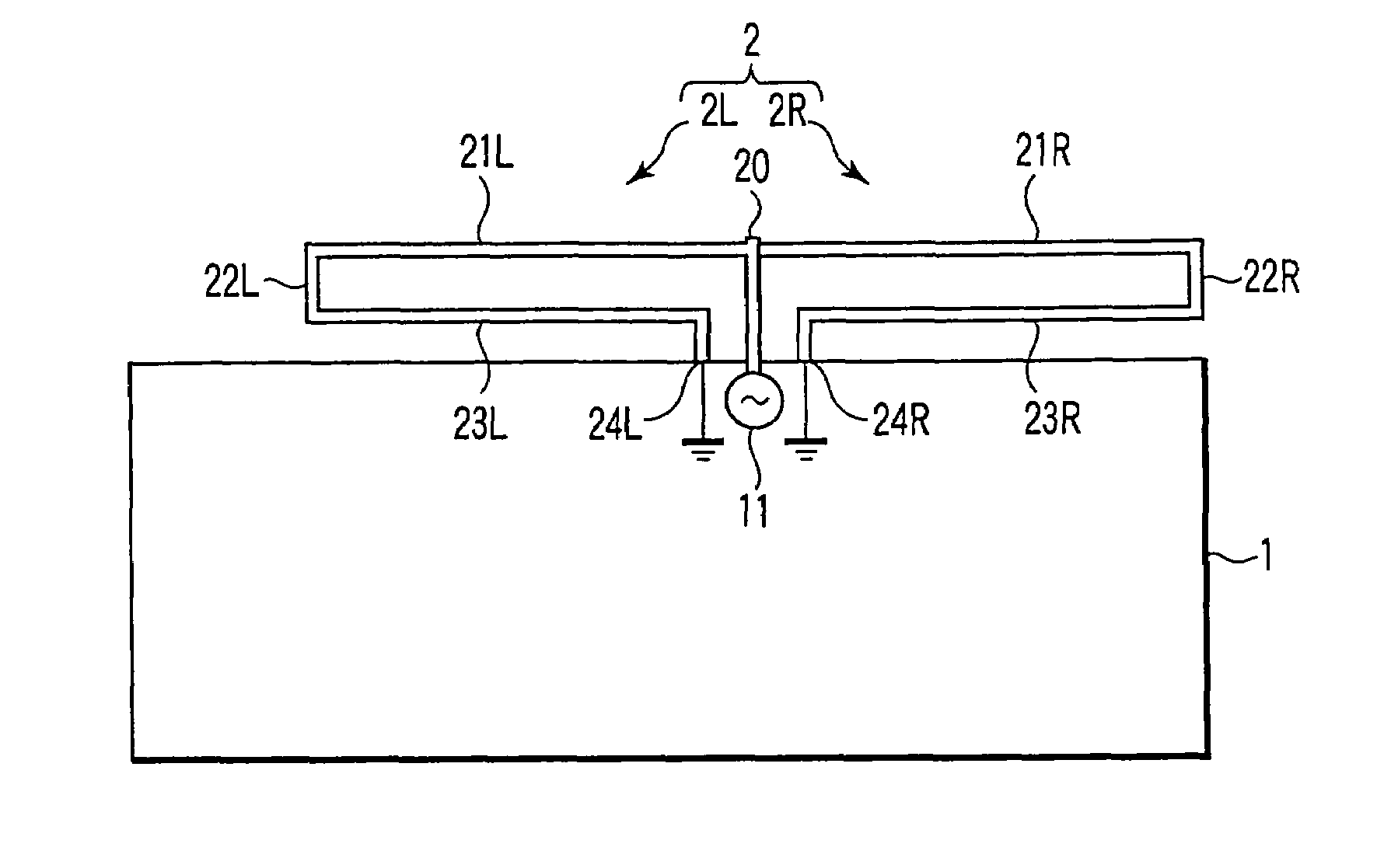
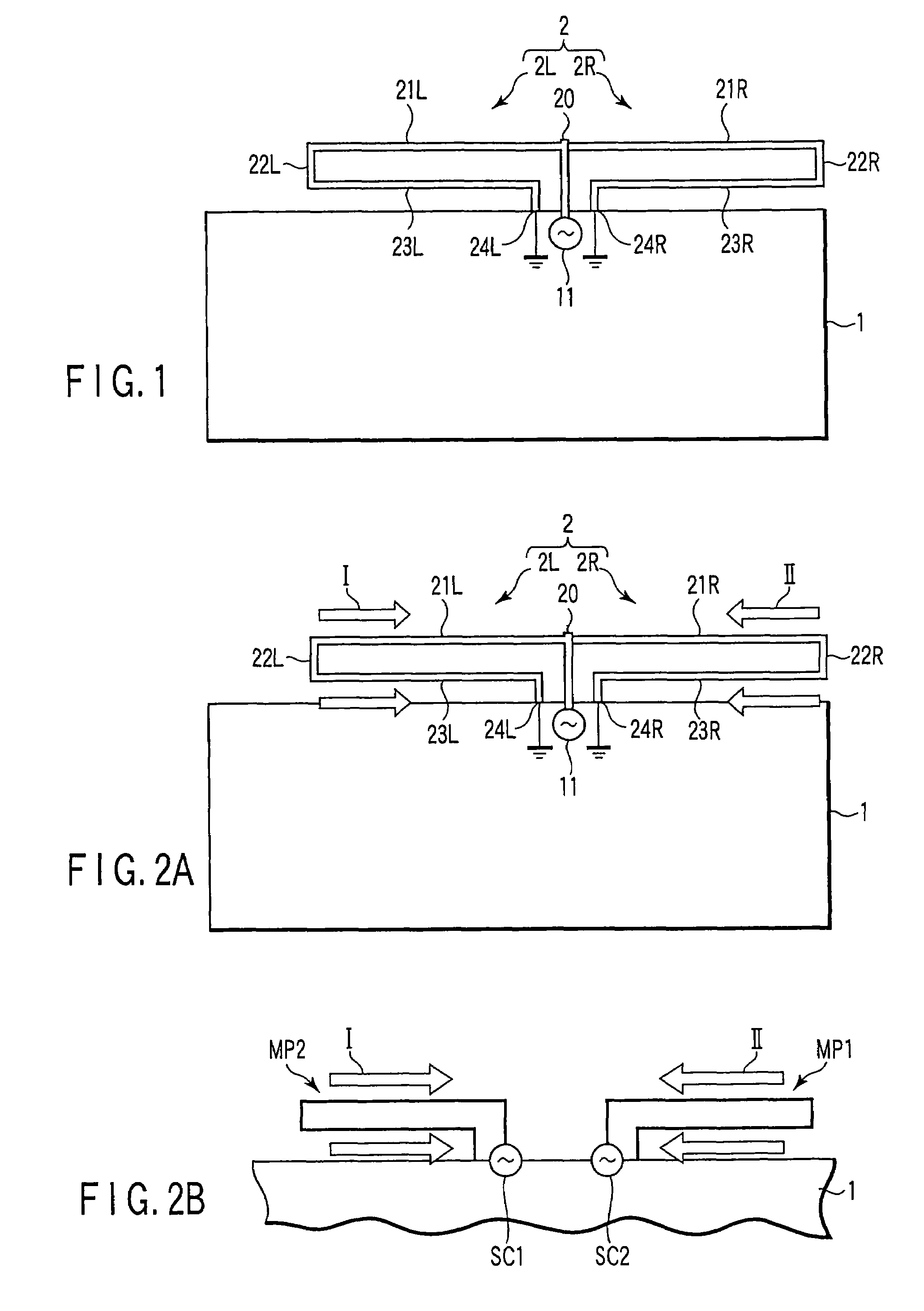
[0038]FIG. 1 shows the substrate of a mobile communication terminal according to the present invention and the construction of the antenna device mounted to the substrate.
[0039]As shown in FIG. 1, a substrate 1 is housed in the casing of a mobile communication terminal (not shown). Also, an antenna device 2 mounted to the substrate 1 is housed similarly in the mobile communication terminal. A power supply section 11 capable of a power supply is mounted to the substrate 1 so as to permit an electric power to be supplied from the power supply section 11 into the antenna device 2 shown in FIG. 1. Also, the antenna device 2 includes a branching point 20 for branching the current.
[0040]The antenna device 2 comprises a folded monopole antenna 2L and an additional antenna 2R. The folded monopole antenna 2L includes a forward path section 21L formed of a conductive line extending from a starting point connected to the power supply point 11 (the starting point substantially corresponding to ...
second embodiment
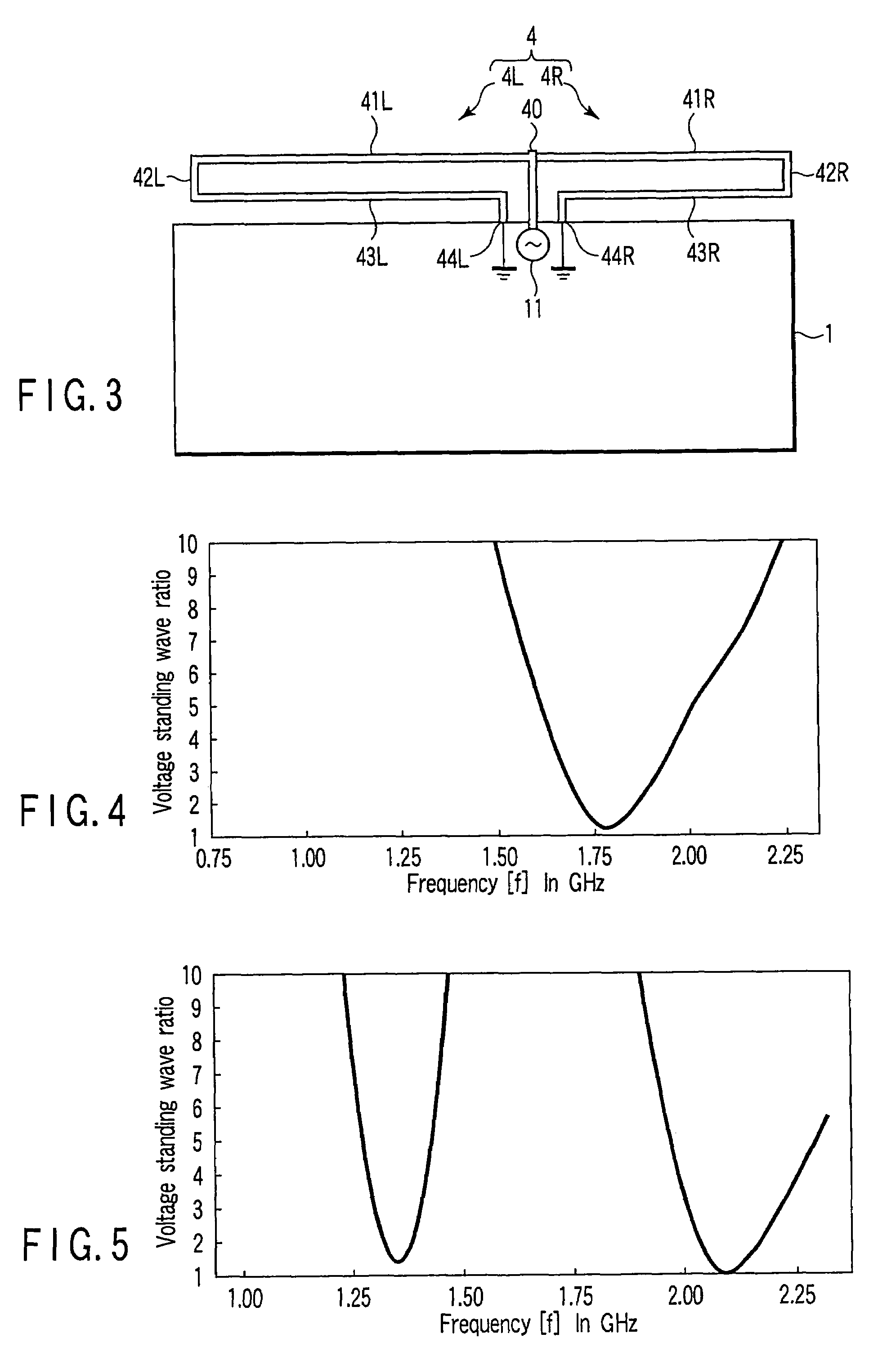
[0049]FIG. 3 shows the substrate 1 of a mobile communication terminal according to the present invention and an antenna device 4 mounted to the substrate. A power supply section 11 capable of a balance power supply is mounted to the substrate 1 as shown in FIG. 3 so as to permit an electric power to be supplied from the power supply section 11 to the antenna device 4. The antenna device 4 comprises a folded monopole antenna 4L and an additional antenna 4R like the antenna device shown in FIG. 1. The antenna device 4 includes a branching point 40 for branching the current supplied from the power supply section 11.
[0050]As shown in FIG. 3, the folded monopole antenna 4L comprises a forward path section 41L including a conductive portion extending from the power supply section 11 to reach the branching point 40, a folding section 42L, and a backward path section 43L. The backward path section 43L is connected to the ground point 44L connected to the ground point of the substrate 1. On ...
third embodiment
[0057]FIG. 6A shows a mobile communication terminal according to the present invention. As shown in the drawing, a folded monopole antenna 5L is mounted to the substrate 1 shown in FIG. 6A. In this case, the forward path section 51L of the folded monopole antenna 5L linearly extends from a folding section 52L to a terminal point 55L. To be more specific, the antenna structure shown in FIG. 6A comprises an L-shaped forward path section 51L, a folding section 52L extending from the forward path section 51L, and a backward path section 53L extending from the folding section 52L in a manner to form an L-shape and having the terminal point connected to the substrate 1 in the ground point 54L. In other words, the antenna structure shown in FIG. 6A comprises an L-shaped portion 51L-1 in which the forward path section 51L extends to reach the folding section 52L, and a linear extending section 51L-2 extending linearly outward from the folding section 52L. It should be noted that the free ed...
PUM
 Login to View More
 Abstract
Description
Claims
Application Information
 Login to View More