
Lewis acid mediated synthesis of cyclic esters
a technology of cyclic esters and lewis acid, which is applied in the field of synthesis of cyclic phosphonic acid diesters from 1, 3diols, can solve the problems of poor oral bioavailability, short plasma half-life, poor cell penetration and limited tissue distribution, etc., and achieve the effect of increasing the ratio of cis to trans diastereomers
- Summary
- Abstract
- Description
- Claims
- Application Information
AI Technical Summary
Benefits of technology
Problems solved by technology
Method used
Image

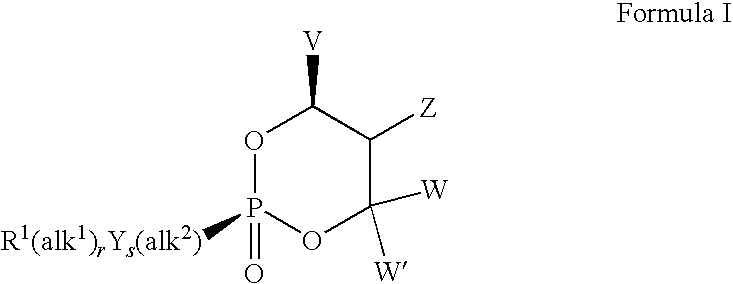
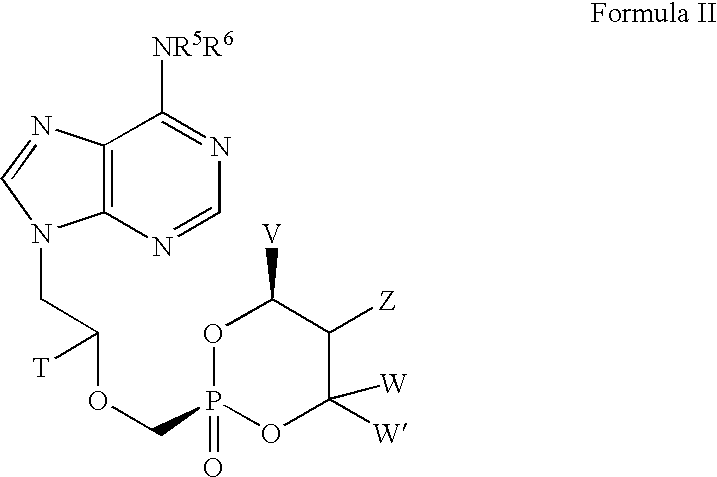
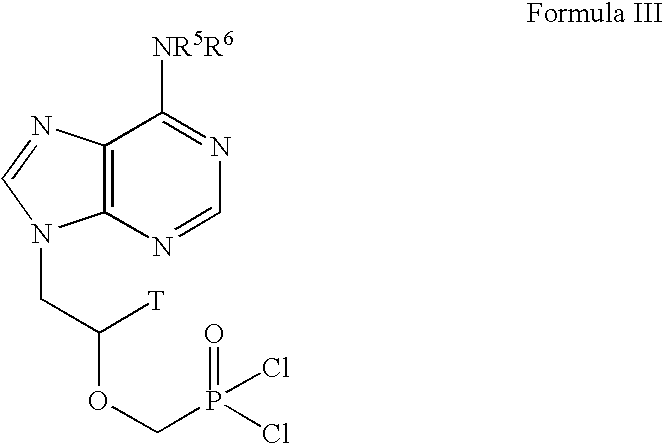
Examples
example 1
Preparation of 3-(3-chlorophenyl)-3-oxo-propanoic acid (1)
[0199]The diol was prepared as described in U.S. PreGrant Published Application No. 20030225277A1. A 12 L, 3-neck round bottom flask was equipped with a mechanical stirrer and addition funnel (2 L). The flask was flushed with nitrogen and charged with diisopropylamine (636 mL) and THF (1.80 L). The stirred contents were cooled to −20° C. n-Butyllithium (1.81 L of a 2.5 M solution in hexanes) was added slowly with stirring, and the temperature was maintained between −20 and −28° C. After the addition was complete (30 min), the addition funnel was rinsed with hexanes (30 mL) and the stirred solution was then cooled to −62° C. Trimethylsilyl acetate (300 g) was added slowly with stirring, maintaining the temperature at 4, 70 g), filtered and concentrated under reduced pressure to give 827 g of a yellow solid. The crude solid was slurried in hexanes (2.2 L) and transferred to a round bottom flask equipped with a mechanical stirre...
example 2
Preparation of (S)-3-(3-Chlorophenyl)-3-hydroxypropanoic acid (2)
[0200]The 3-hydroxypropanoic acid was prepared as described in U.S. PreGrant Published Application No. 20030225277A1. A 12 L, 3-neck round bottom flask was equipped with a mechanical stirrer and addition funnel (1 L). The flask was flushed with nitrogen and charged with 3-(3-chlorophenyl)-3-oxo-propanoic acid (275.5 g) 1 and dichloromethane (2.2 L). A thermocouple probe was immersed in the reaction slurry and the stirred contents were cooled to −20° C. Triethylamine (211 mL) was added over 5 min. to the stirred slurry and all solids dissolved. A dichloromethane solution of (−)-beta-chlorodiisopinocampheylborane (1.60 M, 1.04 L) was charged to the addition funnel, and then added slowly with stirring while maintaining the temperature between −20 and −25° C. After the addition was complete (approximately 35 min), the solution was warmed to ice bath temperature (2-3° C.) and stirred. After approximately 4 h of stirring an ...
example 3
Preparation of (S)-(−)-1-(3-chlorophenyl)-1,3-propanediol (3)
[0202]The diol was prepared as described in U.S. PreGrant Published Application No. 20030225277 A1. A 12 L, 3-neck round bottom flask was equipped with a mechanical stirrer, addition funnel (2 L) and thermometer. The flask was flushed with nitrogen and charged with (S)-3-(3-chlorophenyl)-3-hydroxypropanoic acid 2 (206.7 g) and THF (850 mL), and the stirred solution was cooled to 5° C. (ice bath). A 1 M borane in THF solution (2.14 L) was charged to the addition funnel, and then added slowly with stirring maintaining the temperature at 4, 322 g), filtered and concentrated under reduced pressure to provide 189.0 g of a pale yellow oil (101%).
PUM
| Property | Measurement | Unit |
|---|---|---|
| temperature | aaaaa | aaaaa |
| temperature | aaaaa | aaaaa |
| temperature | aaaaa | aaaaa |
Abstract
Description
Claims
Application Information
 Login to View More