Check patentability & draft patents in minutes with Patsnap Eureka AI!

Systems and methods for facilitating a first response mission at an incident scene using precision location

a technology of incident scene and location, applied in the field of first response services, can solve the problems of limited connectivity of first responders, police officers or firefighters deployed at an incident scene, and limited connectivity of hospitals and other places remote from the incident scene, and achieve the effect of facilitating the first response mission at the incident scene and avoiding the danger of the incident itsel

Inactive Publication Date: 2011-08-16
AVAYA INC
View PDF105 Cites 10 Cited by
  • Summary
  • Abstract
  • Description
  • Claims
  • Application Information

AI Technical Summary

Benefits of technology

Improves communication and location accuracy for first responders and patients, optimizing care and safety by providing real-time data and environmental monitoring, thus enhancing response efficiency and patient outcomes.

Problems solved by technology

First responders such as emergency medical service (EMS) workers, police officers or firefighters deployed at an incident scene have limited connectivity to hospitals and other places remote from the incident scene.
In particular, first responders have limited connectivity to the emergency room (ER) of the hospital to which they are delivering and do not know the status of the ER, nor does the ER know their status.
Furthermore, the incident scene may encompass multiple casualties who have to be triaged and stabilized on-site if their number threatens to overwhelm the first responders.
In addition, the incident scene itself may be hazardous, both to the casualties and to the first responders.
Unknown or undetected conditions or changes therein at the incident scene may present serious risks for both the casualties and the first responders.
While certain technologies have been developed to assist first responders, they are unsatisfactory in many respects.
For example, existing technologies are typically point solutions and lack in terms of an integrated approach which takes into account information from a variety of sources.
Also, existing technologies tend to not be rapidly deployable (i.e., seconds, not minutes or hours) and are thus often of limited effectiveness where time is crucial.
Furthermore, while it may often be useful to know where the first responders and / or the casualties are located, existing technologies may only provide inadequate or insufficient precision in locating them (e.g., civilian grade global positioning system (GPS) technology typically offers accuracies of about 9 to 15 meters (30 to 50 feet)., due to the user equivalent range errors (UEREs) of ionospheric effects, ephemeris errors, satellite clock errors, multipath distortion, and tropospheric effects).

Method used

the structure of the environmentally friendly knitted fabric provided by the present invention; figure 2 Flow chart of the yarn wrapping machine for environmentally friendly knitted fabrics and storage devices; image 3 Is the parameter map of the yarn covering machine
View more

Image

Smart Image Click on the blue labels to locate them in the text.
Viewing Examples
Smart Image
  • Systems and methods for facilitating a first response mission at an incident scene using precision location
  • Systems and methods for facilitating a first response mission at an incident scene using precision location
  • Systems and methods for facilitating a first response mission at an incident scene using precision location

Examples

Experimental program
Comparison scheme
Effect test

example 1

[0217]By processing the data indicative of the environment at the incident scene 12 (i.e., location data, physical data, physiological data) produced by the environmental data processing engine 411, the situational context processing engine 421 determines that the following situation has occurred: vital signs of a patient 18x have dropped significantly (based on physiological data from the patient pack 24x of the patient 18x); none of the first responders 141 . . . 14N is currently treating the patient 18x (based on their location); a first responder 14k who initially treated the patient 18x is now far away and treating another patient (based on their location and / or other determinants of the situational context, such as communications involving the first responder 14k or a state of that other patient's patient pack); a first responder 14y is close to the patient 18x (based on their location); and the first responder 14y is not currently treating any of the patients 181 . . . 18P (b...

example 2

[0221]By processing the data indicative of the environment at the incident scene 12 produced by the environmental data processing engine 411 and by processing data relating to communications effected via the communication system 208, the situational context processing engine 421 determines that the following situation has occurred: a patient 18y is currently being treated by a first responder 14z (based on their location); and the first responder 14z has requested treatment information for the patient 18y using his / her first responder pack 22z, for example, by describing a physical condition or symptoms of the patient 18y and requesting assistance from a doctor to determine what treatment to give.[0222]Based on the data indicative of this situation, the institutional context processing engine 431 consults the institutional information system 200 to obtain institutional data relevant to this situation. For instance, the institutional data may include: data indicative that Dr. Smith i...

example 3

[0225]By processing the data indicative of the environment at the incident scene 12 produced by the environmental data processing engine 411 (and possibly by processing data relating to communications effected via the communication system 208), the situational context processing engine 421 determines that the following situation has occurred: twenty patients 181 . . . 1820 at the incident scene 12 have low vital signs (based on physiological data from their patient packs 241 . . . 2420 and possibly based on reports provided by the first responders 141 . . . 14N using their first responder packs 221 . . . 22N).[0226]Based on the data indicative of this situation, the institutional context processing engine 431 consults the institutional information system 200 to obtain institutional data relevant to this situation. For instance, the institutional data may include: data indicative that seventeen of the patients 241 . . . 2420 need immediate transportation to an ER (based on their vita...

the structure of the environmentally friendly knitted fabric provided by the present invention; figure 2 Flow chart of the yarn wrapping machine for environmentally friendly knitted fabrics and storage devices; image 3 Is the parameter map of the yarn covering machine
Login to View More

PUM

No PUM Login to View More

Abstract

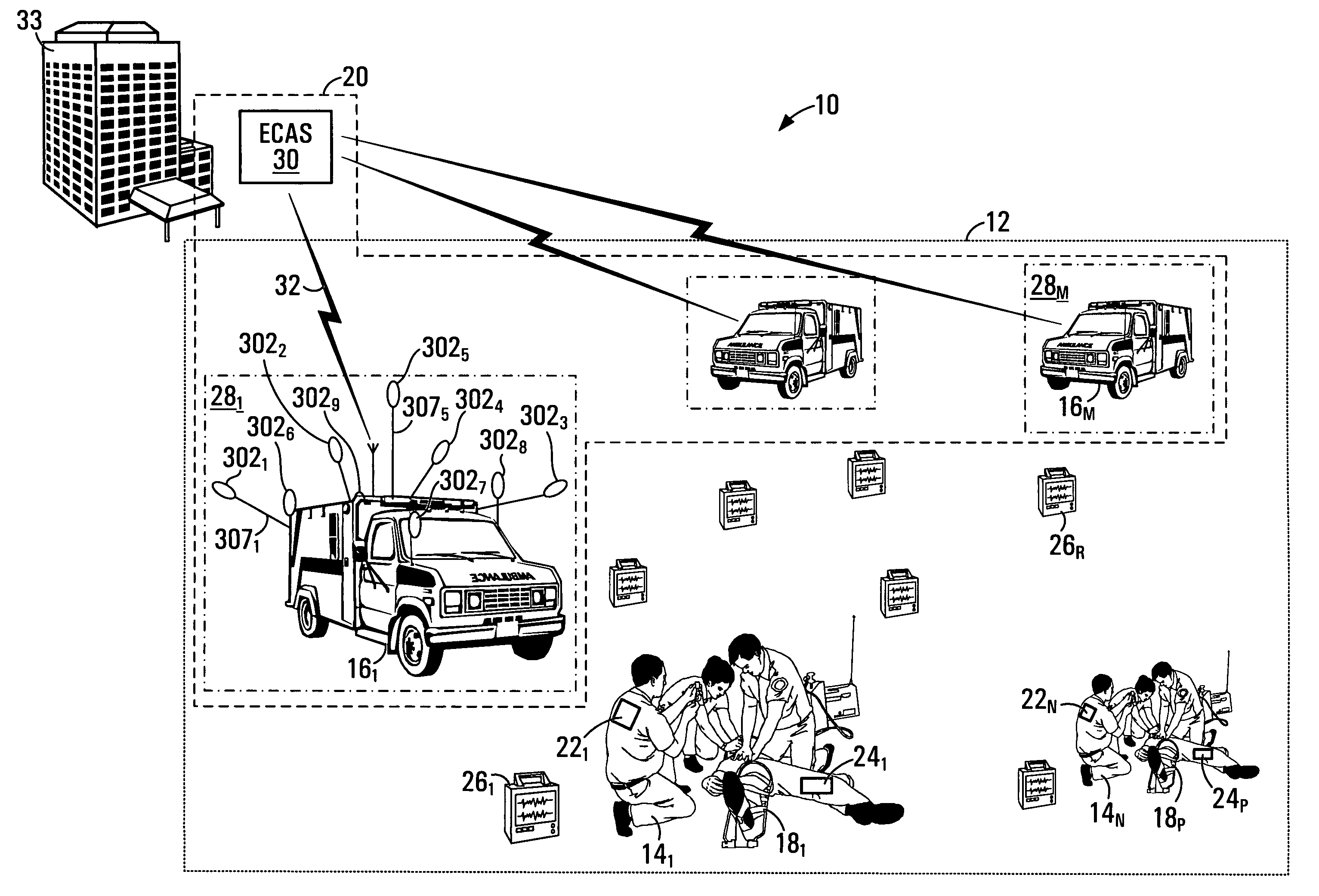
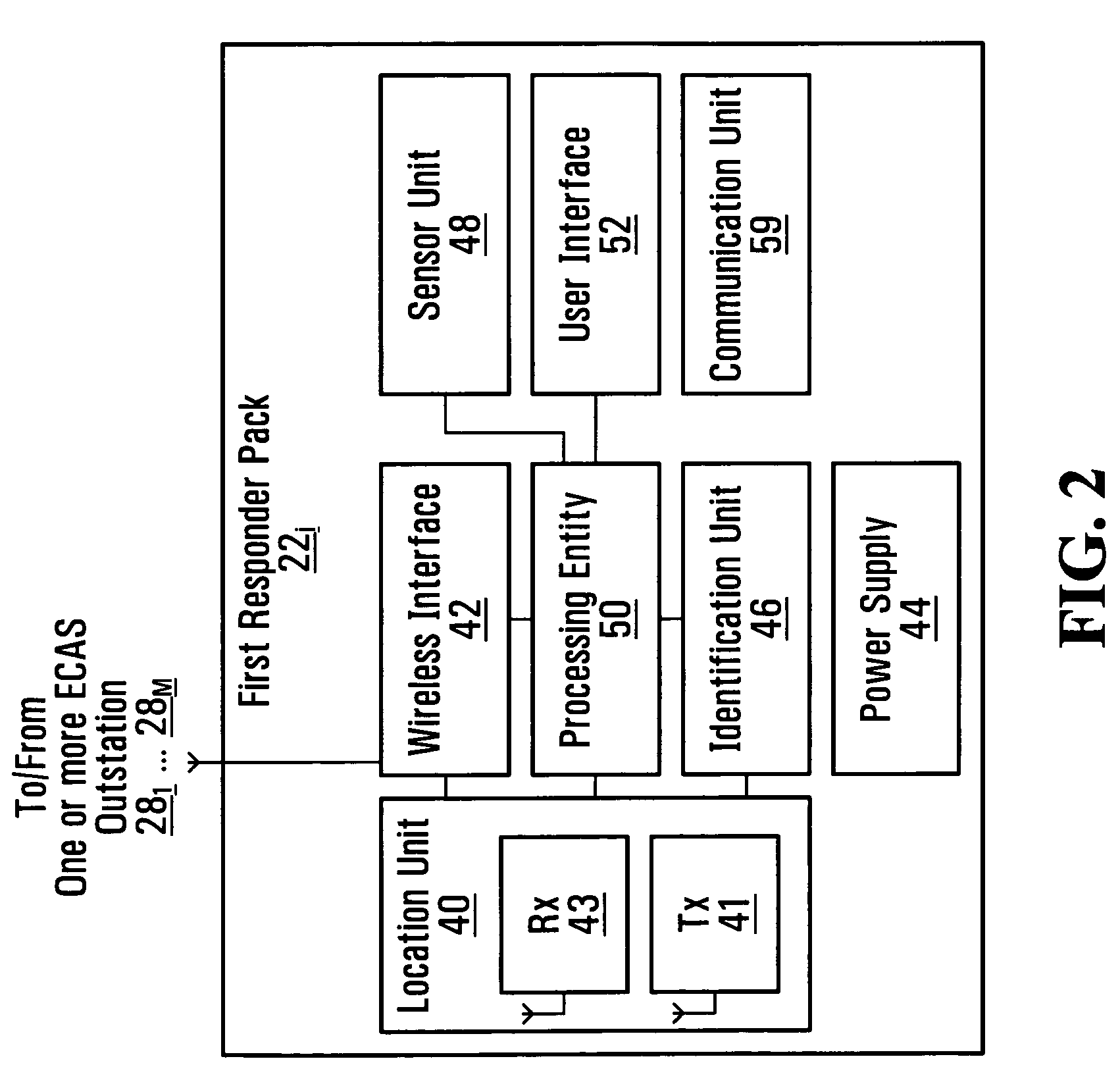
Systems and methods for facilitating a first response mission at an incident scene, such as an accident site, a natural or human-made disaster site, or any other first response site. One system is for locating a plurality of portable modules at an incident scene. The system comprises a plurality of receivers transportable to the incident scene. The system also comprises a processing entity configured to: determine a location of a first one of the portable modules based on first data derived from a wireless signal transmitted by the first one of the portable modules and received by at least three receivers of the plurality of receivers; and determine a location of a second one of the portable modules based on the location of the first one of the portable modules and second data derived from a wireless signal transmitted by the second one of the portable modules and received by the first one of the portable modules. For example, the system enables precision location of first responders, patients and equipment at the incident scene.

Description

CROSS-REFERENCE TO RELATED APPLICATION[0001]This application claims the benefit under 35 U.S.C. §119(e) of U.S. Provisional Patent Application No. 60 / 992,182 filed on Dec. 4, 2007 by Graves et al. and hereby incorporated by reference herein.FIELD OF THE INVENTION[0002]The invention relates generally to first response services and, more particularly, to systems and methods for facilitating a first response mission at an incident scene.BACKGROUND[0003]First responders such as emergency medical service (EMS) workers, police officers or firefighters deployed at an incident scene have limited connectivity to hospitals and other places remote from the incident scene. In particular, first responders have limited connectivity to the emergency room (ER) of the hospital to which they are delivering and do not know the status of the ER, nor does the ER know their status. Adding to this the fact that only limited medical information, if any, can be passed backward and forward between the first ...

Claims

the structure of the environmentally friendly knitted fabric provided by the present invention; figure 2 Flow chart of the yarn wrapping machine for environmentally friendly knitted fabrics and storage devices; image 3 Is the parameter map of the yarn covering machine
Login to View More

Application Information

Patent Timeline
no application Login to View More
Patent Type & Authority Patents(United States)
IPC IPC(8): G01S1/00G16H40/67
CPCA61B5/02055A61B5/1113A61B5/411A61B5/681G06F19/323G06F19/327G06F19/3418G08B21/0453A61B5/0022A61B2560/0242A61B5/002A61B2505/01A61B2560/0431A61B5/747G16H10/65G16H40/20G16H40/67
Inventor GRAVES, ALANFITCHETT, JEFFREYBEAULIEU, LAURENCEVEZZA, BRIAN
Owner AVAYA INC
Features
  • R&D
  • Intellectual Property
  • Life Sciences
  • Materials
  • Tech Scout
Why Patsnap Eureka
  • Unparalleled Data Quality
  • Higher Quality Content
  • 60% Fewer Hallucinations
Social media
Patsnap Eureka Blog
Learn More