
Organic-inorganic hybrid multifunctional biological material based on nanocellulose crystals and preparation method and application thereof
A technology of nanocellulose and biomaterials, applied in the field of organic-inorganic hybrid multifunctional biomaterials and its preparation, can solve problems such as easy aggregation of nano-venus, high biological toxicity of protective agents, and lack of protective agents
Patent Information
- Authority / Receiving Office
- CN · China
- Current Assignee / Owner
- Publication Date
- 2020-10-23
Smart Images
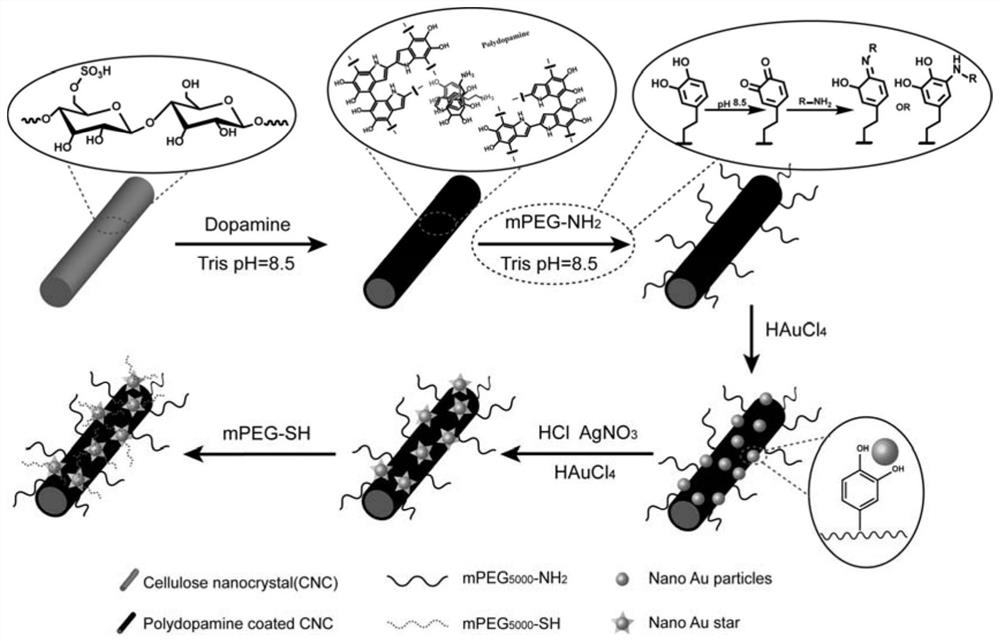
Figure 1 
Figure 2 
Figure 3
Abstract
Description
technical field
[0001] The invention relates to an organic-inorganic hybrid nano-material used in the field of photoacoustic-photothermal technology, in particular to an organic-inorganic hybrid multifunctional biological material based on nano-cellulose crystals and a preparation method and application thereof. Background technique
[0002] Nanocellulose crystal (Cellulose nanocrystal, CNC) is a nanomaterial formed by linear polymers composed of D-glucose units connected by 1,4-β glycosidic bonds. It is composed of green terrestrial, submarine plants and animals. Extracted, such as: wood, cotton, bacteria, tunicates, etc. Based on the rapid development of the emerging bio-economy, the high specific surface area, high crystallinity, high strength, biodegradability, non-toxicity, green environmental protection and other unique properties of CNC have attracted a lot of attention, and its demand is increasing. Gold nanoparticles (AuNPs), as one of the important members of the ...
Examples
Embodiment 1
[0051] The preparation process is as figure 1 As shown, the preparation method of organic-inorganic hybrid multifunctional nanomaterials based on cellulose nanocrystals is as follows: (wherein the solution or dispersion prepared in each step is based on CNC to calculate the concentration)
[0052] (1) Sonicate the high-concentration (10mg / mL) cellulose nanocrystal (CNC) aqueous dispersion at 100kHz for 30min using a cell disintegrator to obtain a uniformly dispersed CNC dispersion;
[0053] (2) Dilute the 10mg / mL CNC dispersion to 1mg / mL with Tris-HCl (10mM, pH=8.5) buffer solution, add dopamine to ensure that the dopamine concentration in the system is 1mg / mL, and place the reaction system in an ultrasonic cleaner Ultrasonic reaction at medium 50kHz for 3h, high-speed centrifugation (20000rpm, 20min) and purification of the upper layer 3 times to prepare polydopamine-modified nanocellulose crystal particle CNC@PDA NPs dispersion;
[0054] (3) Centrifuge the CNC@PDA NPs dispe...
Embodiment 2
[0060] In vitro photoacoustic signal measurement of organic-inorganic hybrid nanomaterials based on nanocellulose crystals:
[0061] The organic-inorganic hybrid multifunctional nanomaterial based on nanocellulose crystals prepared in Example 1 was configured with ultrapure water as a solvent to have the following concentration gradients: 0.1mg / mL, 0.32mg / mL, 3.16mg / mL, 6mg / mL mL, 8mg / mL, 10mg / mL, put the above concentration materials in a centrifuge tube, use a wavelength of 720nm, and a power density of 0.5W / cm 2 The laser is used to collect photoacoustic signals, and 0.4mg / mL is selected to collect photoacoustic signals with different wavelengths. The result is as Figure 4 Figure (a) shows that the concentration of the material has a linear relationship with the photoacoustic intensity, (b) and (c) are the 2D and 3D photoacoustic imaging images of the material in the test tube respectively, and the white bright spot in the figure is the material collection. To the photoa...
Embodiment 3
[0063] In vitro photothermal performance test of organic-inorganic hybrid nanomaterials based on nanocellulose crystals:
[0064]The organic-inorganic hybrid multifunctional nanomaterial solution based on nanocellulose crystals prepared in Example 1 was configured with ultrapure water to have the following concentration gradient: 0.05mg / mL, 0.1mg / mL, 0.15mg / mL, 0.2mg / mL mL, and use ultrapure water as the control group, put the above-mentioned concentration of materials in a centrifuge tube, use a wavelength of 635nm, and a power density of 0.5W / cm 2 Irradiate for 6min. The result is as Figure 5 It can be seen from the figure that the temperature of pure water rises very little under laser irradiation, while materials with different concentrations have different degrees of temperature rise after laser irradiation, and the temperature of 0.2mg / mL material rises up to 30°C, Figure 5 It shows that the organic-inorganic hybrid nanomaterials based on nanocellulose crystals have...