
Novel gene overexpressed in heart and skeletal muscle and use thereof
a gene and gene technology, applied in the field of disease(e . g heart disease) associated genes, can solve the problems of heart failure as insufficient myocardial contraction, heart failure becoming worse, and compensation mechanisms failing
Patent Information
- Authority / Receiving Office
- US · United States
- Patent Type
- Applications(United States)
- Current Assignee / Owner
- Publication Date
- 2006-06-15
- Estimated Expiration
- Not applicable · inactive patent
Smart Images
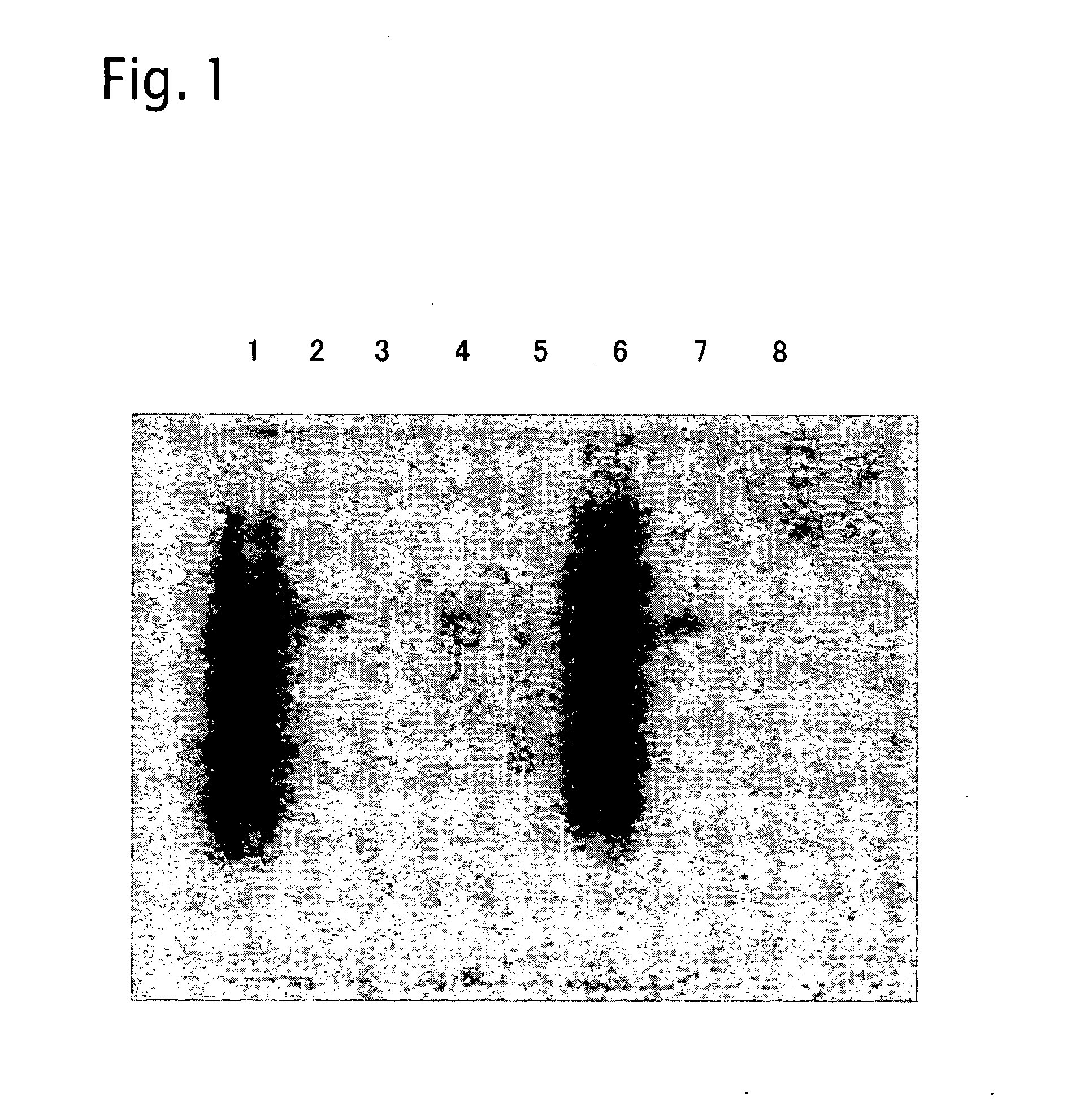
Figure 1 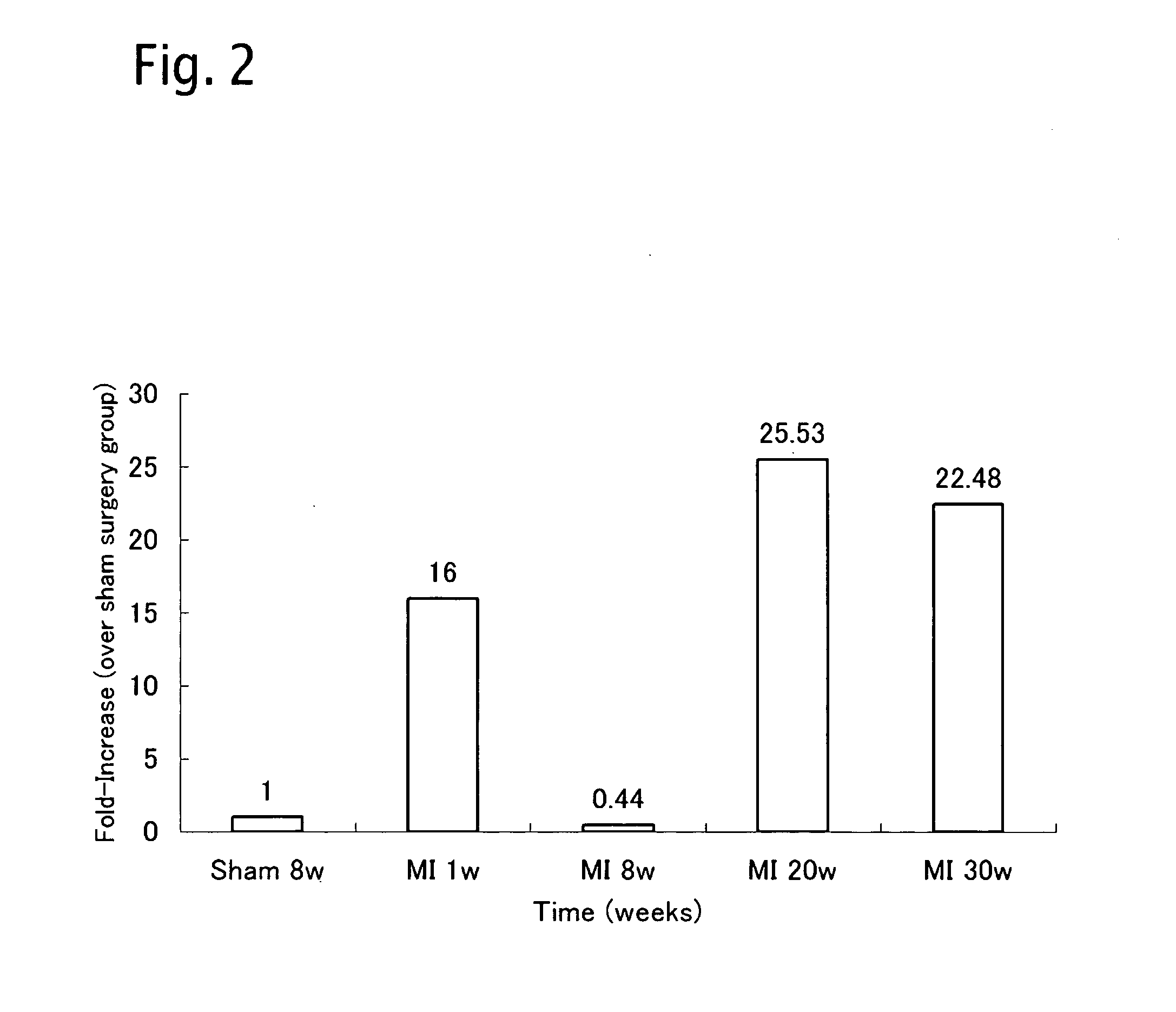
Figure 2 
Figure 3
Abstract
Description
TECHNICAL FIELD
[0001] The present invention relates to a disease- (e.g. heart disease-) associated gene, and use thereof. More specifically, the present invention relates to a method of screening for a pharmaceutical, which comprises using the disease-associated gene; an antisence nucleotide to the disease-associated gene, which is useful as a diagnostic marker for heart disease such as cardiac myopathy, cardiac infarction, cardiac failure, angina pectoris; an antibody to the product of the disease-associated gene. TECHNICAL BACKGROUND
[0002] Heart failure is considered as insufficient myocardial contraction. Possible onset mechanisms of heart failure is as follows: disturbance of a heart muscle, mechanical and functional abnormality of a heart pump, an excessive pressure loaded by hypertension and pulmonary hypertension, a voluminal overload due to anemia or acute nephritis to cause a condition of an impossible cardiac output of a blood volume sufficient to a living body demand. F...
Examples
example 1
[0443] (1) Preparation of a Rat Model of Cardiac Infarction
[0444] Male Wistar rats (11-week-old; body weight 300 to 400 g) were anesthetized with pentobarbital (50 mg / kg, i.p.) according to the report by Watanabe et al. (Circulation Res. 69: 370-377, 1991) and subjected to the median sternotomy under artificial respiration. After incision of- a pleuropericardial membrane, a heart was exposed. The coronary artery together with cardiac muscles was ligated in the origin of a left anterior descending branch of the coronary artery using a surgical needle with silk suture (Elp, 5-0 silk) and then the incision of the chest was closed. For a sham surgery group, the chest was closed without the suture ligature of the coronary artery. After recovery from anesthesia, all rats were kept in a normal manner.
[0445] (2) Extraction of Total RNA
[0446] At 1 week, 8 weeks, 20 weeks, and 30 weeks passed after the surgery, these rats were subjected to thoracotomy under pentobarbital anesthesia, and he...
example 2
Analysis of Tissue Distribution of the Rat 187-2 Gene
[0453] In order to obtain a probe for the northern blotting analysis, a PCR was carried out using the rat 187-2 cDNA obtained in Example I as the template, and using a primer represented by SEQ ID No: 7 and another primer represented by SEQ ID No: 10 in the same way as described in Example 1. The “Rat MTN Blot” membrane (Clontech) was used for the northern blotting analysis. Prehybridization was conducted at 68° C. in “Express Hyb Hybridization Solution” (Clontech) as a hybridization solution. Meanwhile, the rat 187-2 gene fragment prepared above as the probe was labeled with [α-32P] dCTP using “BcaBEST Labeling Kit” (Takara). Hybridization was conducted in “Express Hyb Hybridization Solution” (Clontech) containing the labeled probe at 68° C. for 1 hour. The membrane was finally washed with a solution of 0.1× SSC and 0.1% SDS at 50° C., and BAS-2000 (Fuji Film) was used for detection. The result is shown in FIG. 1.
[0454] The re...
example 3
Analysis of Changes of the Rat 187-2 Gene Expression with Time in a Rat Model of Cardiac Infarction
[0455] cDNAs were synthesized using TaqMan Reverse Transcription Reagents (PE Applied BioSystyems) from the total RNAs derived from the non-infarction regions of the rat left ventricles at 1 week, 8 weeks, 20 weeks, and 30 weeks after the surgery inducing cardiac infarction, which is described in Example 1, and from the total RNA derived from the left ventricles at 8 weeks after the sham surgery, used as the control.
[0456] Subsequently, the copy number of the rat 187-2 gene was determined on ABI Prism 7700 Sequence Detection System, by PCR using the DNAs represented by SEQ ID No: 4 and SEQ ID No: 11 as primers and using a fluorescent-labeled form of the DNA represented by SEQ ID No: 12 (PE Applied BioSystyems) as the probe. This reaction was conducted by using “TaqMan PCR Core Reagents Kit” (PE Applied BioSystyems) and following an instruction manual attached. A method for preparati...