
Modified promoter
a promoter and modified technology, applied in the field of modified promoters, can solve the problems of low possibility of obtaining high expression promoters, and cannot say that such a sufficient expression property as to carry out the production of proteins can be obtained, so as to reduce catabolite repression for glucose, enhance expression, and reduce catabolite repression.
Patent Information
- Authority / Receiving Office
- US · United States
- Patent Type
- Patents(United States)
- Current Assignee / Owner
- Publication Date
- 2014-02-11
Smart Images
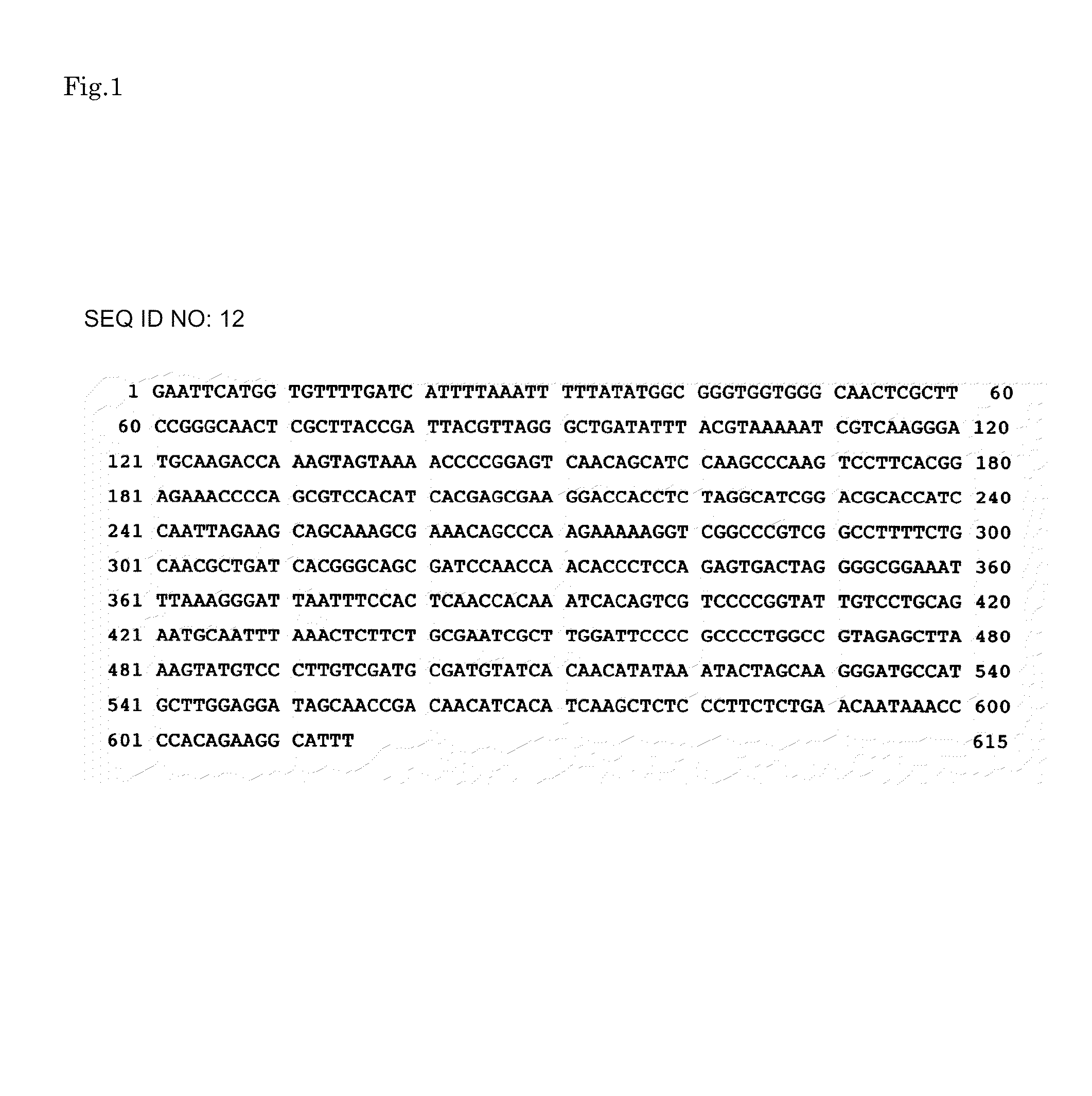
Figure 1 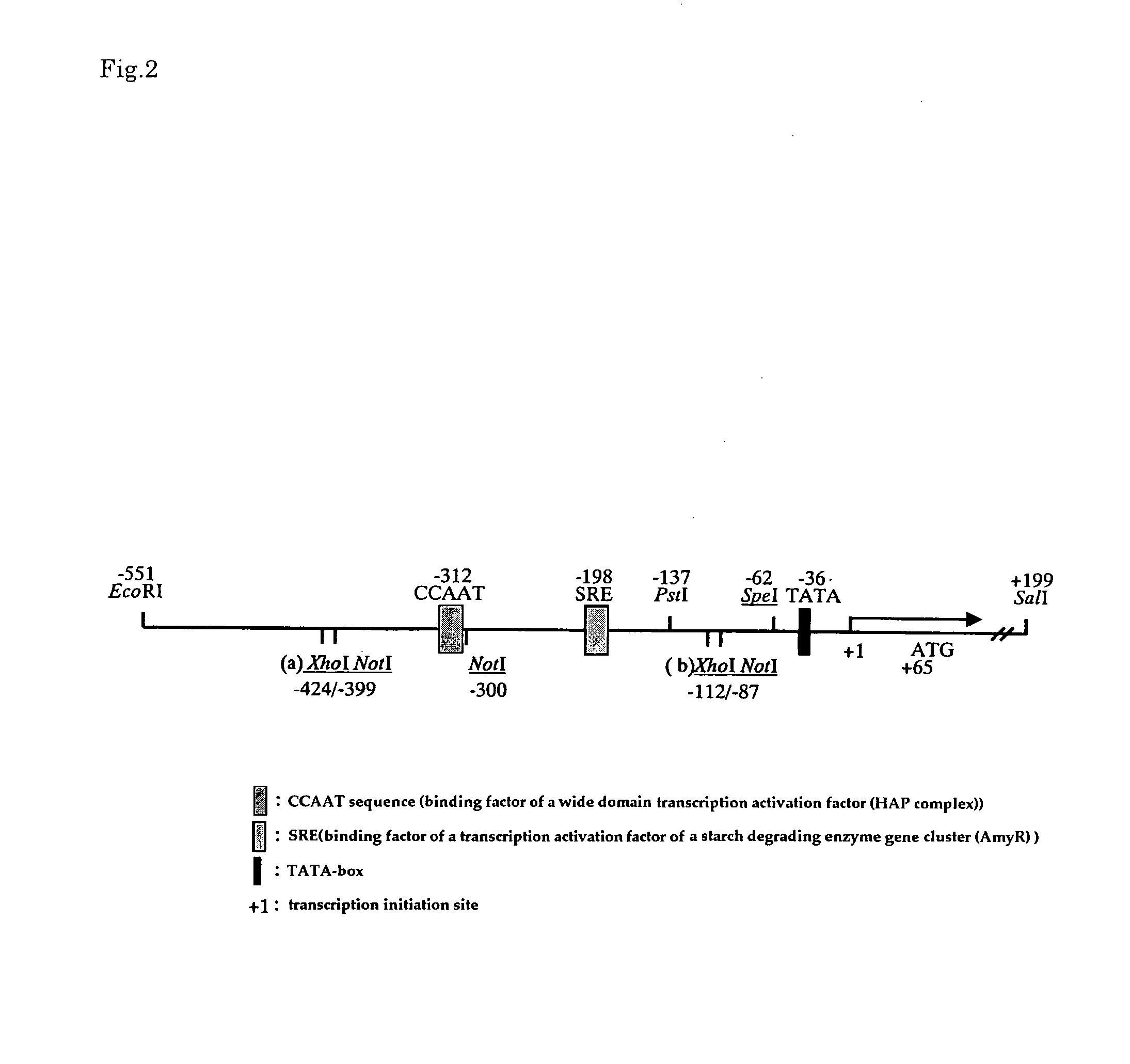
Figure 2 
Figure 3
Abstract
Description
[0001] This is a 371 of PCT / JP03 / 02401, filed on Feb. 28, 2003, which is hereby incorporated by reference.TECHNICAL FIELD
[0002] The present invention relates to an improvement in a promoter used for producing a protein. More particularly, the present invention relates to a modified promoter obtained by modifying a promoter capable of functioning in a filamentous fungus. Furthermore, the present invention relates to a protein production system using the modified promoter.BACKGROUND ART
[0003] It has been confirmed that Aspergillus filamentous fungi secrete a large amount of various enzyme proteins to the outside of the fungus body. For example, it is said that industrially used Aspergillus oryzae produces several tens grams or more of enzyme proteins per litter of culture medium. Thus, the use of filamentous fungi as a host enables secretion production of homogenous and heterogeneous proteins with high productivity. Furthermore, many strains of filamentous fungi have conventionally been ...
Examples
example 1
Subcloning of Promoter Region
[0069]By using pTG-taa [Mol. Gene. Genet., 254, 119-126 (1997)] including 3164 bp of a Taka-amylase A gene (taaG2) of an Aspergillus oryzae strain JCM02239 [Gene, 84, 319-327 (1989)] as a starting material, a Taka-amylase A gene promoter region and a coding region of Taka-amylase A gene were prepared.
[0070]Firstly, from pTG-taa, 750bp of EcoRI-SalI fragment including a Taka-amylase A (taaG2) promoter region was obtained. This fragment was inserted into an EcoRI-SalI site of a multicloning site of a plasmid pKF18K (Toyobo Co., Ltd.) to obtain a plasmid pKF-taaP including a Taka-amylase promoter. Introducing mutation into a promoter region and the construction of the modified promoter region were carried out using this plasmid.
example 2
Obtaining DNA Fragment Including Binding Sequence of Transcriptional Regulation Factor
[0071]A fragment including a CCAAT sequence [Mol. Gen. Genet., 237, 251-260(1993)] that is a binding factor of a previously reported wide-domain transcription activation factor (HAP) and SRE [Mol. Gen. Genet., 262, 668-676(1999)] that is a binding factor of transcription activation factor of starch degrading enzyme gene cluster (AmyR) was obtained as follows.
[0072]Firstly, as a synthetic DNA in which an XhoI site was added to the 5′-end side and a NotI site was added to the 3′-end side of a CCAAT sequence, XNF (5′-CCGCTCGAGGCACCATCCAATTAGAAGCGCGGCCGCTAAACTAT3′: SEQ ID NO: 13), and as a complementary strand of this sequence, XNR (5′-ATAGTTTAGCGGCCGCGCTTCTAATTGGATGGTGCCTCGAGCGG-3′: SEQ ID NO: 14) were synthesized. Then, complementary strands of the synthetic DNAs were mixed with each other and heated at 98° C. for 10 minutes, then cooled down to 30° C. over two hours, and then cooled down to 4° C. fo...
example 3
Construction of Plasmid Including Modified Promoter
[0083]Introduction of mutation into a promoter region of a Taka-amylase A gene was carried out as follows. Firstly, in order to introduce a restriction enzyme site for modifying a promoter region into pKF-taaP prepared in Example 1, site-directed mutation was introduced into pKF-taaP using the below-mentioned primers and Mutan-Super Express Km Kit (TAKARA). Note here that FIG. 1 shows a sequence (SEQ ID NO: 12) of a wild type promoter; and FIG. 2 shows the position of the introduced restriction enzyme.
[0084]Primer for introducing NotI site into a down stream region (position 465 where a Taka-amylase promoter shown in SEQ ID NO: 12 is located)
[0085]
(SEQ ID NO: 21)Not-b:5′-CGCTTGGATTCCCCGCCCGCGGCCGCAGAGCTTAAAGTATGTCCC-3′
[0086]Primer for introducing XhoI site into a downstream region (position 440 where a Taka-amylase promoter shown in SEQ ID NO: 12 is located)
[0087]
(SEQ ID NO: 22)Xho-b:5′-GAATGCAATTTAAACTCTTCCTCGAGTCGCTTGGATTCCCCGCCC-...