
Deletion mutant of maize phosphatidylinositol synthase gene promoter p-zmpis and its application
A corn phosphatidylinositol and phosphatidylinositol technology, which is applied in the field of molecular biology and plant genetic engineering, can solve the problems of not being able to meet the needs of stress-resistant breeding genetic improvement, and the lack of stress-inducible promoters.
Patent Information
- Authority / Receiving Office
- CN · China
- Patent Type
- Patents(China)
- Current Assignee / Owner
- Publication Date
- 2016-02-10
Smart Images
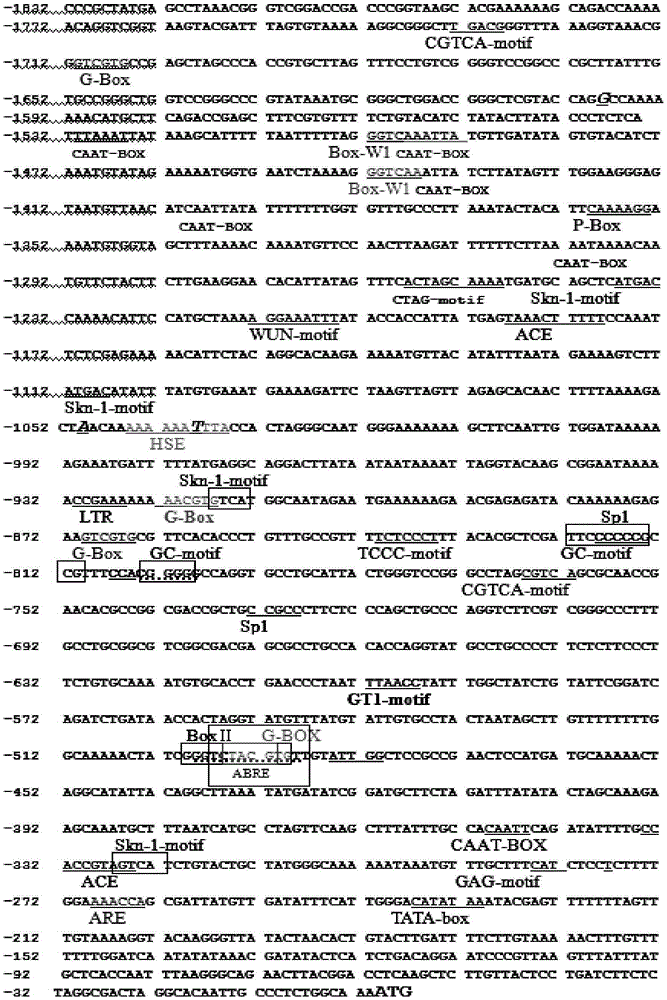
Figure 1 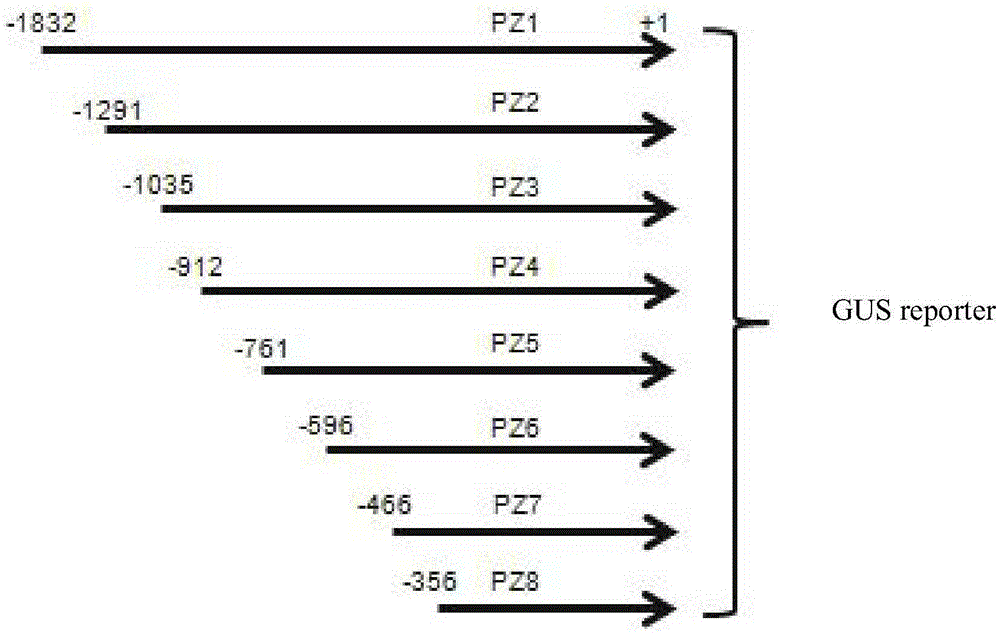
Figure 2 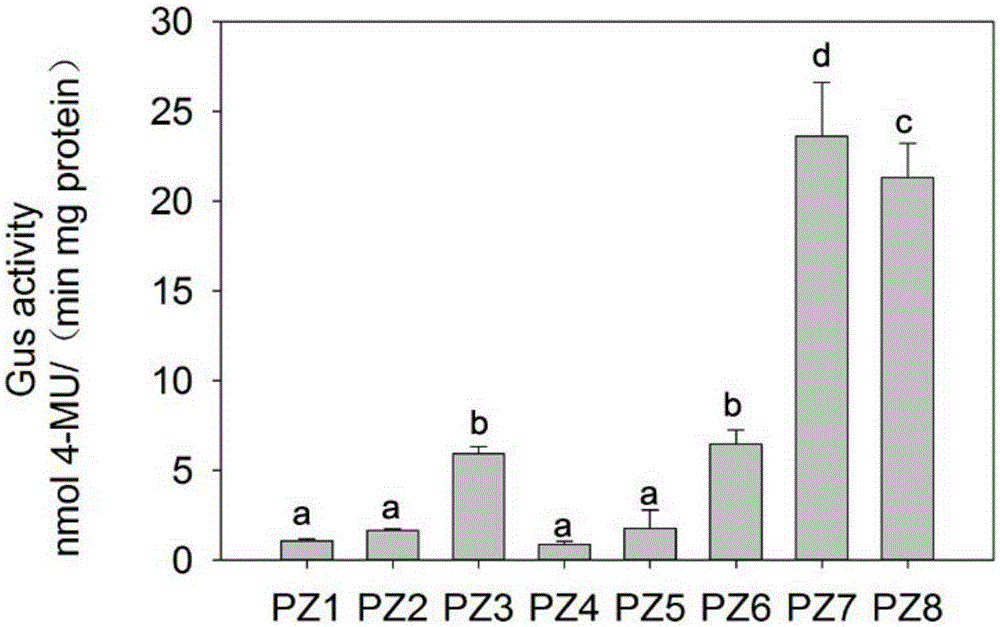
Figure 3
Abstract
Description
technical field
[0001] The invention belongs to the technical fields of molecular biology and plant genetic engineering, and in particular relates to a deletion mutant PZ7 of a corn phosphatidylinositol synthetase gene promoter P-ZmPIS and application thereof. Background technique
[0002] Soil drought and salinization have seriously affected plant growth and development, and have become important factors affecting agricultural production. In recent years, the rapid development of molecular biology technology and the in-depth study of functional genomics of Arabidopsis, rice, corn and other model plants have provided new ideas and methods for breeding new varieties of drought-resistant and salt-tolerant crops. The biological process of crops coping with drought and unfavorable soil salinization and promoting yield is regulated by multiple key genes, discovering and cloning key functional genes and promoters of stress tolerance, and using transgenic technology to cultivate dr...
Examples
Embodiment 1
[0032] Example 1: Cloning of the promoter
[0033] 1) The lab cloned the cDNA sequence of ZmPIS gene from the maize drought subtraction library, which has been submitted to GenBank database (accessionno.AY370763).
[0034] 2) Use the cDNA sequence of the gene to perform NucleotideBLAST analysis from the maize high-throughput genome database in NCBI (http: / / www.ncbi.nlm.nih.gov / ) to obtain the upstream of the 5' start codon of the ZmPIS gene About 2kb regulatory sequence is used as its candidate promoter sequence.
[0035] 3) According to the obtained candidate promoter sequence, use PRIMER5.0 software to design primers, the forward primer is 5'-CCCGCTATGAGCCTAAAC-3' and the reverse primer is 5'-TCCAGAGGCGTACCGATAA-3'.
[0036] 4) Using corn genomic DNA (extracted by CTAB method, see "Molecular Cloning Experiment Guide III") as a template for PCR amplification, the amplification conditions are as follows:
[0037] 25μL PCR reaction system contains 10mM Tris Cl, 50mMKCl, 1.5mM...
Embodiment 2
[0040] Example 2: Plant expression vector construction of full-length promoter P-ZmPIS and transformation of Escherichia coli and Agrobacterium
[0041] 1) Design primers based on the nucleic acid sequence of the above clone, and introduce enzyme cutting sites at the same time. The upstream primer is 5'-cgcggatcccccgctatgagcctaaa-3', which introduces the restriction site of BamH1; the downstream primer is 5'-ccggaattctttgccagagggcaattg-3', which introduces the restriction site of EcoR1.
[0042] 2) Perform PCR amplification using the above-identified correct plasmid as a template, and the amplification conditions are as follows:
[0043] PCR reaction system: 5×PCR reaction buffer (containing Mg 2+ ) 5 μL, primer Ⅰ (10 μM) 1 μL, primer Ⅱ (10 μM) 1 μL, dNTP (2.5 mM), 2 μL, high-fidelity DNA polymerase (5U / μl) 0.25 μL, plasmid 1 μL, ddH 2 O to make up to 25 μL.
[0044] PCR program: pre-denaturation at 95°C for 5 minutes; denaturation at 95°C for 1 minute; annealing at 56°C fo...
Embodiment 3
[0056] Example 3: Construction of promoter P-ZmPIS 5' end series deletion mutant plant expression vector and transformation of Escherichia coli and Agrobacterium
[0057]1) Using the online biological software PLACE (HigoK, UgawaY, IwamotoM, et al. (1998) PLACE: adatabaseofplantcis-actingregulatoryDNAelements.NucleicAcidsRes, 26:358–359.) and PLANTCARE (LescotM, DéhaisP, ThijsG, et al. (2002) PlantCARE ,adatabaseofplantcis-actingregulatoryelementsandaportaltotoolsforinsilicoanalysisofpromotersequences.NucleicAcidsRes,30:325–327.) analyzed the P-ZmPIS promoter sequence, and predicted 37 possible cis-acting elements that may act, and designed promoter deletion fragment primers using the spacer sequences between the existing elements ,上游引物分别为PZ2F5'-taaggatccgttctacttcttgaagg-3';PZ3F5'-aaaggatccccactagggcaatgggaa-3';PZ4F5'-acgggatccggcaatagaatgaaaaa-3';PZ5F5'-ctaggatccgcgcaaccgaacacgccg-3';PZ6F5'-aatggatcctatttggctatctgtat-3';PZ7F5'-ccgggatccatgatgcaaaaactagg- 3'PZ8F5'-aagggatcctt...