
Carbon fiber, porous support-carbon fiber composite and method for producing the same as well as catalyst structure, electrode for solid polymer fuel cell and solid polymer fuel cell
a technology of carbon fiber and porous support, which is applied in the direction of catalysts, cell components, physical/chemical process catalysts, etc., can solve the problems of difficult to obtain fibers having a size finer than 1 m, high production instrument cost, and complicated production steps. , to achieve the effect of small fiber diameter, high surface area and short production tim
Patent Information
- Authority / Receiving Office
- US · United States
- Patent Type
- Applications(United States)
- Current Assignee / Owner
- Publication Date
- 2009-06-04
- Estimated Expiration
- Not applicable · inactive patent
Smart Images
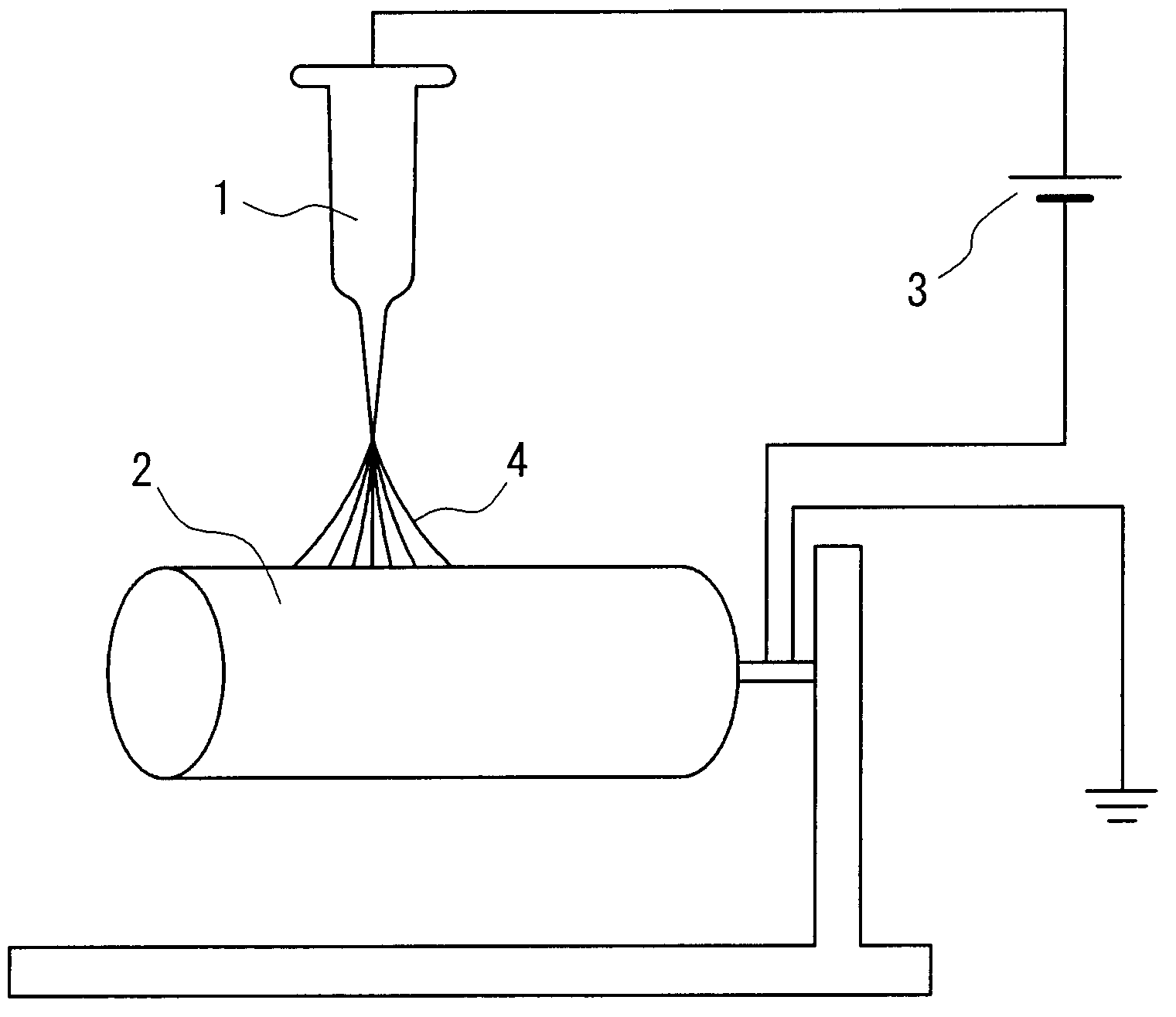
Figure 1 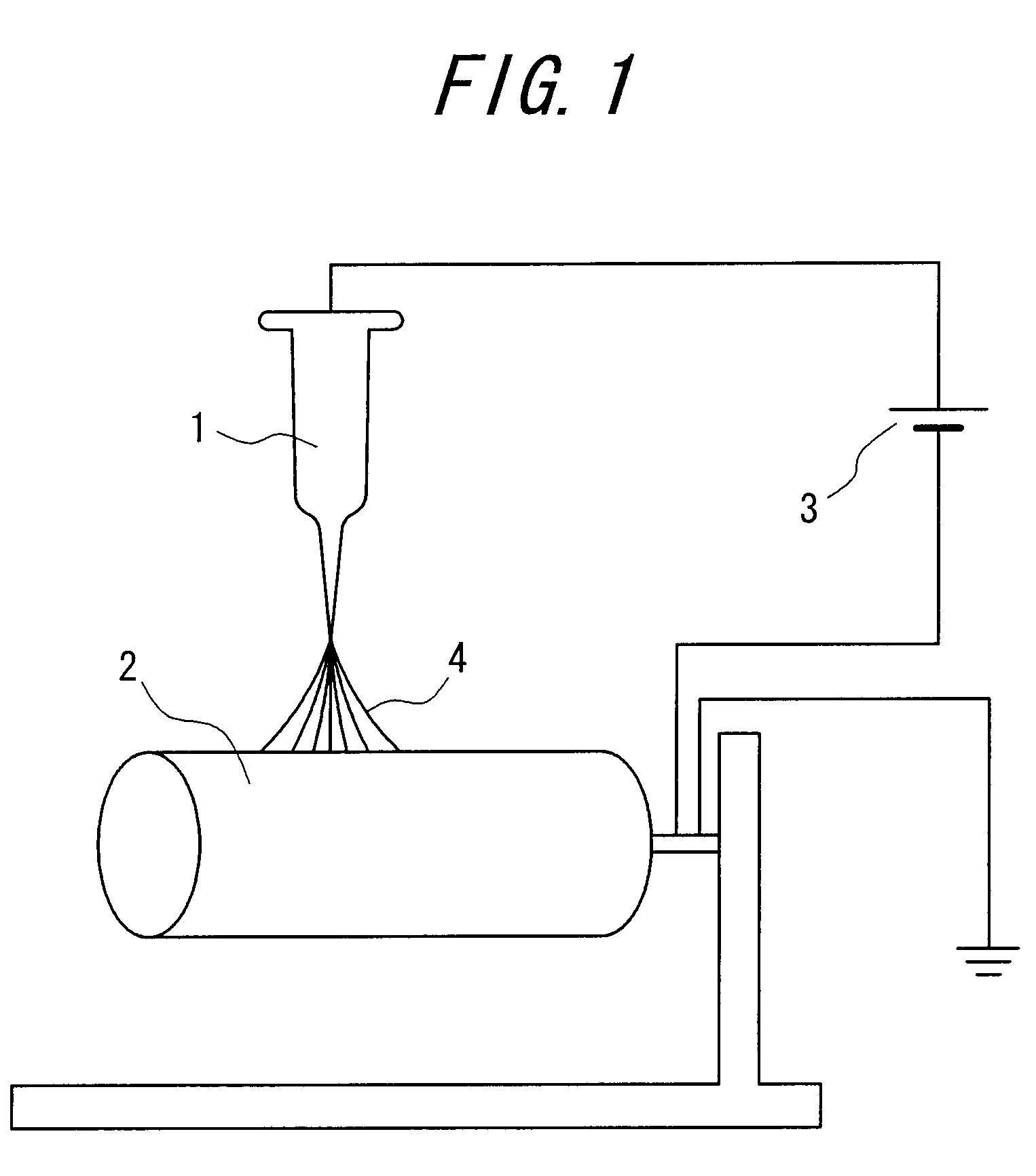
Figure 2 
Figure 3
Abstract
Description
TECHNICAL FIELD
[0001] This invention relates to carbon fibers, a porous support-carbon fiber composite and a method for producing the same, a catalyst structure using the porous support-carbon fiber composite obtained by this method, an electrode for a solid polymer fuel cell composed of the catalyst structure and a solid polymer fuel cell comprising the electrode, and more particularly to a method for producing carbon fibers and a porous support-carbon fiber composite having a high surface area.BACKGROUND ART
[0002] As the carbon fiber have hitherto been known pitch-based carbon fiber obtained by liquid phase carbonization, polyacrylonitrile-based and rayon-based carbon fibers obtained by solid phase carbonization, vapor-grown carbon fiber obtained by vapor phase carbonization, carbon nanotubes obtained by laser process or arc discharge process, and the like. In the production step of the pitch-based carbon fiber, polyacrylonitrile-based carbon fiber and rayon-based carbon fiber, it i...
Examples
example 1
[0055]A commercially available aqueous solution of 35 wt % of polyacrylic acid [manufactured by Aldrich] is diluted to prepare a solution containing 10 wt % of polymer material. A deposit layer of nanofibers is formed on a carbon paper [manufactured by Toray Industries, Inc.] under the following conditions by using the polymer material-containing solution according to the electrospinning method shown in FIG. 1 (electrospinning conditions: applied voltage: 20 kV, distance between a tip of a capillary and a substrate: 15 cm). As the membrane thus obtained is observed through SEM, it is confirmed that fibers of polyacrylic acid are obtained at an entangled state. The deposit layer is subjected together with the carbon paper to a firing treatment by heating up to 900° C. at a temperature rising rate of 7° C. / min in an Ar atmosphere and then keeping at 900° C. for 1 hour. As the fired product is observed through SEM, it is confirmed that carbon fibers having a diameter of 1 to 2 μm are o...
example 2
[0058]A commercially available aqueous solution of 35 wt % of polyacrylic acid [manufactured by Aldrich] is diluted and a commercially available carbon black is dispersed therein to prepare a polymer material-containing solution containing 10 wt % of polyacrylic acid and 20 wt % of carbon black. A deposit layer of nanofibers is formed on a carbon paper [manufactured by Toray Industries, Inc.] under the following conditions by using the polymer material-containing solution according to the electrospinning method shown in FIG. 1 (electrospinning conditions: applied voltage: 20 kV, distance between a tip of a capillary and a substrate: 15 cm). As the membrane thus obtained is observed through SEM, it is confirmed that fibers of polyacrylic acid are obtained at an entangled state. The deposit layer is subjected together with the carbon paper to a firing treatment by irradiating microwaves of 28 GHz under a reduced pressure for 1 hour. As the fired product is observed through SEM, it is ...