
Photosensitive resin composition, insulating film, protective film, and electronic equipment
Patent Information
- Authority / Receiving Office
- US · United States
- Current Assignee / Owner
- Publication Date
- 2010-03-25
- Estimated Expiration
- Not applicable · inactive patent
Smart Images
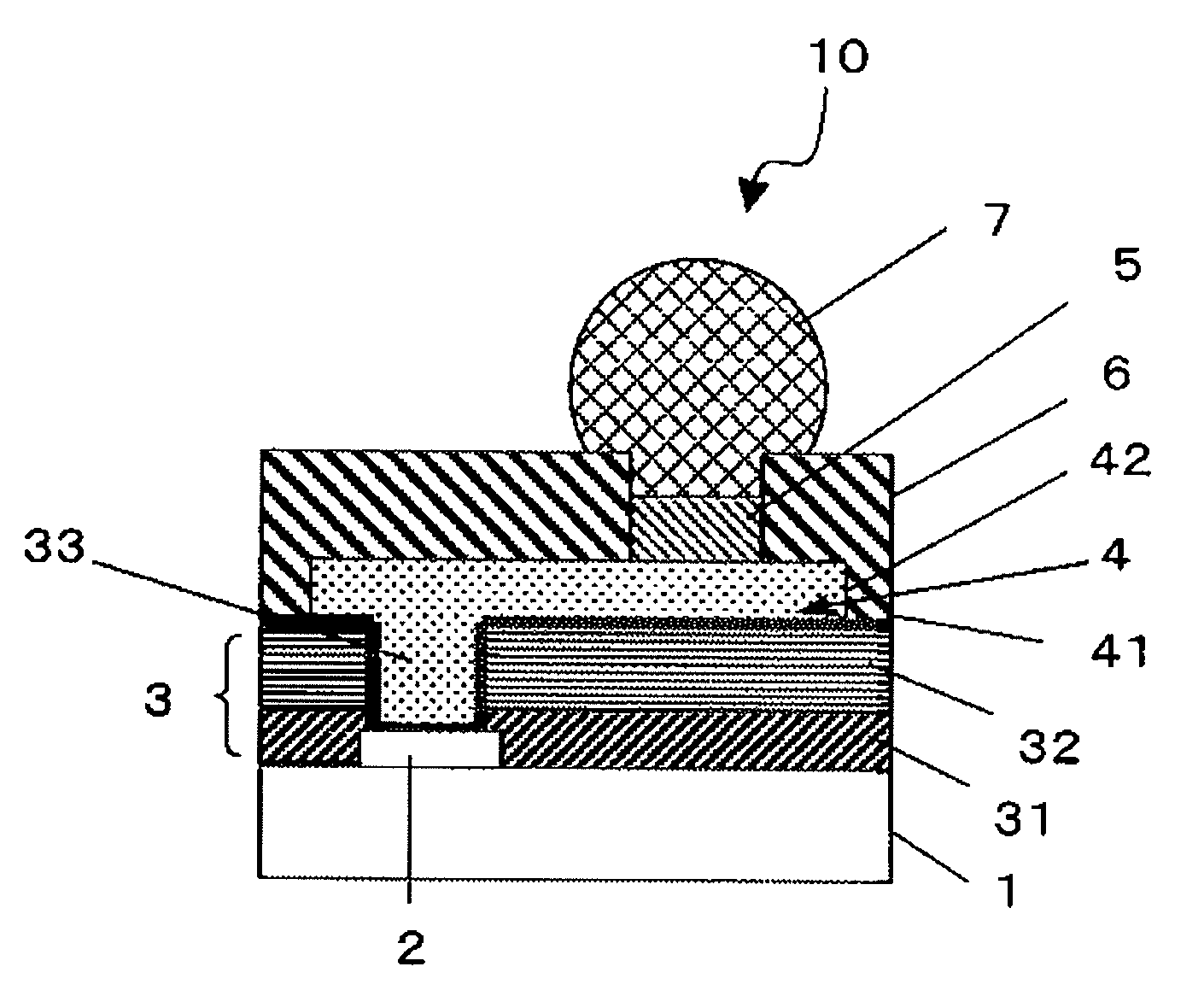
Figure 1 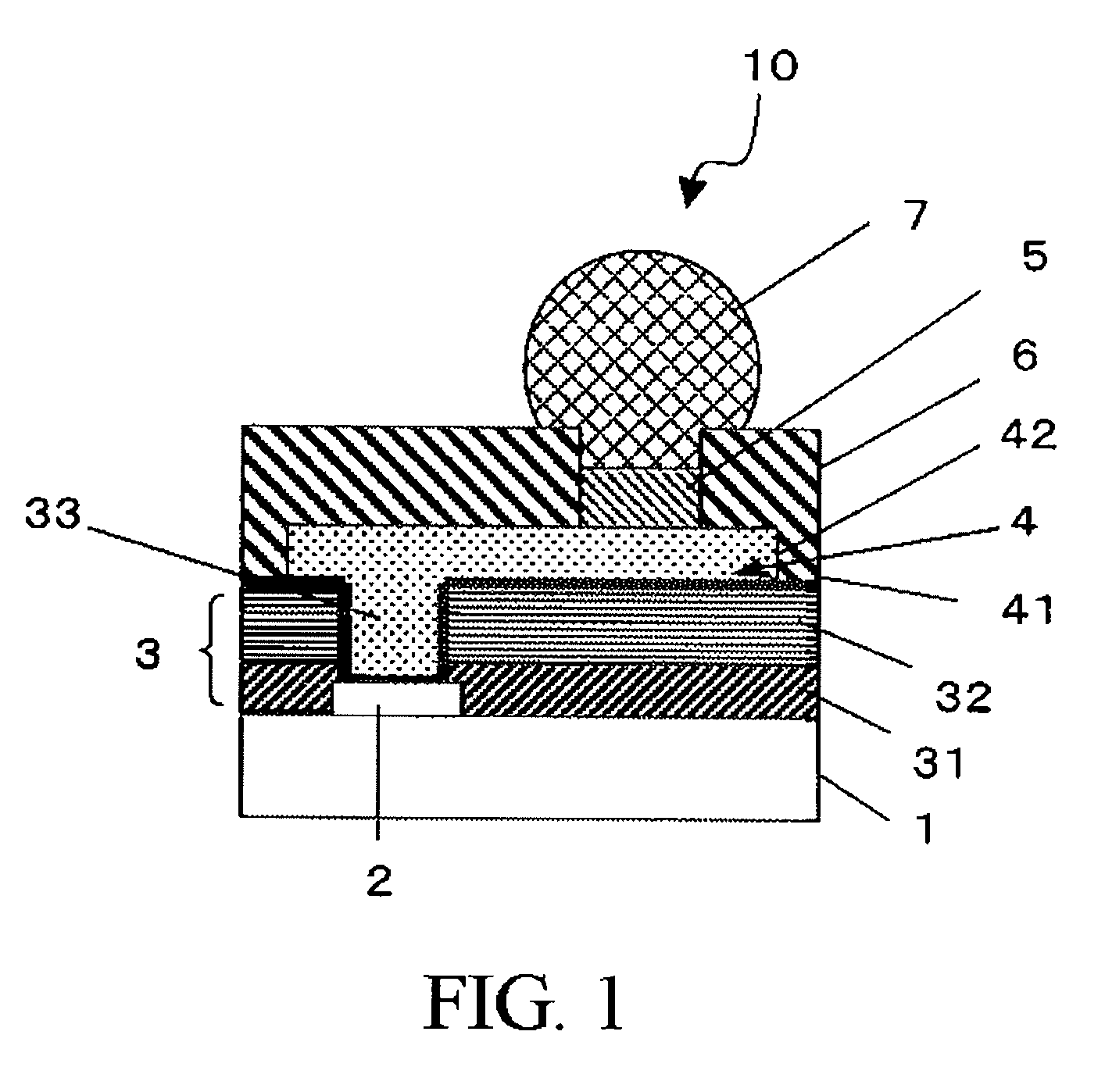
Figure 2 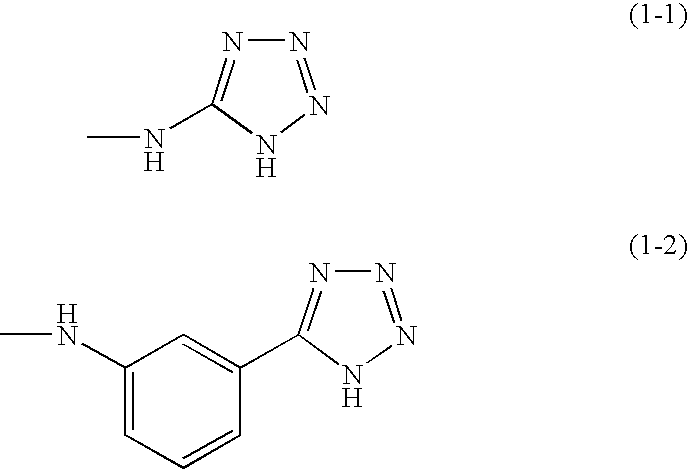
Figure 3
Abstract
Description
TECHNICAL FIELD
[0001] The present invention relates to a photosensitive resin composition, an insulating film, a protective film, and electronic equipment.BACKGROUND ART
[0002] Recently, a semiconductor element is formed by laminating a plurality of wiring layers for downsizing it or high integration thereof. Further, a type of the semiconductor element is changed to a chip size package (CSP) or a wafer level package (WLP).
[0003] For these reasons, a case that a surface protective film and an interlayer insulating film are directly formed on a metal wiring (which is generally made of copper, copper alloy or the like) of the wiring layer is increased.
[0004] Therefore, adhesiveness between the films and the wiring made of copper, copper alloy or the like affects reliability of the semiconductor element remarkably. As a result, a film having high adhesiveness to the wiring made of copper, copper alloy or the like is required.
[0005] Further, from the viewpoint of a property and productivity o...
Examples
example 1
1. Synthesis of Polyamide Resin (A-1)
[0149]First, 80.7 g (170.3 mmol) of a mixture of dicarboxylic acid ester derivatives obtained by reacting 35.2 g (136.3 mmol) of diphenylether-4,4′-dicarboxylic acid and 5.7 g (34.5 mmol) of isophthalic acid with 46.0 g (340.8 mmol) of 1-hydroxy-1,2,3-benzotriazole, 41.6 g (179.3 mmol) of 4,4′-oxybis(2-aminophenol), and 3.3 g (31.4 mmol) of 5-amino-1H-tetrazole 1-hydrate were put into a four-necked separable flask equipped with a thermometer, a stirrer, a raw material input port and a dry nitrogen gas-introducing tube.
[0150]Next, 363.5 g of N-methyl-2-pyrrolidone (NMP) was added to the above materials so that they were dissolved into the NMP to obtain a liquid solution, and then the liquid solution was stirred at room temperature for 2 hours.
[0151]Thereafter, the liquid solution was heated at 75° C. for 12 hours using an oil bath so that the dicarboxylic acid ester derivatives, the 4,4′-oxybis(2-aminophenol) and the 5-amino-1H-tetrazole 1-hydrate...
example 2
[0159]A positive type photosensitive resin composition was obtained in the same manner as in the Example 1 except that the following polyamide resin (A-2) was used instead of the polyamide resin (A-1).
[0160]Synthesis of Polyamide Resin (A-2)
[0161]6.5 g (34.1 mmol) of trimellitic acid anhydride and 4.3 g (41.3 mmol) of 5-amino-1H-tetrazole 1-hydrate were put into a four-necked separable flask equipped with a thermometer, a stirrer, a raw material input port and a dry nitrogen gas-introducing tube.
[0162]Thereafter, 37.8 g of NMP was added to the above materials so that they were dissolved into the NMP to obtain a liquid solution, and then the liquid solution was stirred at 20° C. or less overnight so that the trimellitic acid anhydride and the 5-amino-1H-tetrazole 1-hydrate were reacted with each other to obtain an amide compound.
[0163]Next, 31.6 g (136.2 mmol) of diphenylether-4,4′-dicarboxylic acid and 46.0 g (340.6 mmol) of 1-hydroxy-1,2,3-benzotriazole were added to the liquid sol...
example 3
[0168]A positive type photosensitive resin composition was obtained in the same manner as in the Example 1 except that the following polyamide resin (A-3) was used instead of the polyamide resin (A-1) .
[0169]Synthesis of Polyamide Resin (A-3)
[0170]6.6 g (34.4 mmol) of trimellitic acid anhydride and 4.3 g (41.7 mmol) of 5-amino-1H-tetrazole 1-hydrate were put into a four-necked separable flask equipped with a thermometer, a stirrer, a raw material input port and a dry nitrogen gas-introducing tube.
[0171]Thereafter, 37.8 g of NMP was added to the above materials so that they were dissolved into the NMP to obtain a liquid solution, and then the liquid solution was stirred at 20° C. or less overnight so that the trimellitic acid anhydride and the 5-amino-1H-tetrazole 1-hydrate were reacted with each other to obtain an amide compound.
[0172]Next, 35.2 g (136.2 mmol) of diphenylether-4,4′-dicarboxylic acid and 46.0 g (340.6 mmol) of 1-hydroxy-1,2,3-benzotriazole were added to the liquid so...