
Therapeutic agent for interstitial pulmonary disease comprising Anti-hmgb-1 antibody
Patent Information
- Authority / Receiving Office
- US · United States
- Current Assignee / Owner
- Publication Date
- 2010-08-26
- Estimated Expiration
- Not applicable · inactive patent
Smart Images
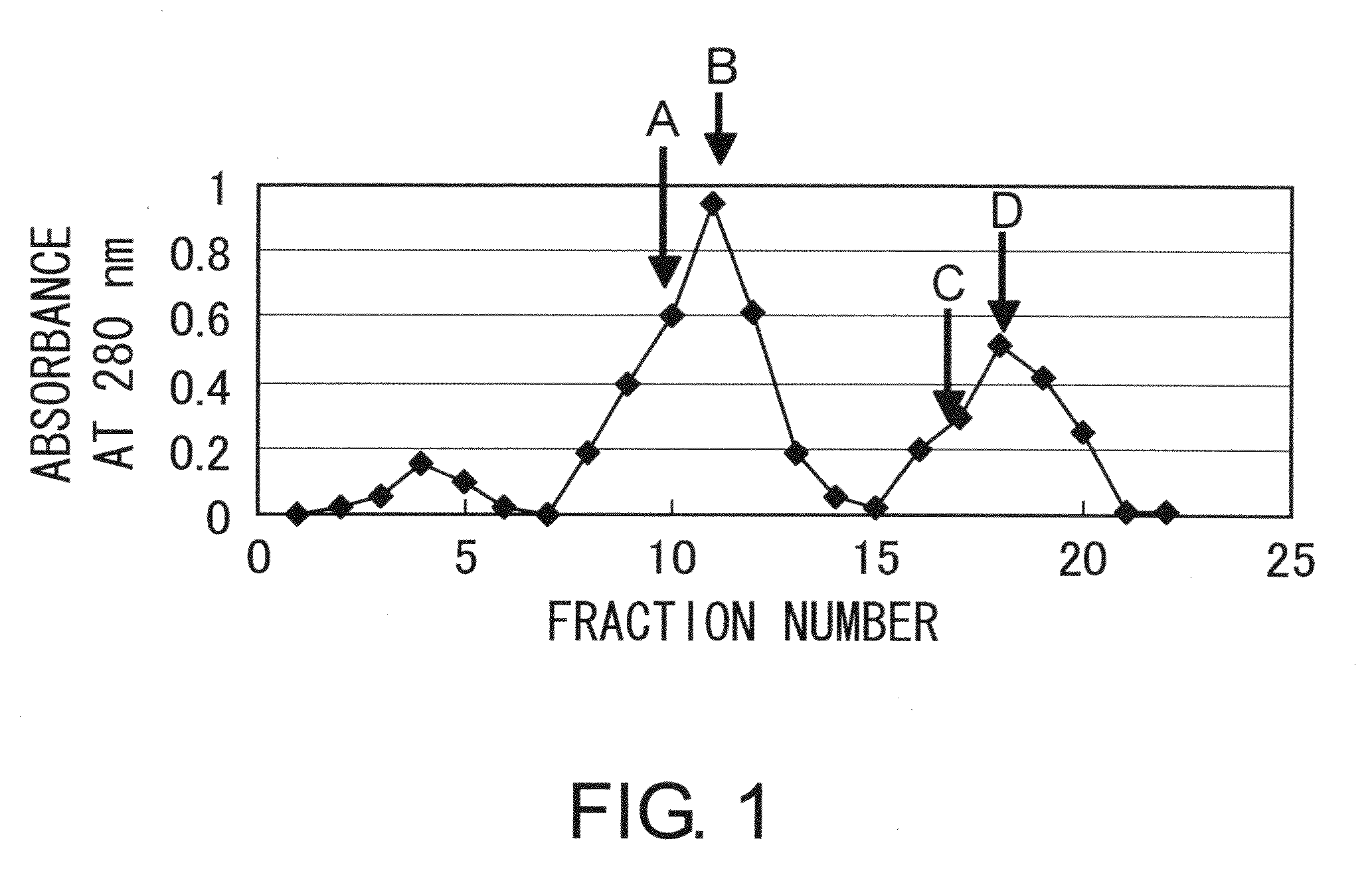
Figure 1 
Figure 2 
Figure 3
Abstract
Description
TECHNICAL FIELD
[0001] The present invention relates to preparations for treating or preventing interstitial pulmonary diseases, which comprise an antibody against high mobility group box protein 1 (HMGB-1) as an active ingredient.BACKGROUND ART
[0002] Mammalian lungs are spongy tissues with very fine mesh consisting of a hundred millions of alveoli with a diameter of several microns. The inhaled air is transported to each alveolus through the bronchi. The very thin walls surrounding the alveoli are called interstitium, and they contain a network of capillaries that absorb oxygen to be supplied to the whole body. Diseases involving inflammation of the alveolar walls, namely interstitium, are collectively named “interstitial pulmonary diseases”. Of the diseases, those that are likely to result in fibrosis are collectively referred to as “interstitial pneumonia”. Among interstitial pneumonia, idiopathic interstitial pneumonia which has unknown pathogenesis is specified as an intractable d...
Examples
example 1
Selection of Highly Hydrophilic Amino Acid Sequences in the Amino Acid Sequence of Human HMGB-1, Which Exhibit Low Homology to Human HMGB-2
[0112]Highly hydrophilic amino acid sequences that exhibit low homology to human HMGB-2 were selected from the amino acid sequence of human HMGB-1.
(1) The amino acid sequence of human HMGB-1 (SEQ ID NO: 6) is shown above as the data of Wen et al. (Wen et al., Nucleic Acids Res. (1989) 17: 1197-214).
(2) The hydrophilicity of each amino acid residue in the amino acid sequence of human HMGB-1 was estimated by the method of Hopp et al. (T. P., Hopp et al., Proc. Natl. Acad. Sci. USA (1981) 78: 3824-8).
(3) Next, highly hydrophilic amino acid sequences from the amino acid sequence of human HMGB-1 were compared with the amino acid sequence of human HMGB-2 (M. Yoshida et al., J. Biol. Chem. (1992) 267: 6641-5). Then, some amino acid sequences exhibiting low homology to human HMGB-2 were selected from the highly hydrophilic amino acid sequences of human H...
example 2
Peptide Synthesis
[0113]The peptide consisting of the amino acid sequence “Cys Lys Pro Asp Ala Ala Lys Lys Gly Val Val Lys Ala Glu Lys” (SEQ ID NO: 3), which has an extra cysteine at the N-terminus of the amino acid sequence selected in Example 1, was synthesized for the convenience of linking.
[0114]First, the peptide having the amino acid sequence “Cys Lys Pro Asp Ala Ala Lys Lys Gly Val Val Lys Ala Glu Lys” (SEQ ID NO: 3) was synthesized by the solid-phase synthesis method with t-butoxycarbonyl amino acids using the Applied Biosystems Model 430A peptide synthesizer according to the instruction manual. The synthesized peptide was cleaved from the resins by the hydrogen fluoride method in the presence of dimethylsulfide, p-thiocresol, m-cresol, and anisole as scavengers to suppress the side reactions. Then, the scavengers were extracted with dimethyl ether, and the synthesized peptide was extracted with 2N acetic acid. The peptide was purified by anion exchange column chromatography ...
example 3
Immunogen Preparation
[0116]10 mg of a carrier, namely keyhole limpet hemocyanin. (KLH) (Calbiochem) or bovine serum albumin (BSA) (Seikagaku Co.), was dissolved in 10 mM potassium dihydrogen phosphate-dipotassium hydrogen phosphate buffer (pH 7.0), and then 150 μl of N,N-dimethylformamide solution containing 2.5% maleimidebenzoyl N-hydroxysuccinimide ester (MBS) (PIERCE) was added thereto. The mixture was incubated at room temperature for 30 minutes while stirring. The mixture was loaded at 4° C. onto a gel filtration column (Sephadex G-25 column (Pharmacia LKB)) pre-equilibrated with 10 mM potassium dihydrogen phosphate-dipotassium hydrogen phosphate buffer (pH 7.0). The absorbance was monitored at 280 nm to collect the MBS-carrier conjugate fraction. The pH of the MBS-carrier conjugate fraction was adjusted to 7.0 using trisodium phosphate. The peptide “Cys Lys Pro Asp Ala Ala Lys Lys Gly Val Val Lys Ala Glu Lys” (SEQ ID NO: 3) synthesized as described in Example 2 was added to th...