
Hyperthermic inducible expression vectors for gene therapy and methods of use thereof
a gene therapy and hyperthermia technology, applied in the field of gene therapy, can solve the problems that the hyperthermia system cannot adequately heat large and deep tumors, and achieve the effects of promoting nerve regeneration, and inhibiting the growth of tumor cells
Patent Information
- Authority / Receiving Office
- US · United States
- Patent Type
- Patents(United States)
- Current Assignee / Owner
- Publication Date
- 2007-10-23
- Estimated Expiration
- Not applicable · inactive patent
Smart Images
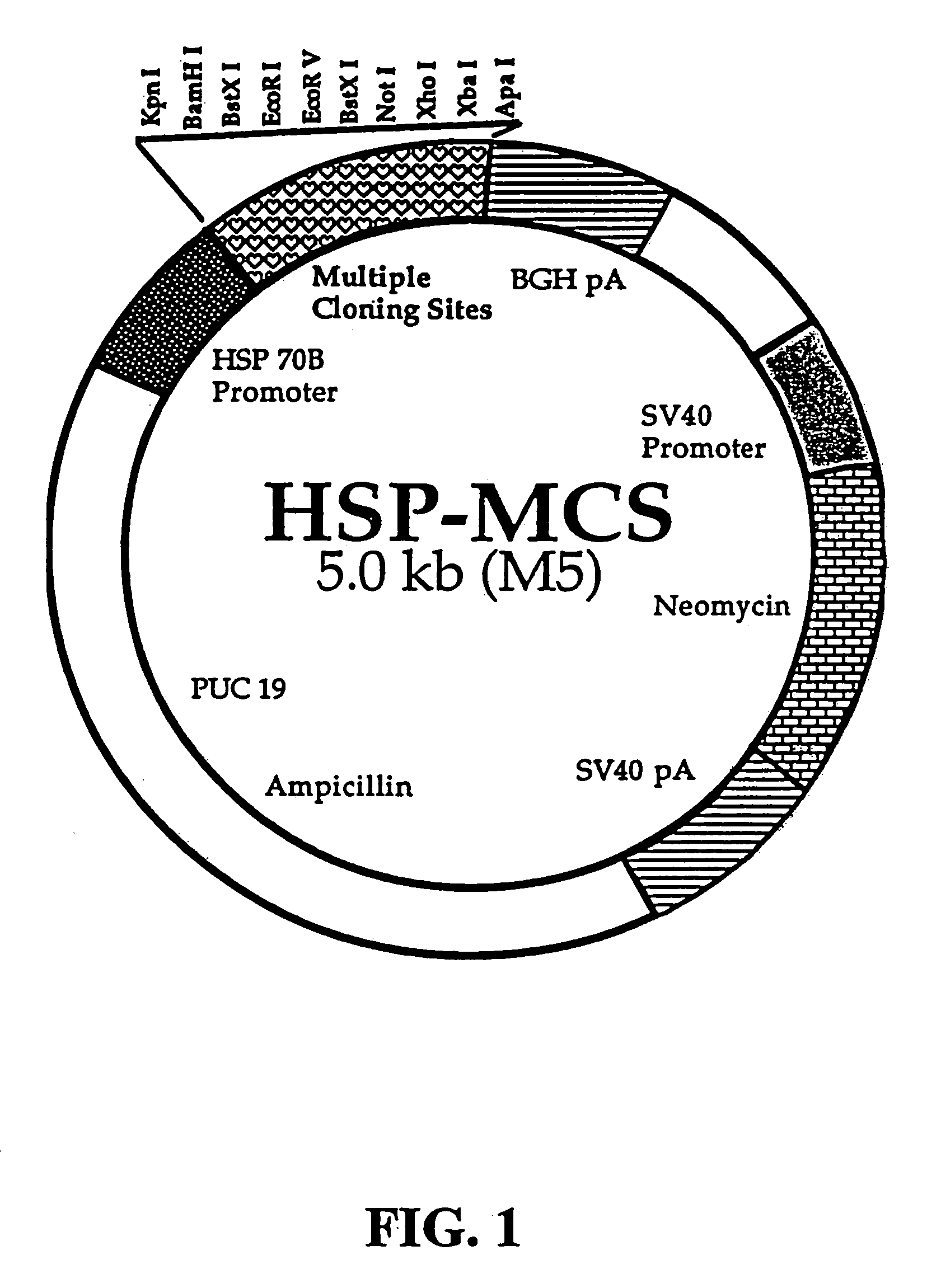
Figure 1 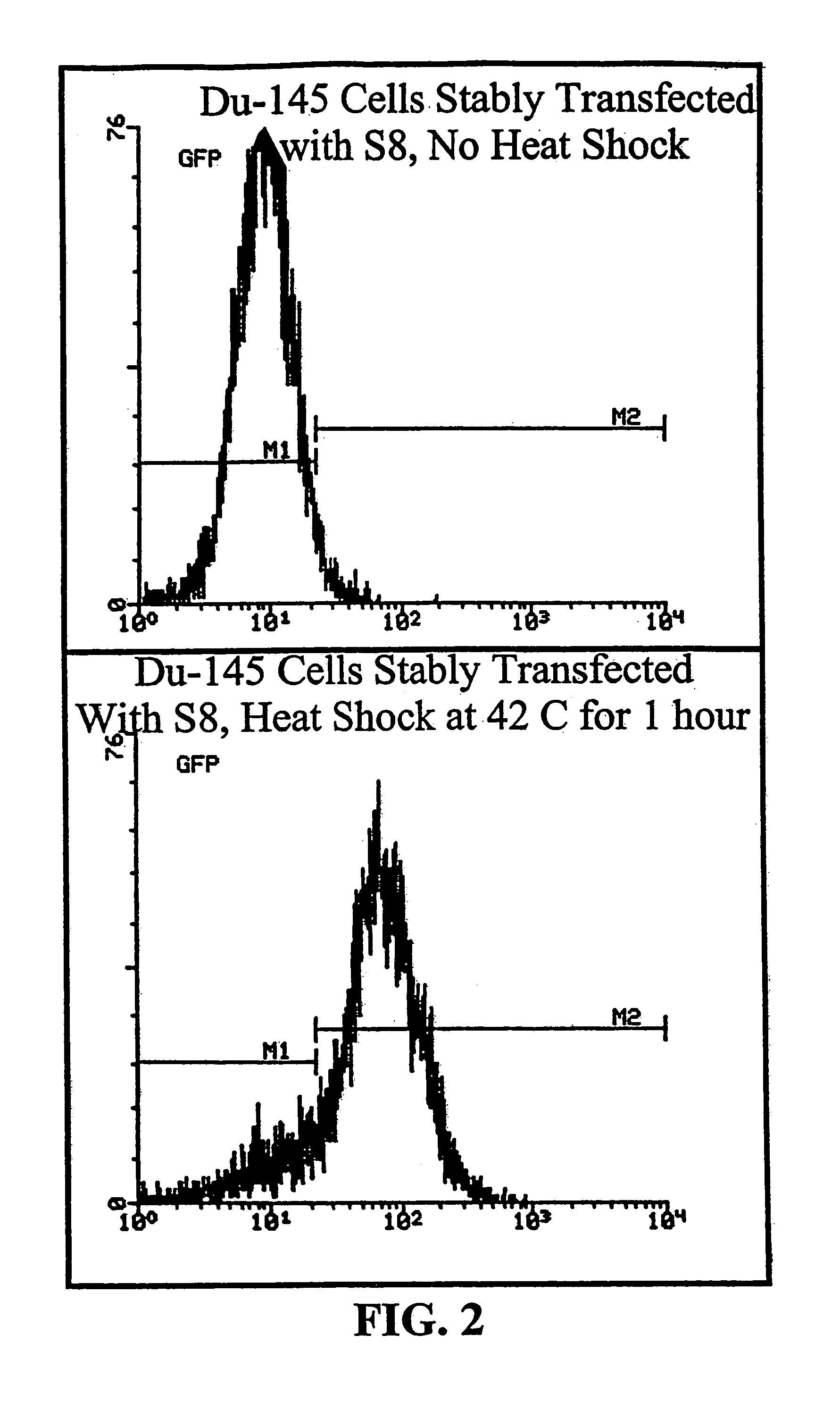
Figure 2 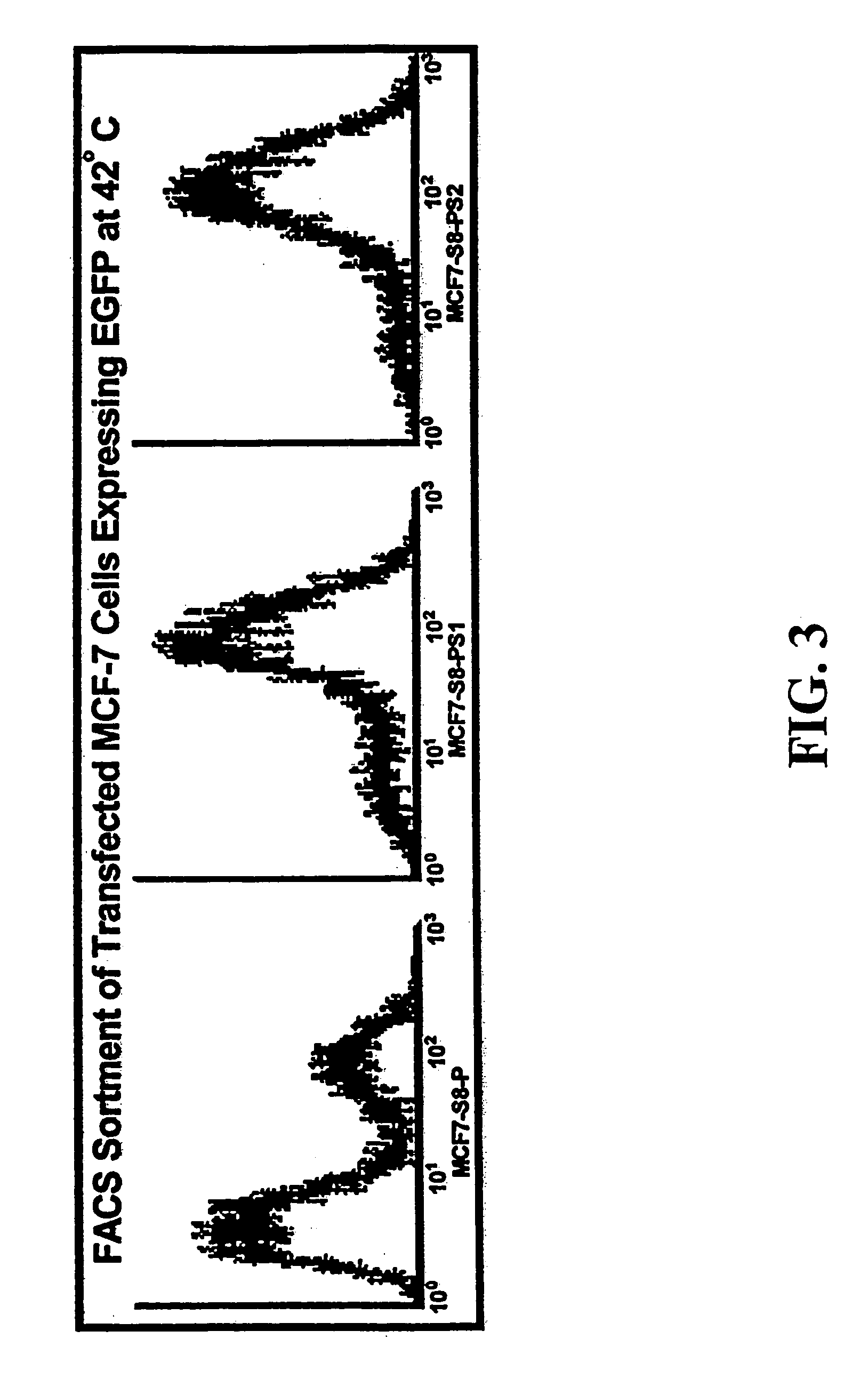
Figure 3
Abstract
Description
CROSS-REFERENCE TO RELATED APPLICATIONS
[0001] The present application is a continuation application of U.S. application Ser. No. 09 / 185,243 filed Nov. 3, 1998, now U.S. Pat. No. 6,709,858, which claims priority from U.S. provisional application Ser. No. 60 / 064,088 filed Nov. 3, 1997.BACKGROUND OF THE INVENTION
[0002] 1. Field of the Invention
[0003] The present invention relates generally to the field of gene therapy. More particularly, it concerns methods and compositions for increasing transgene expression.
[0004] 2. Description of Related Art
[0005] Gene therapy now is thought to be widely applicable in the treatment of a variety of cancers and a number of other diseases. Viral vectors are one method employed as a gene delivery system. A great variety of viral expression systems have been developed and assessed for their ability to transfer genes into somatic cells. In particular, retroviral and adenovirus based vector systems have been investigated extensively over a decade. Recently, ad...
Examples
example 1
The Heat Shock Promoter Can Induce Expression of a Reporter Gene
[0172]Vector Constructs. To study the ability of the HSP70 promoter to induce gene expression, either a minimal heat shock (HS) promoter or a minimal CMV promoter was inserted upstream of a reporter gene in a plasmid containing neomycin and ampicillin selectable markers. The basic design of a plasmid (M5) containing one multiple cloning site in operable position to a promoter derived from HSP70 is shown in FIG. 1. M5 was constructed by replacing the CMV promoter in pcDNA3.0 (Invitrogen, Inc.) with a minimal HSP70B promoter (SEQ ID NO:1, FIG. 10), a 0.4 kb fragment (HindIII-BamH1) of the human heat shock protein 70B (HSP70B) promoter, obtained from StressGen, Inc.
[0173]Activity of the minimal HS and CMV promoters were determined by transfecting human cancer cells, MCF7 human breast carcinoma cells and DU145 human prostate carcinoma cells, with the plasmid S8. The S8 plasmid, derived from the M5 vector of FIG. 1, contains...
example 2
Expression of 12 Can Be Amplified by the Use of a HIV Promoter and tat in a Construct
[0196]Initial Amplifier Studies. Studies involving new constructs capable of amplifying a therapeutic gene's expression were performed. To demonstrate the principle of the amplifier idea, several constructs were produced. The constructs contain a constitutive promoter, the CMV promoter, rather than a heat-shock induible promoter. These constructs are the plasmids L-27, X14, RR13, Y15, and SS10. Table 3, below, shows the promoters / genes present in each plasmid and the amount of IL-2 produced. Four of the plasmids Were obtained from a plasmid containing two multiple cloning sites. In these four plasmids, the CMV promoter was inserted upstream of either the tat gene or a multiple cloning site (MCS) and either the HIV1 or HIV2 long terminal repeats (LTRs) was inserted upstream of the mouse interleukin-2 (IL-2) gene. The plasmids X14 and Y15 are shown schematically in FIGS. 9A and 9B. The L-27 plasmid se...
example 3
Heat Inducible Amplifiers
[0199]Vector Construction. To determine if a second promoter could be used to increase the activity of the minimal HS promoter, MCF-7 cells were transiently transfected with a series of vectors, including pC8, pf12, and p007 (FIGS. 8 and 9). Using a plasmid containing two multiple cloning sites, the minimal heat shock promoter was inserted upstream of either the tat gene or a multiple cloning site (MCS) and either the HIV1 or HIV2 long terminal repeats (LTRs) was inserted upstream of the mouse interleukin-2 (IL 2) gene. The plasmids also each carried neomycin and ampicillin selectable markers.
[0200]The plasmid f11 was first created by inserting a 0.5 kb EcoRI fragment, containing the interleukin-2 (IL-2) coding region (see GenBank accession no. 577834), from plasmid C5 into the EcoRI site of the vector M5 (see specific example, Example 1, above). The plasmid C8 was constructed by inserting a 1 kb BamHI fragment, containing the 0.4 kb HSP70B fragment upstream...