Devilíõs rush herb fiber dying method

The invention relates to a technology of daffodil fiber and a dyeing method, which is applied to the dyeing field of daffodil fiber for textiles to achieve the effect of pure dyeing and removal of impurities and variegated colors.

CN101187179AInactive Publication Date: 2008-05-28QINGDAO UNIV
0 Cites 8 Cited by

Patent Information

Authority / Receiving Office
CN · China
Patent Type
Applications(China)
Current Assignee / Owner
Publication Date
2008-05-28
Estimated Expiration
Not applicable · inactive patent

Smart Images

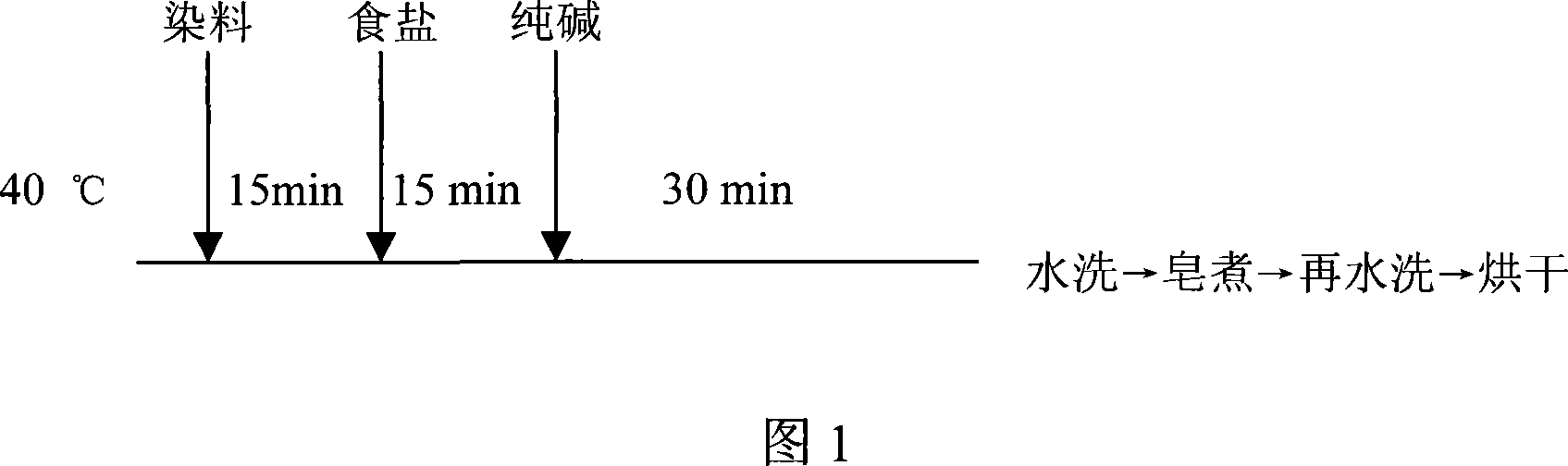
  • Figure 1
    Figure 1
Patent Text Reader

Abstract

The invention provides a Chinese alpine rush fabric dyeing method, which comprises preparative finishing and dyeing. The invention method is characterized in that: the detail processing steps comprises: obtaining the Chinese alpine rush fabric after degumming, boiling, bleaching, dyeing, washing, boiling in soap, washing again and baking. The dyeing process comprises: X type active dyeing material is used, dyeing material dosage is 45-55 g / L, salt dosage is 45-55g / L, soda dosage is 4-6g / L, bath ratio is 1:45-55, dyeing temperature 38-42 DEG C, color fixing temperature is 38-42 DEG C, after dyeing for 25 to 35 minutes, charging the color fixing agent soda in the dyeing bath, the dyeing liquid is in strong alkalinity, which can obtain fresh and pure color dyeing of the Chinese alpine rush fabric and improve the Chinese alpine rush utility value and realize the industrialized production.
Need to check novelty before this filing date? Find Prior Art

Description

technical field

[0001] The invention relates to the technical field of fiber dyeing in the textile industry, in particular to a method for dyeing asparagus fibers for textile use. Background technique

[0002] In recent years, people have paid more and more attention to the development and utilization of new natural fibers. On the one hand, it can enrich the types of textiles and meet consumers' demand for "green" products; on the other hand, it can make full use of natural resources, bring certain economic benefits, and at the same time meet the requirements of "environmental protection".

[0003] Asparagus is widely distributed in central China, east China, southwest, Shaanxi, Taiwan and other places in my country, and it is also distributed in India, Afghanistan, Iran, Philippines, Vietnam, Myanmar and other countries. As an excellent pioneer plant for water and soil conservation, Asparagus can still be planted on a large scale in a saline-alkaline soil environment. It c...

Examples

Embodiment Construction

[0016] Asparagus fiber is a kind of natural cellulose fiber. The natural color of asparagus fiber for textile is light brown or light grass green after being prepared. The dyeing principle is that asparagus fiber is a natural cellulose fiber, and reactive dyes are commonly used for dyeing cellulose fiber. Wherein X-type reactive dyes belong to low-temperature dyes, can be dyed at room temperature, and the process is better controlled, so the present invention selects X-type reactive dyes for dyeing. In addition, because the natural color of asparagus fiber for textiles is light brown or light grass green, the natural color fiber will have problems such as uneven shade, dim color, and limited color range after being directly dyed. In order to obtain a brighter and purer dyeing effect, the natural-color asparagus fiber is subjected to a pre-treatment process, namely scouring and bleaching, to remove impurities and variegated colors.

[0017] The dyeing process of the asparagus ...