
Communication method decision device, transmission device, reception device, OFDM adaptive modulation system, and communication method decision method
A technology of adaptive modulation and communication mode, which is applied in the fields of communication mode determination device, sending device, receiving device, OFDM adaptive modulation system and communication mode determination, and can solve problems such as large error and poor efficiency
- Summary
- Abstract
- Description
- Claims
- Application Information
AI Technical Summary
Problems solved by technology
Method used
Image

Examples
no. 1 Embodiment approach
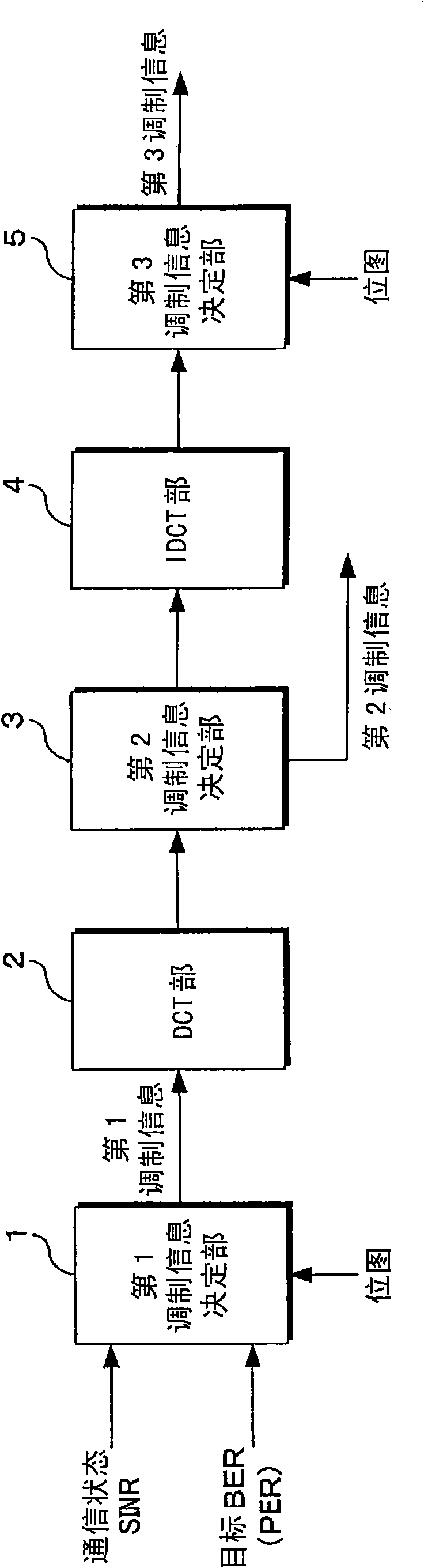
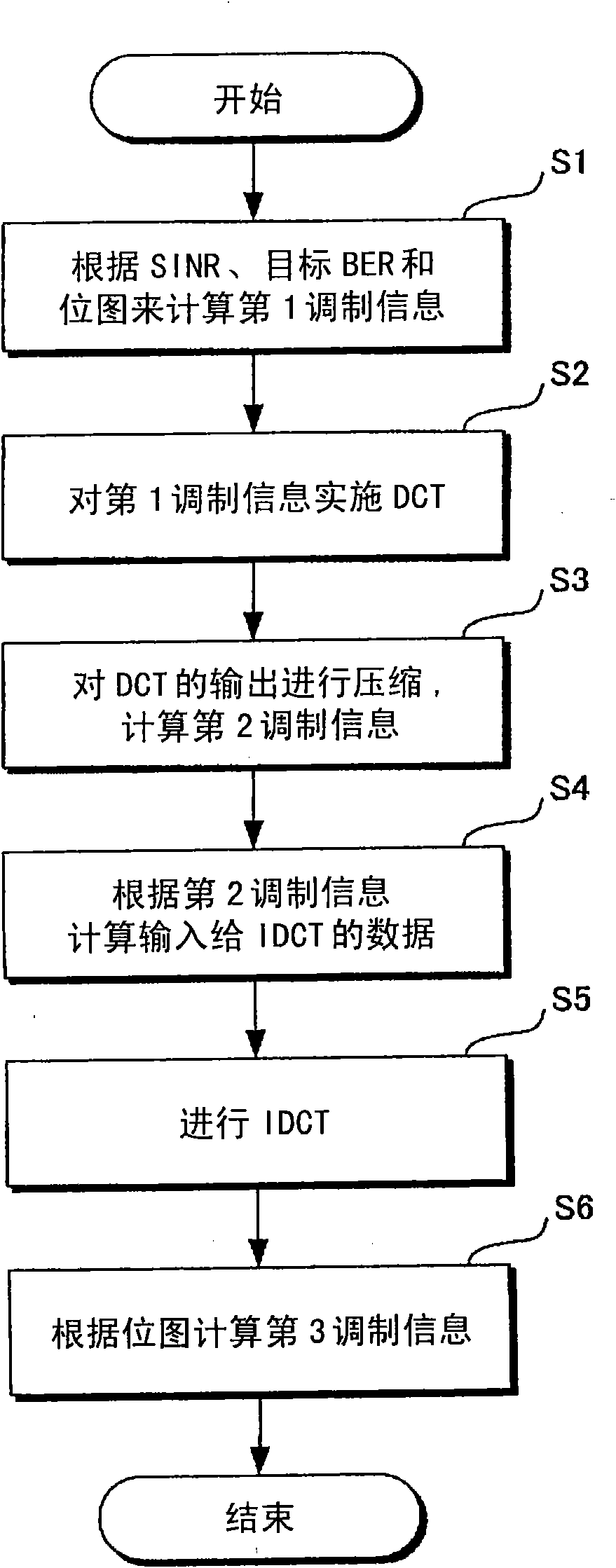
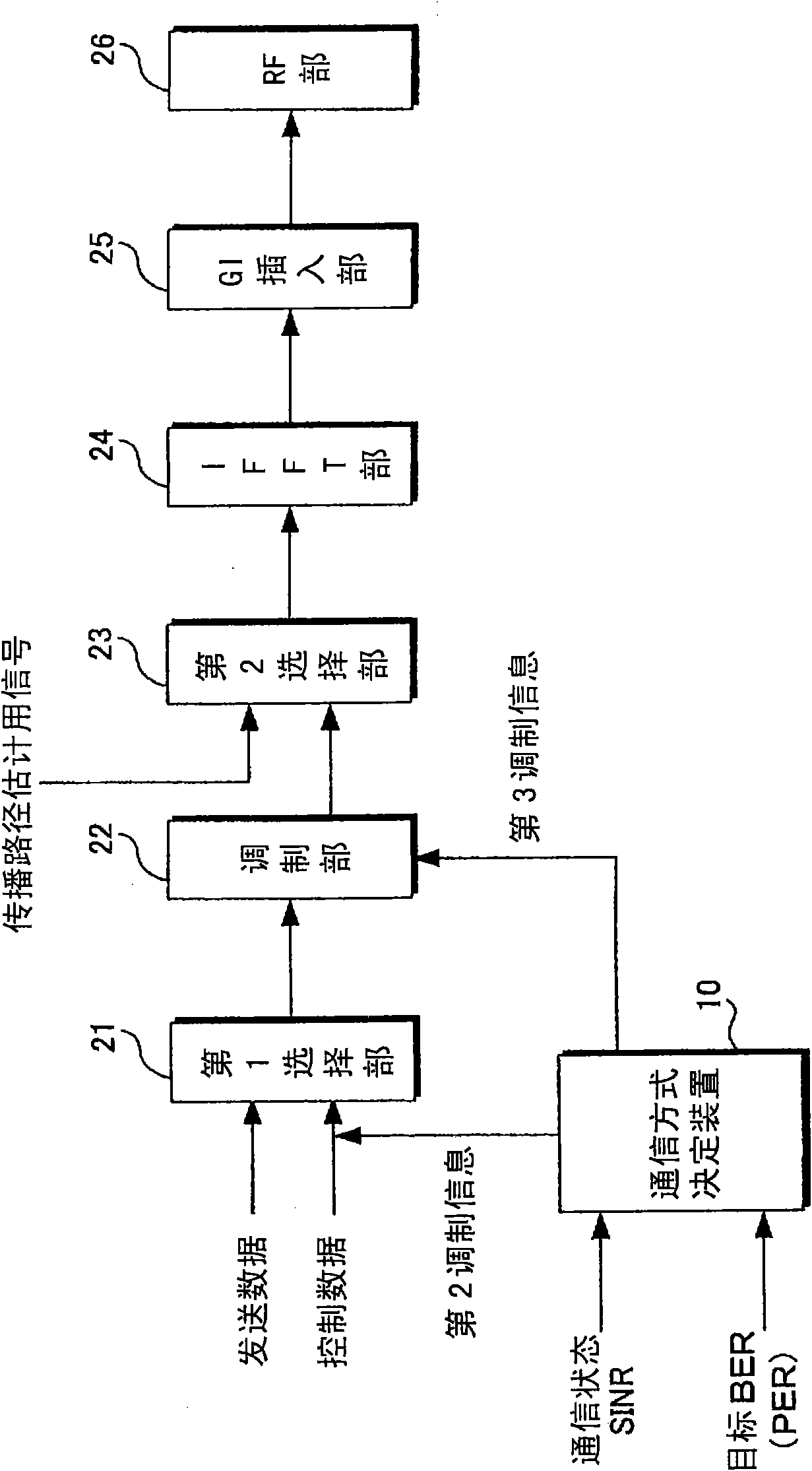
[0101] In this embodiment, a communication system determining device that compresses MLI using data space transformation processing and a transmission device of an OFDM adaptive modulation system using the device will be described. In the present embodiment, the communication method determination device is described as a device for determining the modulation method and coding rate of each subcarrier in an OFDM adaptive modulation system, but there are cases where the transmission power of each subcarrier is determined. In order to simplify the description, the following situations are considered in this embodiment:
[0102] (1) The total number of subcarriers of the OFDM signal is considered to be 64;
[0103] (2) As the modulation information of each sub-carrier, four modulation modes of BPSK, QPSK, 16QAM, and 64QAM are considered;
[0104] (3) Consider 12 coding rates from the four combinations of 1 / 2, 2 / 3, 3 / 4, and 7 / 8;
[0105] (4) A total of 13 types of subcarriers (emp...
no. 2 Embodiment approach
[0132] In this embodiment, for figure 1 The compression in the shown second modulation information determination unit 3 will be described in detail. In addition, compared with the difference-based information compression, the method proposed here is more suitable for the next generation wireless communication system.
[0133] In the first embodiment, a method of compressing data by setting signal components in a high-frequency region to zero was described. Also, the same quantization was performed on the sampled data that was not deleted. Since DCT is performed on the MLI data having correlation in the subcarrier direction, its output signal components are concentrated in the low frequency region. In addition to deleting components in the high-frequency region by utilizing this property, efficient and accurate compression can be performed by changing the number of bits used for quantization in the frequency region to be used.
[0134] In the above example, 24 sample data in...
no. 3 Embodiment approach
[0150] In the embodiments described above, it was assumed that there is a post-DCT compression method in the system or the transmission device. However, as from Image 6 As can be seen, in order to perform compression as efficiently as possible, it is better to change the compression rate according to the propagation path. In this embodiment, a communication system determining device that performs communication by changing the compression rate according to the delay distribution of the propagation path and a transmission device of an OFDM adaptive modulation system using the same will be described.
[0151] Figure 7 It is a block diagram showing a schematic configuration of the communication method determining device according to the third embodiment. and figure 1 Blocks having the same function are assigned the same reference numerals and descriptions thereof are omitted. That is, the second modulation information determination unit 33 and figure 1 shown differently. The...
PUM
 Login to View More
 Abstract
Description
Claims
Application Information
 Login to View More