Method for improved scaling of filters
A technology for scaling and filtering equipment, applied in the direction of chemical instruments and methods, instruments, membranes, etc., which can solve problems such as acceptable performance tolerances
- Summary
- Abstract
- Description
- Claims
- Application Information
AI Technical Summary
Problems solved by technology
Method used
Image



Examples
Embodiment 1
[0024] A key performance parameter for sterile gradient membrane filters is water permeability, which correlates to the productivity of the equipment. Water permeability was measured by feeding water to the membrane, maintaining a pressure differential across the membrane, and measuring the water flow rate. Calculate the permeability according to the following formula:
[0025] Lp=Q / (A*ΔP)
[0026] where Lp is the water permeability, A is the membrane area, and ΔP is the pressure difference across the membrane. Water permeability is usually expressed in units of L / (m 2 -hr-psi) or LMH / psi.
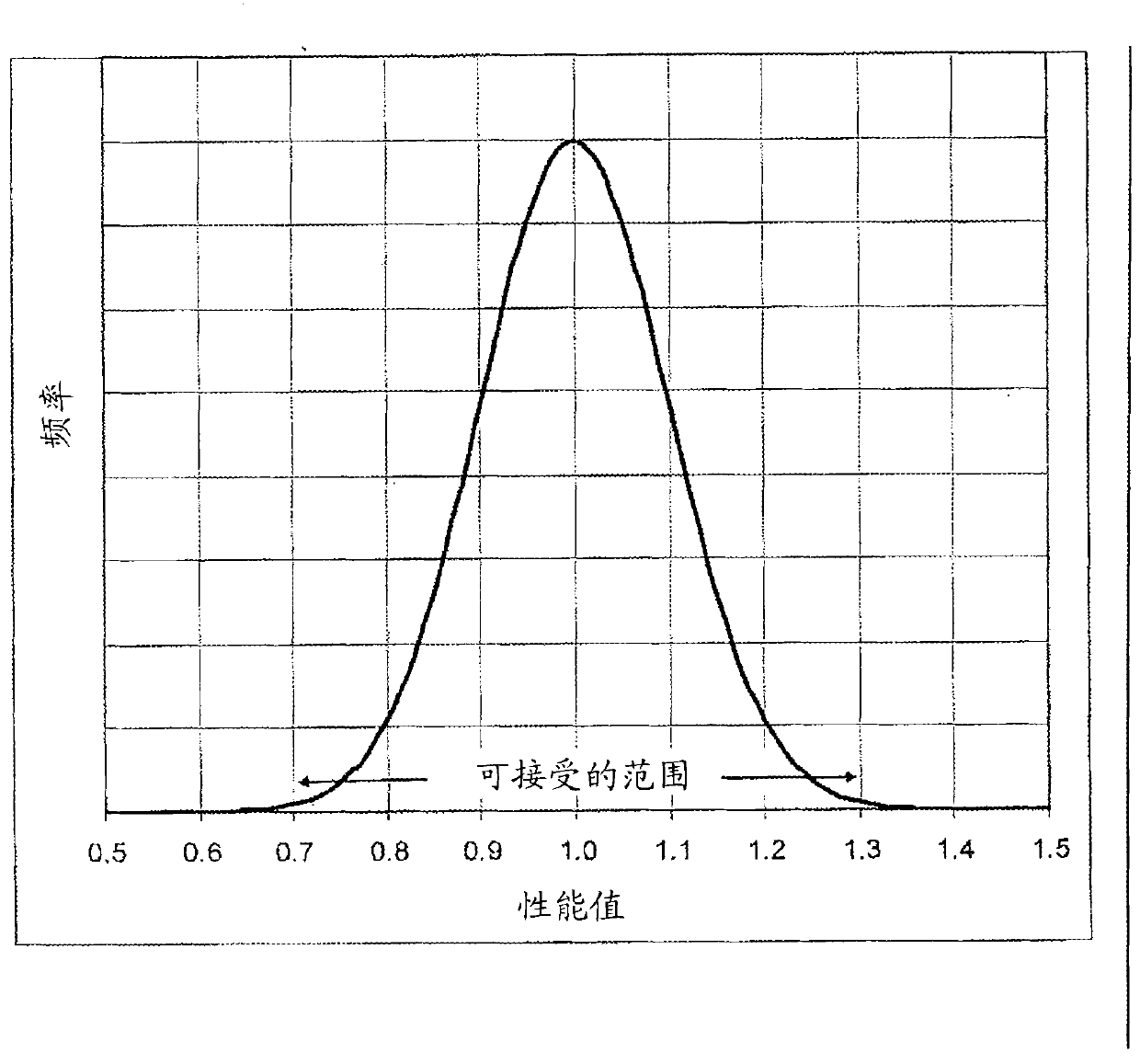
[0027] Water permeability was measured on a representative collection of pleated boxes, each box containing approximately 0.5 m2 The polyethersulfone membrane, the nominal pore size of the membrane is 0.2 μm. Figure 5 Distribution curves are shown. The water permeability is from about 1000 LMH / psi to about 1300 LMH / psi. A subset of the membranes contained in the entire population wa...
Embodiment 2
[0029] Based on the water permeability profile of Example 1, a single membrane that had been characterized for water permeability was selected from the entire membrane population. Since the water permeability of the membrane is known, Equation 2 can be applied, the scaling factor uncertainty ratio is 1300 / 1000=1.3, representing a 23% improvement in the scaling factor uncertainty compared to the prior art.
PUM
 Login to View More
 Abstract
Description
Claims
Application Information
 Login to View More