
Gait rehabilitation training robot
A rehabilitation training and robotics technology, applied in passive exercise equipment, physical therapy and other directions, to achieve the effect of simple and reliable implementation, smooth trajectory operation, and overcoming the small rigidity of chain transmission
- Summary
- Abstract
- Description
- Claims
- Application Information
AI Technical Summary
Problems solved by technology
Method used
Image

Examples
Embodiment Construction
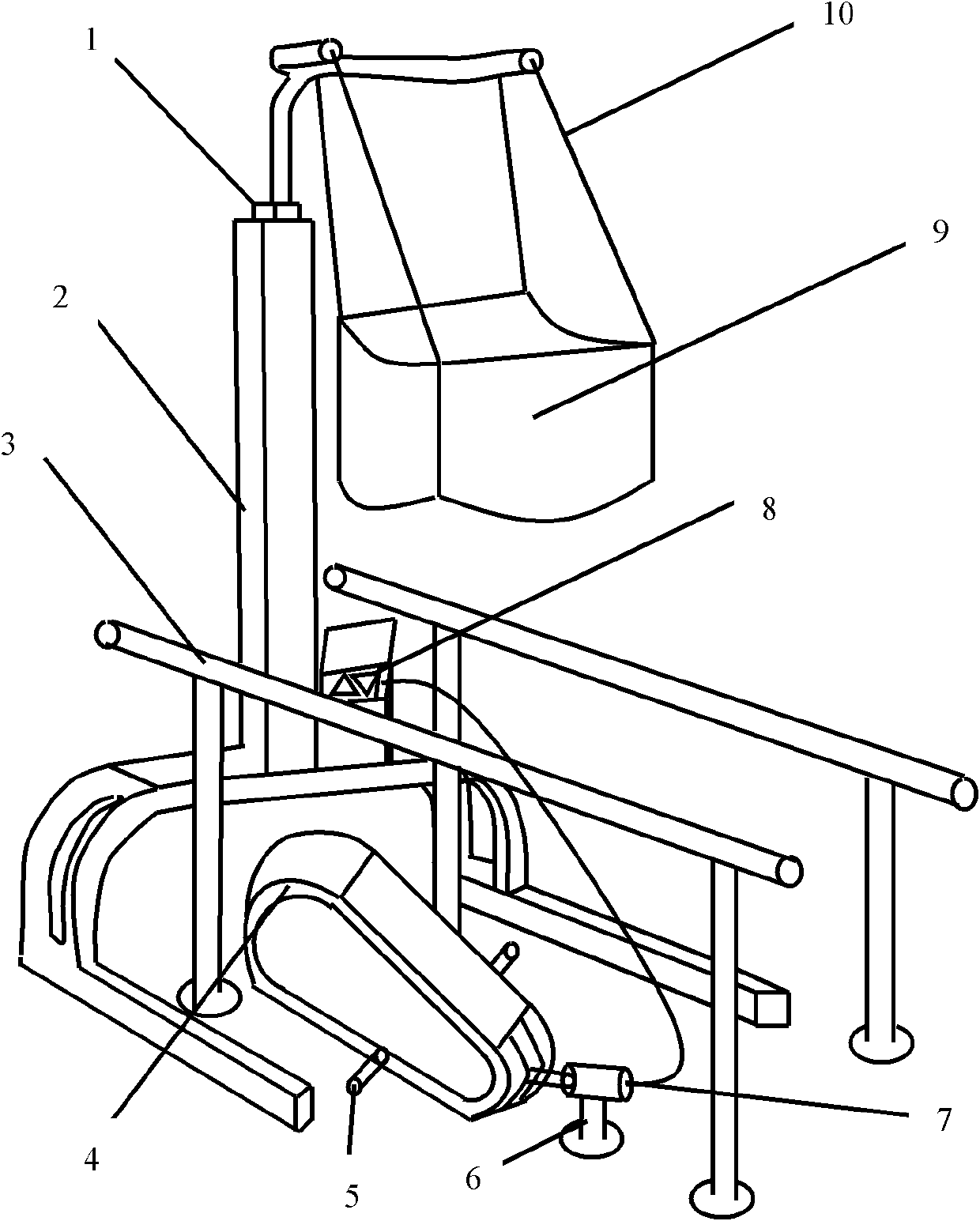
[0026] see figure 1 , the structural settings of the gait rehabilitation robot in this embodiment include:
[0027] A weight reducing device is that a push rod 1 driven by a lifting motor is set on the base 2, and the load-bearing vest 9 is suspended on the push rod 1 in the form of a cantilever through the sling 10; a guardrail 3 is arranged below the load-bearing vest 9, The guardrails 3 are located on both sides of the load-bearing vest 9 .
[0028] When the trainer performs rehabilitation training, the weight-reducing device constrains the trainer's body through the load-bearing vest 9 and the sling 10, and the patient is in a suspended state by controlling the lifting height of the push rod 1, so as to reduce the strength and maintenance of the trainer's walking. The body of the trainer is balanced; during rehabilitation training, the guardrail 3 on the one hand restricts the space for movement of the trainer, and on the other hand supports the trainer with both hands to...
PUM
 Login to View More
 Abstract
Description
Claims
Application Information
 Login to View More