
Image-recognition-technology-based shooting-speed-adjustable wireless capsule endoscope system and method
A technology for capsule endoscopy and image recognition, which is applied to endoscopy, in-vivo radio detectors, medical science, etc., can solve the problems of false detection and missed detection of photo information, so as to reduce missed detection and false detection and reduce the possibility of false detection. performance, improve accuracy
- Summary
- Abstract
- Description
- Claims
- Application Information
AI Technical Summary
Problems solved by technology
Method used
Image

Examples
Embodiment
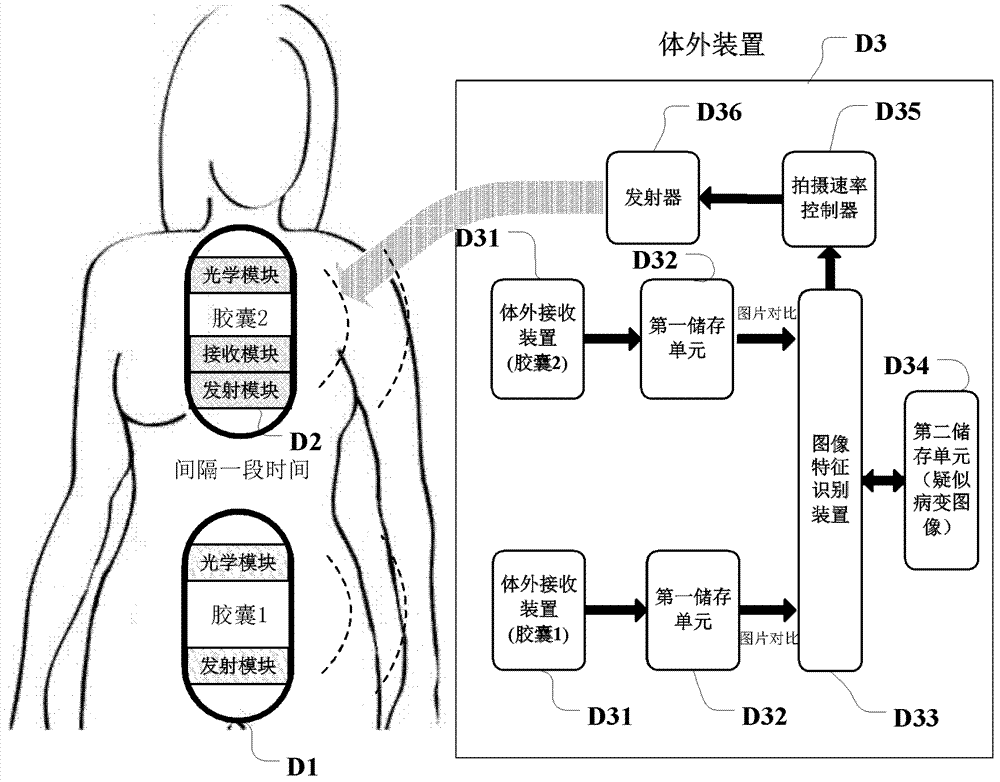
[0042] Such as figure 1 Shown is a wireless capsule endoscope system with adjustable shooting rate based on image recognition technology, including a wireless capsule endoscope and an extracorporeal device D3. The first wireless capsule endoscope D1 and the second wireless capsule endoscope D2 that adjusts its own shooting rate according to the reference image information captured by the first wireless capsule endoscope in vivo, the external device includes a wireless capsule endoscope for receiving An external receiving device D31 for the in-vivo captured images of the wireless capsule endoscope, a first storage unit D32 for storing the in-vivo captured images of the wireless capsule endoscope, and an image feature recognition device for performing image feature recognition on the stored in-vivo captured images of the wireless capsule endoscope The device D33, the second storage unit D34 for storing the in-vivo captured image of the wireless capsule endoscope as a suspected l...
PUM
 Login to View More
 Abstract
Description
Claims
Application Information
 Login to View More