
Vision care device
A vision and light source technology, applied in medical science, diagnostic signal processing, eye exercisers, etc., can solve problems such as treating the symptoms but not the root cause, incomplete vision training, unsightly eyes, etc., to improve refractive power and solve vision problems. Correction of problems, restoration or effects of refractive power
- Summary
- Abstract
- Description
- Claims
- Application Information
AI Technical Summary
Problems solved by technology
Method used
Image

Examples
Embodiment Construction
[0044] At first the principle of the present invention is described as follows:
[0045] After passing through a lens, parallel rays focus to a point, and the distance from the point to the center of the lens is the focal length.
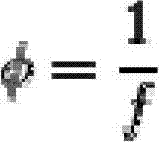
[0046] Diopter or focal power, expressed in English as "Dioptre", is a unit for measuring the refractive power of a lens. The length of the focal length f indicates the size of the refractive power. The shorter the focal length, the greater the refractive power. The reciprocal of the focal length is called the focal power of the lens, or diopter, with means, that is: φ = 1 f
[0047] Convex lenses (such as: long-sighted lenses) are positive (+), concave lenses (such as: near-sighted lenses) are negative (-).
[0048] The unit abbreviation of diopter is D, and the unit of International System of Units is m-1.
[0049] Generally, glasses often use degrees to express diopter, and th...
PUM
 Login to View More
 Abstract
Description
Claims
Application Information
 Login to View More