
Super-speed wireless local area network channel binding and allocation method based on channel quality
A wireless local area network and channel quality technology, which is applied in the field of ultra-high-speed wireless local area network channel binding and allocation based on channel quality, can solve the problems of wasting wireless resources, not considering QoS, and cannot guarantee the service quality of high-priority services, etc., to improve Effects of throughput, QoS guarantee, and good channel resources
- Summary
- Abstract
- Description
- Claims
- Application Information
AI Technical Summary
Problems solved by technology
Method used
Image

Examples
Embodiment 1
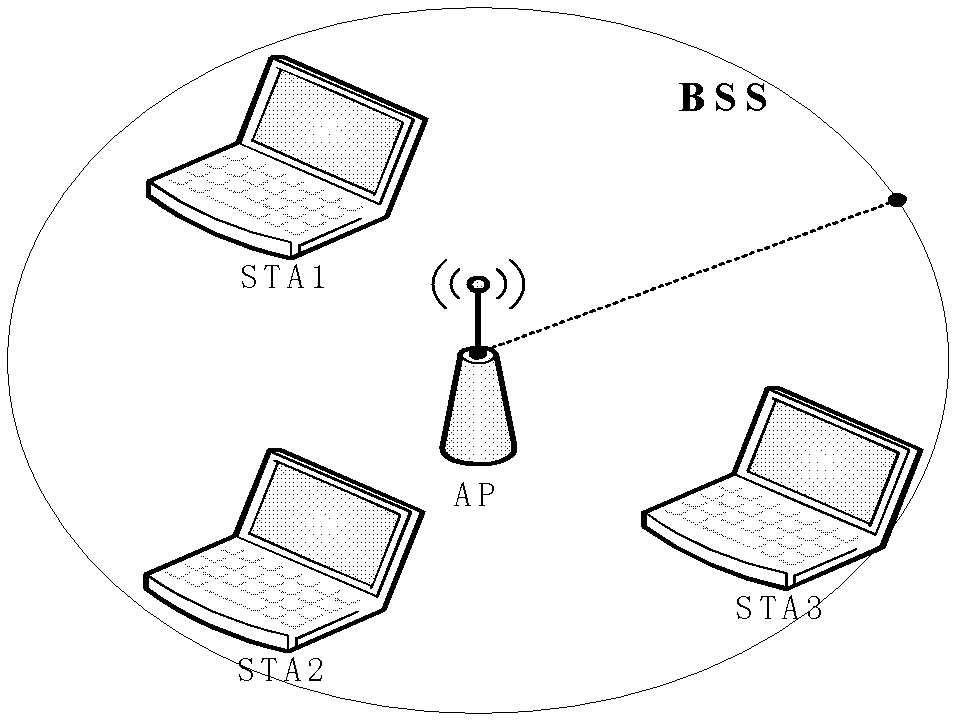
[0035] This embodiment provides a channel quality-based ultra-high-speed wireless local area network channel binding and allocation method, which is applied to an infrastructure wireless local area network (WLAN) with APs. The specific application scenarios are as follows: figure 1 As shown, each STA has the ability to support channel bonding and multiplex transmission.
[0036] figure 1 In , BSS represents a basic service set, and BSS is composed of a wireless access point AP and several wireless workstations STA connected to the AP, and the communication between STAs is controlled and coordinated by the AP. The basic function of the AP access point device: responsible for wireless communication management, such as: assigning the right to use wireless channels to wireless nodes; realizing the conversion between wireless communication and wired communication; playing a role similar to wired LAN bridges and routers.
[0037] In a WLAN with infrastructure, the AP acts as a CAS ...
Embodiment 2
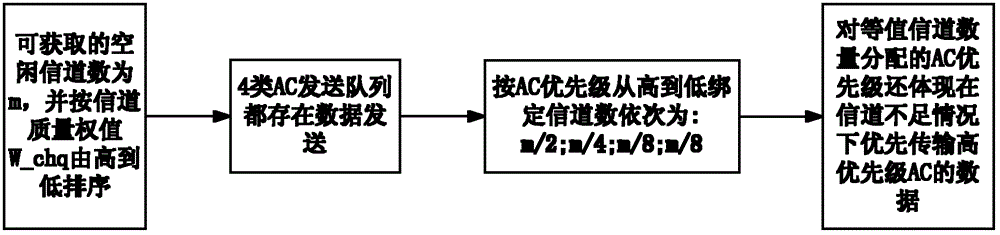
[0055] The difference between this embodiment and Embodiment 1 is that in step 5) of the channel quality-based ultra-high-speed wireless local area network channel binding and allocation method, only 3 of the four access categories have data (that is, only 3 A kind of AC send queue to send data), such as Figure 4 As shown, according to the channel quality weight priority from high to low, the first priority access category (AC) is allocated the first 1 / 2 of the total number of idle channels, and the second priority access category (AC) allocates the remaining channels. The first 1 / 2 number of free channels, and the last remaining free channels are given to the third priority access category (AC) in sequence. When the number of channels is small, the access category (AC) with high priority is given priority to transmission data in . Therefore, corresponding to different access categories (AC), the range of the number of idle channels that can be allocated is shown in Table 3....
Embodiment 3
[0059] The difference between this embodiment and Embodiment 1 is that in step 5) of the channel quality-based ultra-high-speed wireless local area network channel binding and allocation method, only 2 of the four access categories have data (that is, only 2 A kind of AC send queue to send data), such as Figure 5 As shown, according to the channel quality weight priority from high to low, the first priority access category (AC) is assigned the first 1 / 2 number of channels in the total idle channels, and the remaining idle channels are assigned to the second priority access category ( AC), when the number of channels is small, the data in the access category (AC) with high priority is transmitted preferentially. Therefore, corresponding to different access categories (AC), the range of the number of idle channels that can be allocated is shown in Table 4.
[0060] Table 4: The range of the number of channels where data can be obtained for the two access categories
[0061] ...
PUM
 Login to View More
 Abstract
Description
Claims
Application Information
 Login to View More