
Inversion method of nuclear magnetic resonance two-dimensional spectrum
A technology of nuclear magnetic resonance and two-dimensional spectrum, which is applied in the directions of magnetic resonance measurement, measurement using nuclear magnetic resonance image system, measurement of magnetic variables, etc., can solve the problem of slow evolution, achieve good robustness and improve resolution Effect
- Summary
- Abstract
- Description
- Claims
- Application Information
AI Technical Summary
Problems solved by technology
Method used
Image

Examples
Embodiment Construction
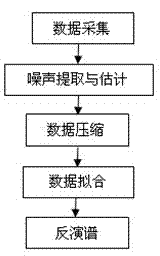
[0029] figure 1 It is the flow chart of the method for nuclear magnetic resonance two-dimensional spectrum inversion of the present invention, comprising steps: the first step, noise extraction and estimation: use wavelet transform to extract the noise in the acquisition data CPMG echo train and estimate its standard deviation; Step 1, data compression: generate an inversion kernel, and use the rank of the kernel matrix to perform truncated singular value decomposition and reconstruction to complete data compression; step 3, data fitting: regularize the fitting problem of the compressed data, And use Newton's method combined with non-exact one-dimensional search to iteratively solve the regularization factor and inversion spectrum to obtain the inversion spectrum.
[0030] 1. Noise extraction and estimation:
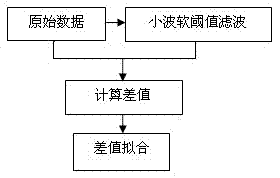
[0031] Such as figure 2 It is the algorithm flowchart of the noise extraction and estimation part. The wavelet transform is introduced in the noise extraction, and t...
PUM
 Login to View More
 Abstract
Description
Claims
Application Information
 Login to View More