
Method for breeding aphid-resistant sorghum
A sorghum and seed technology, applied in the agricultural field, can solve problems such as difficulty in breeding against aphid, and achieve the effects of good aphid resistance, resistance to aphid damage, and reduction in the use of pesticides
- Summary
- Abstract
- Description
- Claims
- Application Information
AI Technical Summary
Problems solved by technology
Method used
Image

Examples
Embodiment 1
[0034] Embodiment 1: Stone R49 breeding
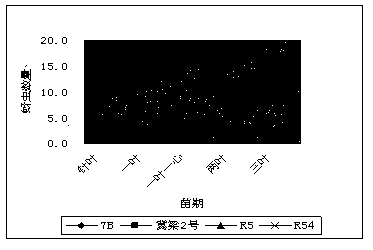
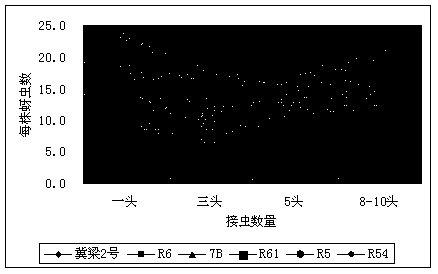
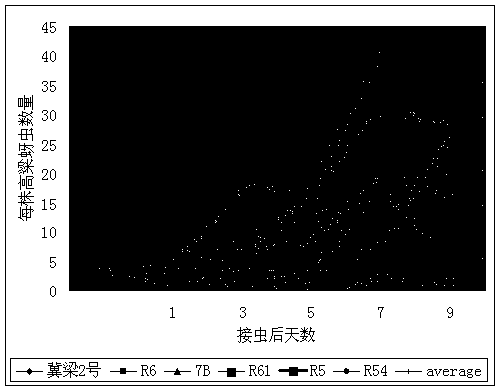
[0035] 130A and R47 were crossed to obtain F1 seeds: the obtained F1 seeds were planted in the field, and two generations of self-crossing were continuously planted to obtain F3 seeds, F2 aphid-resistant single plants were selected, and F3 seeds were harvested. Indoor identification of aphid resistance of the F3 generation: take the resistant single ear of the F3 generation as a unit, and take 100 seeds from each ear for resistance identification in a room with a temperature of 22-29°C and a relative humidity of 55-75%. The sorghum seeds are cultivated in the loam soil of the source field, the loam soil is packed in the nutrient hole of the nutrient tray, and the source is marked with a card. Aphids were bred 1 week in advance, and the number of bred aphids was more than 5 times the number of identified sorghum seedlings. At the 2-leaf stage, 3 aphids were artificially inoculated per plant. On the first day and the third day after in...
Embodiment 2
[0036] Embodiment 2: 98B breeding
[0037] 130B and 1041B were crossed to obtain F1 seeds: the obtained F1 seeds were planted in the field, and two generations of self-crossing were continuously planted to obtain F3 seeds, F2 aphid-resistant single plants were selected, and F3 seeds were harvested. Indoor identification of aphid resistance of the F3 generation: take the resistant single ear of the F3 generation as a unit, and take 100 seeds from each ear for resistance identification in a room with a temperature of 22-29°C and a relative humidity of 55-75%. The sorghum seeds are cultivated in the loam soil of the source field, the loam soil is packed in the nutrient hole of the nutrient tray, and the source is marked with a card. Aphids were bred 1 week in advance, and the number of bred aphids was more than 5 times the number of identified sorghum seedlings. At the 2-leaf stage, 3 aphids were artificially inoculated per plant. On the first day and the third day after inocul...
PUM
 Login to View More
 Abstract
Description
Claims
Application Information
 Login to View More