Method for performing cross-platform unified management on users of cluster storage system

A technology for cluster storage and system users, which is applied in the field of cross-platform unified management of cluster storage system users, can solve problems such as system management inconvenience, and achieve the effect of realizing unified management and simplifying the troubleshooting process

CN104754047AInactive Publication Date: 2015-07-01INSPUR GROUP CO LTD
2 Cites 8 Cited by

Patent Information

Authority / Receiving Office
CN · China
Current Assignee / Owner
Publication Date
2015-07-01
Estimated Expiration
Not applicable · inactive patent

Smart Images

  • Figure 1
    Figure 1
Patent Text Reader

Abstract

The invention specially relates to a method for performing cross-platform unified management on users of a cluster storage system. The method for performing the cross-platform unified management on the users of the cluster storage system includes: uniformly storing all the cluster storage users on an external AD (active directory) domain controller, and simultaneously using SAMBA software to add cluster storage nodes in a Windows AD domain, wherein a storage node SAMBA server is used as a member of the Windows AD domain, and an AD domain controller node provides SAMBA user unified management services to the cluster storage system. According to the method for performing the cross-platform unified management on the users of the cluster storage system, all user management operations are completed through the AD domain controller, unified authentication of the cross-platform users, Windows users and Linux users is achieved, and simultaneously user information is stored on an AD domain service node except the nodes of the cluster storage system, influences of breakdowns of the cluster storage nodes on user access are further avoided, and furthermore not only is the unified management of the cross-platform users achieved, but also an elimination process of system breakdowns is greatly simplified.
Need to check novelty before this filing date? Find Prior Art

Description

technical field

[0001] The invention relates to the technical field of computer and network information storage, in particular to a method for unified cross-platform management of cluster storage system users. Background technique

[0002] Cluster technology is a relatively new technology, through cluster technology, relatively high benefits in terms of performance, reliability, and flexibility can be obtained at a lower cost.

[0003] A cluster is a group of independent computers interconnected by a high-speed network that form a group and are managed as a single system. When a client interacts with the cluster, the cluster behaves like a stand-alone server. Cluster configurations are used to improve availability and scalability.

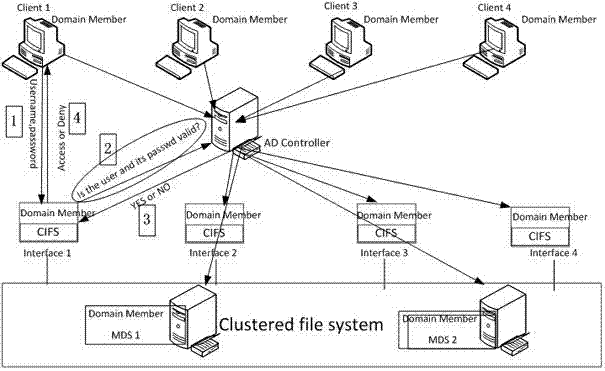
[0004] The purpose of adopting cluster technology includes the following points:

[0005] 1 Improve performance

[0006] Some computing-intensive applications, such as: weather forecast, nuclear test simulation, etc., require computers to hav...

Examples

Embodiment Construction

[0023] The present invention will be described in detail below in conjunction with the accompanying drawings.

[0024] The cross-platform unified management method of cluster storage system users stores all cluster storage users in an external AD domain controller, and uses SAMBA software to add cluster storage nodes to the Windows AD domain, and the storage node SAMBA server is a member of the AD domain , the AD domain controller node provides unified management services for SAMBA users for the cluster system.

[0025] The SAMBA software connects the cluster storage nodes one by one to the service process of the AD domain controller, so that all AD domain users can access the SAMBA service.

[0026] The AD domain controller can realize unified authentication of client users on Windows platform and Linux platform.

[0027] as attached figure 1 As shown, the number of conversion nodes is 4, which can be expanded according to the system deployment situation. The following desc...