A Modeling Method for Numerical Simulation of Heat Source Model of Tandem Double Wire Submerged Arc Welding

A technology of heat source model and numerical simulation, applied in the direction of electrical digital data processing, special data processing applications, instruments, etc., can solve the problem that the shape of the fusion line cannot be effectively controlled, and achieve the effect of strong controllability and simple construction form

CN106529047BActive Publication Date: 2019-07-16HOHAI UNIV CHANGZHOU
8 Cites 0 Cited by

Patent Information

Authority / Receiving Office
CN · China
Patent Type
Patents(China)
Current Assignee / Owner
Publication Date
2019-07-16

Smart Images

  • Figure 1
    Figure 1
  • Figure 2
    Figure 2
  • Figure 3
    Figure 3
Patent Text Reader

Abstract

The invention discloses a modeling method for a serial double-wire submerged arc welding numerical simulation heat source model. The method comprises the steps that first, attenuation functions in the depth direction are added into double-ellipsoid heat source models, and the two double-ellipsoid heat source models are used for building a double-wire model, wherein the attenuation functions include a linear function, an exponential function and a quadratic function; second, parameters of the double-ellipsoid heat source models adopting different attenuation functions are subjected to finite element inversion to obtain corresponding simulated pool shapes; third, the goodness of fit between the simulated pool shapes and the actual pool shape serves as the standard for selecting the attenuation functions to obtain the optimal serial double-wire submerged arc welding numerical simulation heat source model. The attenuation functions in the depth direction are added into the double-ellipsoid heat source models, therefore, the heat source model can be well matched with an actual heat source in respects of welding depth and welding width, and the shape of a fusion line can be effectively controlled to some extent.
Need to check novelty before this filing date? Find Prior Art

Description

technical field

[0001] The invention belongs to the technical field of numerical simulation heat source models for welding, and in particular relates to a modeling method for numerical simulation heat source models of tandem twin-wire submerged arc welding. Background technique

[0002] As a high-efficiency welding method, submerged arc welding has greatly improved the production efficiency of welded components. Submerged arc welding can be divided into single-wire submerged arc welding and multi-wire submerged arc welding according to the number of welding wires. Compared with single-wire submerged arc welding, the double-wire submerged arc welding method has the following characteristics. The welding speed can be increased by 30% to 40%, the welding quality is good, the welding wire deposition rate and the current utilization rate are higher. It mainly includes multi-power tandem twin-wire submerged arc welding, single-power parallel twin-wire submerged arc welding, singl...

Examples

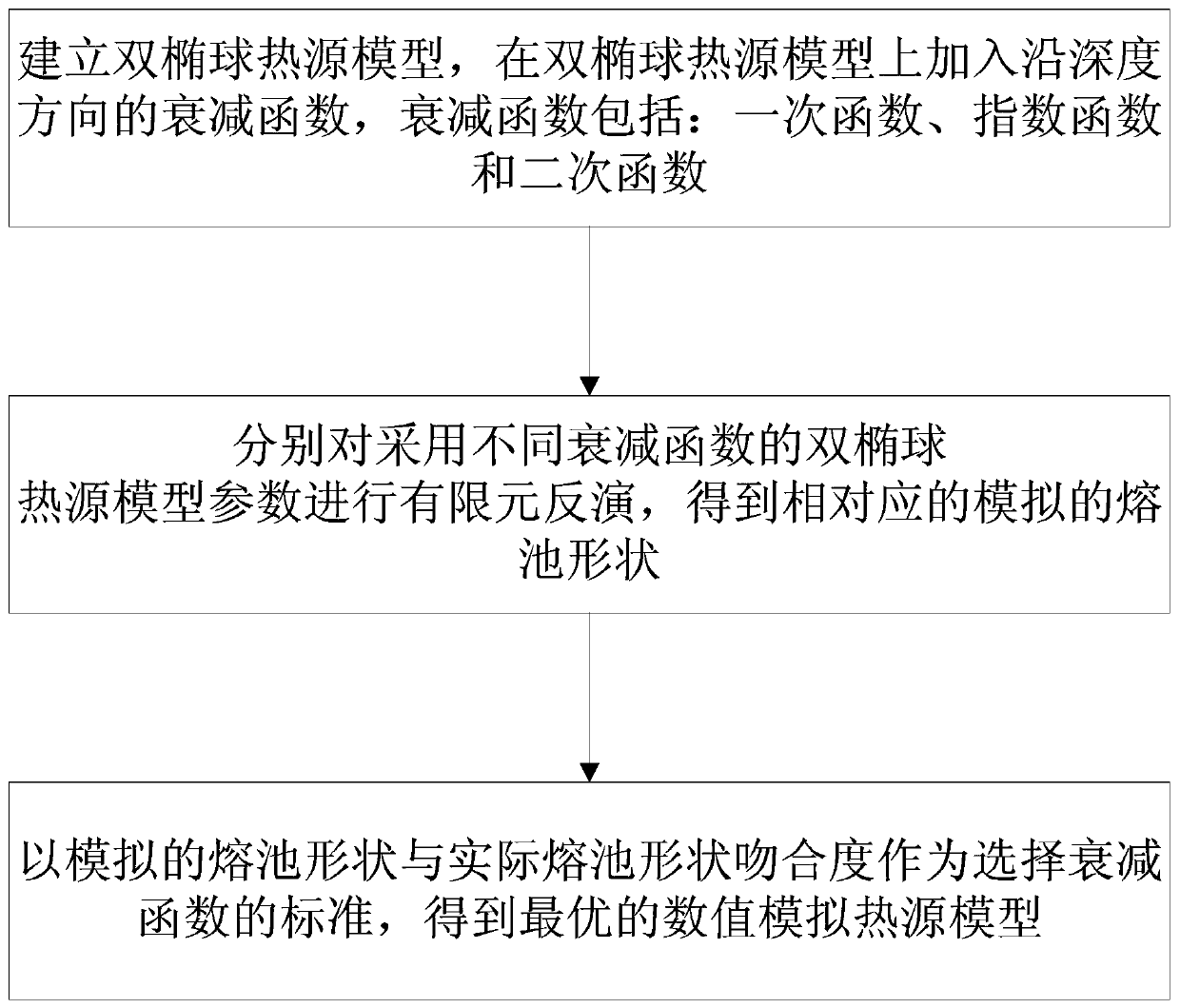
Embodiment Construction

[0027] The present invention will be further described below in conjunction with the accompanying drawings. The following examples are only used to illustrate the technical solution of the present invention more clearly, but not to limit the protection scope of the present invention.

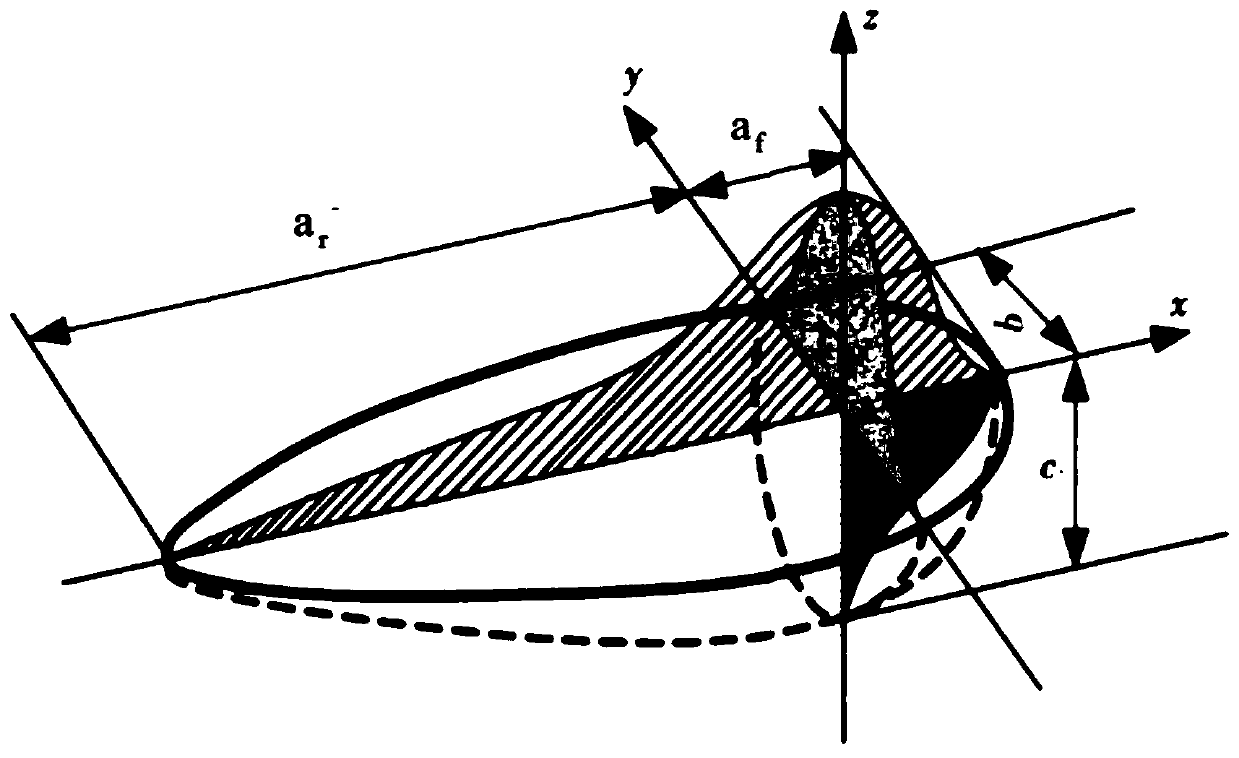
[0028] Such as figure 1 As shown, a kind of modeling method of tandem twin-wire submerged arc welding numerical simulation heat source model of the present invention comprises the following steps:

[0029] Step 1: Add the attenuation function along the depth direction to the double ellipsoid heat source model, and establish a double filament model with two such double ellipsoid heat source models.

[0030] In the prior art, the double ellipsoidal heat source model such as figure 2 As shown, the double ellipsoidal heat source model sets the first half of the welding pool as a 1 / 4 ellipsoid, and the second half as another 1 / 4 ellipsoid, and the heat flux is normally distributed in a Gaussian fu...