
Quick cultivation method of Rosa multiflora thunb.var.cathayensis
A method for cultivating roses and a technology for roses, which are applied in the field of agriculture and forestry cultivation, can solve problems such as difficulties in large-scale seedling raising and production of powdered roses, and achieve the effects of convenient purchase, convenient source and high degree of marketization.
- Summary
- Abstract
- Description
- Claims
- Application Information
AI Technical Summary
Problems solved by technology
Method used
Image

Examples
Embodiment 1
[0029] 1. Materials and methods
[0030] (1) Experimental design
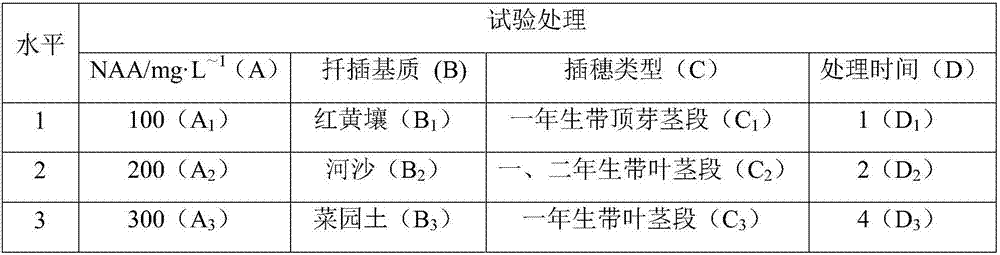
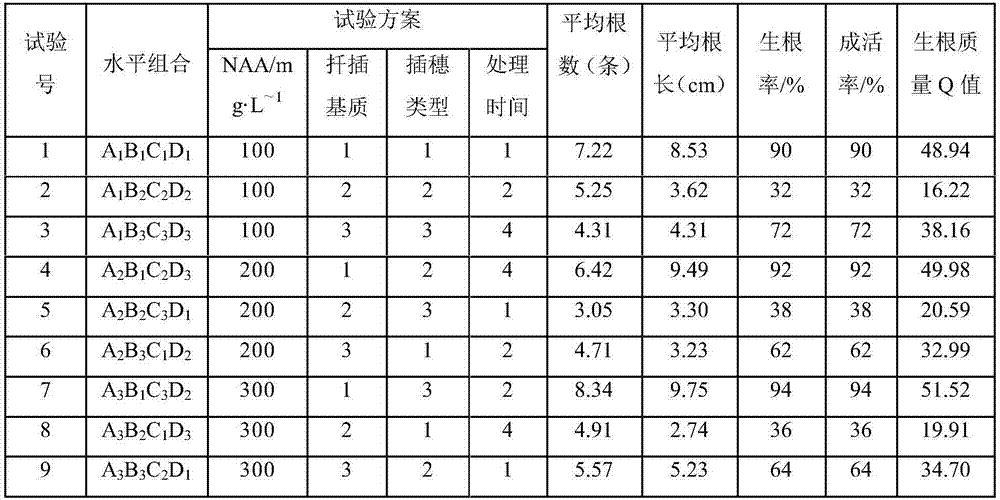
[0031] The inventive method adopts the L of four factors three levels 9 (3 4 ) Orthogonal experiment design scheme, that is, four main factors that affect the rooting quality of rose cuttings in powder group are used as experimental factors: A (NAA concentration), B (cutting substrate), C (cutting type), D (treatment time). The levels of each factor are: A 1 100mg·L ~1 , A 2 200mg·L ~1 , A 3 300mg·L ~1 ;B 1 For red yellow soil, B 2 For river sand, B 3 For vegetable garden soil; C 1 For the stem segment with terminal bud, C 2 It is a stem segment of one or two years, C 3 It is an annual leafy stem segment; D 1 for 1h, D 2 for 2h, D 3 for 4h.
[0032] Table 1L 9 (3 4 ) Orthogonal test
[0033]
[0034] (2) Experiment time: May 12, 2014.
[0035] (3) Experimental location: Nursery base of Shaoyang University.
[0036] (4) Experimental materials
Embodiment 2
[0056] Experiment time: May 10, 2015.
[0057] Experimental location: Nursery base of Shaoyang College.
[0058] experiment procedure
[0059] (1) Preparation of cuttings: Collect annual semi-lignified branches from robust growth, no damage, no pests and diseases of Rosa rosea plants, with a diameter of not less than 1 cm. Cut 12-15cm annual stem cuttings with leaves, keep 2-3 nodes, keep 1-2 axillary buds and half or a small leaf on the buds on the cuttings, cut the upper incision about 1cm away from the buds on the cuttings, and cut it into an obtuse angle , The lower incision is about 1-1.5cm away from the lower part of the lower bud of the cuttings and cut into an acute angled slope. Before cutting, soak both ends of the cuttings with 600-800 times carbendazim dilution solution. After 5-10 minutes, wash 2-3 times with clean water to remove the residual carbendazim on the cuttings, and then use rooting powder solution to clean the cuttings. to process.
[0060] (2) Seed...
PUM
| Property | Measurement | Unit |
|---|---|---|
| diameter | aaaaa | aaaaa |
Abstract
Description
Claims
Application Information
 Login to View More