
Graphene Oxide In-situ Growth Method to Prepare Hollow Structure Nano Tungsten Oxide Wire Preparation Method
A nano-tungsten oxide and in-situ growth technology, applied in the field of nano-materials, can solve the problems of high energy consumption and high conditions, achieve high purity, simple process, and improve the uniformity of nanoscale
- Summary
- Abstract
- Description
- Claims
- Application Information
AI Technical Summary
Problems solved by technology
Method used
Image

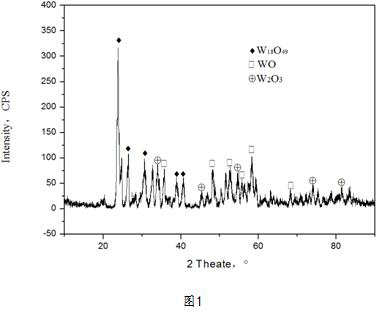
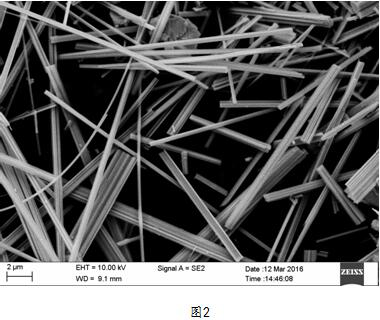
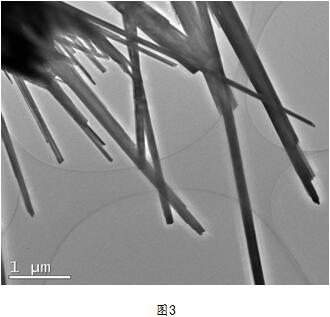
Examples
Embodiment 1
[0027] The invention provides a method for preparing hollow structure nano-tungsten oxide wires by in-situ growth method of graphene oxide, which comprises the steps of: adding a certain amount of graphite powder to the mixture of concentrated H2SO4 (12mL), K2S2O8 (2.5g) and P2O5 (2.5g) ) in a solution composed of 80°C for 4.5 hours. After cooling to room temperature, 0.5 L of deionized water was added. and dry at room temperature. Add this pre-oxidized graphite powder to 150mL of concentrated H2SO4, keep the environment at 0°C with an ice-water bath, gradually add 15g KMnO4, and keep the temperature not exceeding 20°C, and stir at 35°C for 2 hours after the addition. Then 250 mL of deionized water was added and stirred for 2 hours. Then add 0.7 L of deionized water, then add 30 mL of 30% H2O2, dry at room temperature, and then dialyze in a dialysis bag for 1 week to remove heteroions. Finally, it was vacuum filtered and dried at room temperature to obtain graphene oxide. ...
Embodiment 2
[0033] On the basis of the above examples, the steps of this example are as follows: add a certain amount of graphite powder to a solution composed of concentrated H2SO4 (12mL), K2S2O8 (2.5g) and P2O5 (2.5g), and react at 80°C for 4.5 Hour. After cooling to room temperature, 0.5 L of deionized water was added. and dry at room temperature. Add this pre-oxidized graphite powder to 150mL of concentrated H2SO4, keep the environment at 0°C with an ice-water bath, gradually add 15g KMnO4, and keep the temperature not exceeding 20°C, and stir at 35°C for 2 hours after the addition. Then 250 mL of deionized water was added and stirred for 2 hours. Then add 0.7 L of deionized water, then add 30 mL of 30% H2O2, dry at room temperature, and then dialyze in a dialysis bag for 1 week to remove heteroions. Finally, it was vacuum filtered and dried at room temperature to obtain graphene oxide.
[0034] Weigh 2g of graphene oxide, add 1000g of absolute ethanol, stir and mix evenly, add 60...
Embodiment 3
[0036] On the basis of the above examples, the steps of this example are as follows: add a certain amount of graphite powder to a solution composed of concentrated H2SO4 (12mL), K2S2O8 (2.5g) and P2O5 (2.5g), and react at 80°C for 4.5 Hour. After cooling to room temperature, 0.5 L of deionized water was added. and dry at room temperature. Add this pre-oxidized graphite powder to 150mL of concentrated H2SO4, keep the environment at 0°C with an ice-water bath, gradually add 15g KMnO4, and keep the temperature not exceeding 20°C, and stir at 35°C for 2 hours after the addition. Then 250 mL of deionized water was added and stirred for 2 hours. Then add 0.7 L of deionized water, then add 30 mL of 30% H2O2, dry at room temperature, and then dialyze in a dialysis bag for 1 week to remove heteroions. Finally, it was vacuum filtered and dried at room temperature to obtain graphene oxide.
[0037] Weigh 3g of graphene oxide, add 1000g of absolute ethanol, stir and mix evenly, add 70...
PUM
 Login to View More
 Abstract
Description
Claims
Application Information
 Login to View More