

Large-scale multi-user MIMO iterative detection method applicable to low precision quantification
It is an iterative detection and large-scale technology, which is applied in diversity/multi-antenna systems, space transmit diversity, radio transmission systems, etc., and can solve problems such as the absence of detector soft quantity extraction methods, unsatisfactory detector performance, and low complexity. question
- Summary
- Abstract
- Description
- Claims
- Application Information
AI Technical Summary
Problems solved by technology
Method used
Image

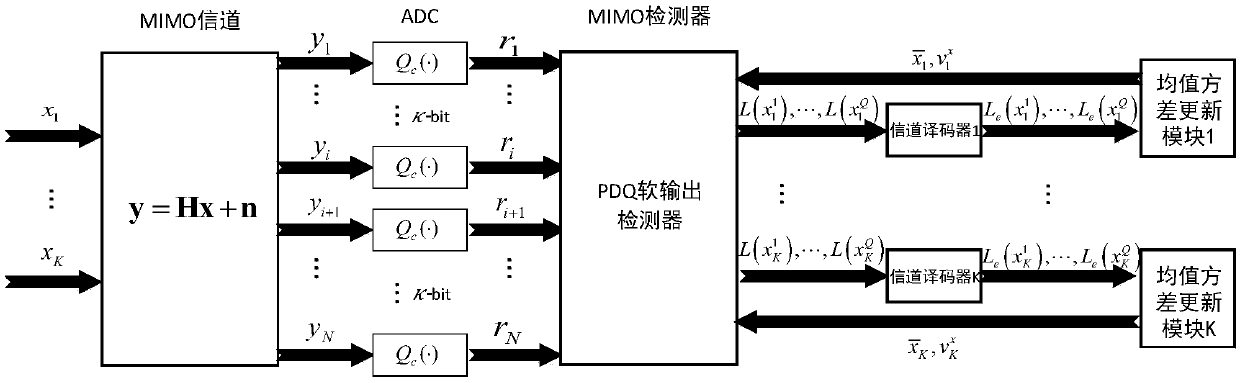


Examples
Embodiment 1
[0062] Embodiment 1: A massive multi-user MIMO iterative detection method suitable for low-precision quantization, the method includes the following steps:
[0063] S1, receiving signal quantization processing;
[0064] This step specifically includes:
[0065] S11. For a massive multi-user MIMO system (N≥K) with K single-antenna users and N antennas installed on the base station side, set its uplink channel model to y=Hx+n, where y=[ the y i ]∈C N×1 Indicates the received signal, x=[x j ]∈C K×1 Indicates the transmitted signal with the average transmitted power of the components being 1, x j Modulation constellation point set Ω used for user j j Points on, n∈[n i ]∈C N×1 Represents additive white Gaussian noise (AWGN), and the noise variances corresponding to its components are H=[h ij ]∈C N×K Indicates the channel matrix between the base station and K users, specifically, h ij Indicates the channel gain from the j-th user at the transmitting end to the i-th rece...
PUM
 Login to View More
 Abstract
Description
Claims
Application Information
 Login to View More