
Method and apparatus for micro-expression recognition based on hybrid spatio-temporal convolution model
A convolution model and recognition method technology, applied in character and pattern recognition, acquisition/recognition of facial features, instruments, etc., can solve problems such as difficulty in landing, slow calculation efficiency, high requirements, etc., to reduce computational complexity and benefit Effect of productization, reduced requirements
- Summary
- Abstract
- Description
- Claims
- Application Information
AI Technical Summary
Problems solved by technology
Method used
Image

Examples
Embodiment 1
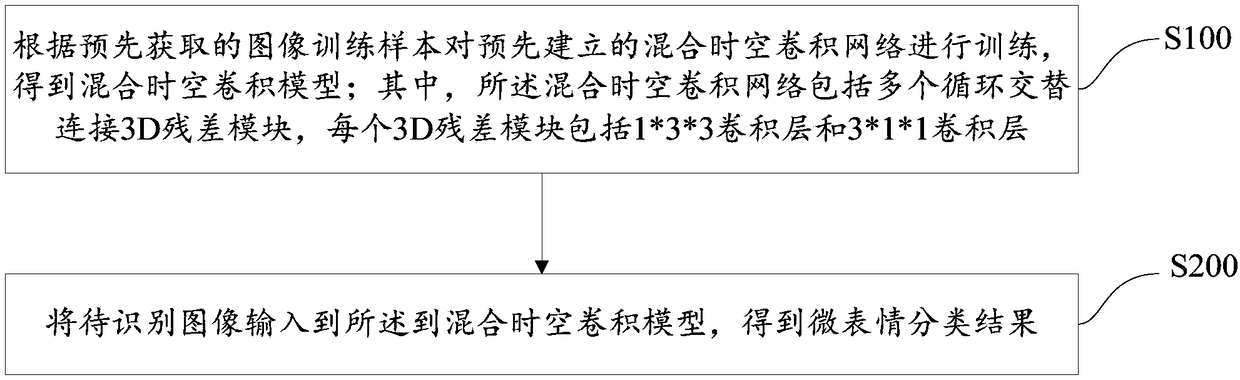
[0052] see figure 1 , which is a schematic flowchart of a micro-expression recognition method based on a hybrid spatio-temporal convolution model provided by an embodiment of the present invention. The methods include:
[0053] S100: Train the pre-established hybrid spatio-temporal convolution network according to the pre-acquired image training samples to obtain a hybrid spatio-temporal convolution model; wherein, the hybrid spatio-temporal convolution network includes a plurality of cyclic alternately connected 3D residual modules, each The 3D residual modules each include a 1*3*3 convolutional layer and a 3*1*1 convolutional layer;
[0054] S200: Input the image to be recognized into the hybrid spatiotemporal convolution model to obtain a micro-expression classification result.
[0055] In step S100, a hybrid spatio-temporal convolution model consisting of a plurality of alternately connected 3D residual modules including 1*3*3 convolutional layers and 3*1*1 convolutional...
Embodiment 2
[0133] see Figure 5, which is a schematic block diagram of a micro-expression recognition device based on a hybrid spatio-temporal convolution model provided by an embodiment of the present invention, the device includes:
[0134] The model construction module 1 is used to train the pre-established hybrid spatiotemporal convolutional network according to pre-acquired image training samples to obtain a hybrid spatiotemporal convolutional model; Difference module, each 3D residual module includes 1*3*3 convolutional layer and 3*1*1 convolutional layer;
[0135] The micro-expression recognition module 2 is configured to input the image to be recognized into the mixed spatio-temporal convolution model to obtain a micro-expression classification result.
[0136] In an optional embodiment, the model building module 1 includes:
[0137] The data classification unit is used to classify the pre-collected expression image data according to several predefined micro-expressions;
[01...
PUM
 Login to View More
 Abstract
Description
Claims
Application Information
 Login to View More