A method for predicting the occurrence of pecan trunk rot based on a discriminant analysis method

A discriminant analysis method, a pecan tree technology, applied in the field of plant disease control, can solve the problems that disease prediction is rarely involved, etc.

CN109685262AActive Publication Date: 2019-04-26杭州市林业科学研究院
10 Cites 1 Cited by

Patent Information

Authority / Receiving Office
CN · China
Current Assignee / Owner
Publication Date
2019-04-26

Smart Images

  • Figure 1
    Figure 1
Patent Text Reader

Abstract

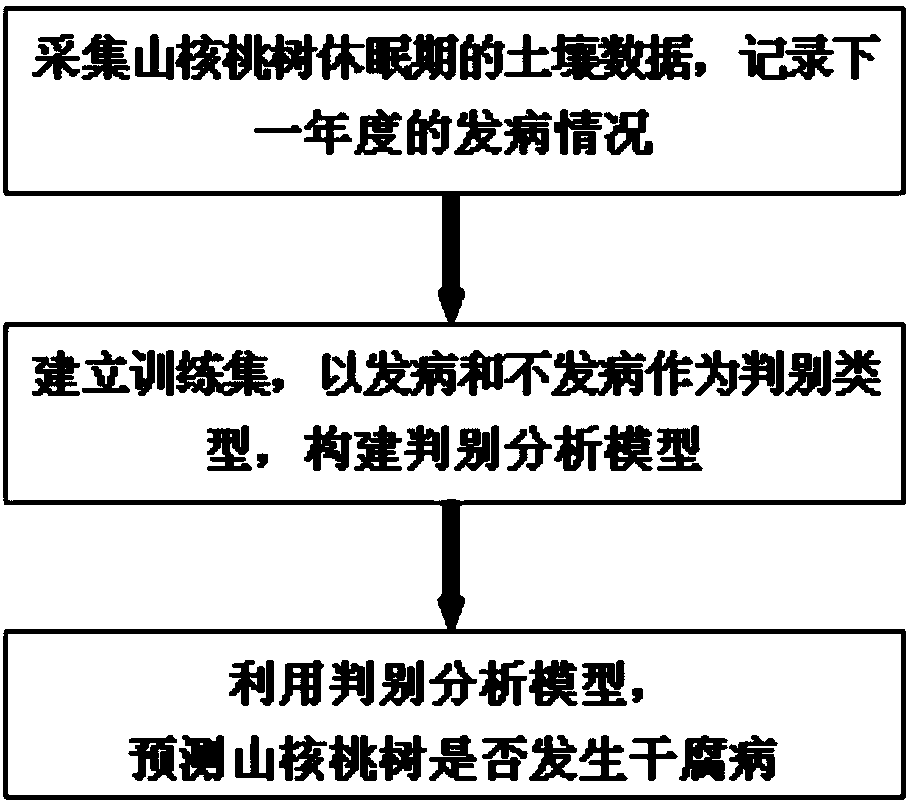
The invention discloses a method for predicting occurrence of pecan trunk rot based on a discriminant analysis method, which comprises the following steps: selecting a pecan tree sample, collecting the soil sample, and acquiring the pH value of the soil in the dormant period and the ratio of the alkaline hydrolysis nitrogen content to the quick-acting potassium content; Recording the morbidity ofthe dry rot in the next year; Establishing a discriminant analysis model by taking morbidity and non-morbidity as discriminant types, soil data as a training set and the ratio of the pH value to the alkaline hydrolysis nitrogen content to the quick-acting potassium content as model parameters; Collecting the pH of the soil of the to-be-predicted walnut tree and the data of the ratio of the alkaline hydrolysis nitrogen content to the quick-acting potassium content, importing the data into the model, and predicting whether the walnut tree suffers from the dry rot or not in the next year. The method depends on a discriminant analysis method to find index parameters which have relatively large correlation with the pecan trunk rot, namely the ratio of the pH value to the alkaline hydrolysis nitrogen content to the quick-acting potassium content, and a prediction model is obtained by utilizing the two parameters, so that the prediction accuracy rate reaches more than 80%.
Need to check novelty before this filing date? Find Prior Art

Description

technical field

[0001] The invention relates to the technical field of plant disease prevention and control, in particular to a method for predicting the occurrence of hickory tree trunk rot based on a discriminant analysis method. Background technique

[0002] Hickory nut (Carya cathayensis) is a unique woody oil tree species in my country. Its fruit tastes crisp and nutritious, and can be processed into snack food and edible oil, with high economic value. Hickory is a deciduous tree species, the annual growth period is from March to November, and the dormancy period is from December to February of the next year.

[0003] In recent years, pecan dry rot has occurred in a large area, which has caused huge economic losses to farmers and has also brought a serious threat to the pecan industry. Dry rot, also known as canker, is caused by the infection of tree trunks by Botryosphaeria spp. fungi; , the lesion area expands, and eventually the hickory plant dies. The annual onse...

Examples

Embodiment 1

[0038] A method based on discriminant analysis to predict the occurrence of hickory tree trunk rot, the concrete steps are as follows:

[0039] 1. Collection of data information: select the hickory tree sample used to construct the discriminant analysis model, collect the soil sample of the hickory tree in the dormant period, and obtain 15 index data information such as pH of the soil, alkaline nitrogen content; according to the following The incidence of hickory tree trunk rot in one year, the data information is divided into two types of incidence and no incidence;

[0040] (1) In December 2016, after pecans entered the dormant period, 100 pecans were selected as samples for constructing a discriminant analysis model; 42 of them were pecans cultivated on red loam, and 36 22 are hickory trees grown on limestone soil.

[0041] On the ground within the crown width of each hickory single plant, randomly select 5 sampling points, collect the soil samples of the 0-20cm soil layer...