
MSI prediction model construction method based on immune-related genes
An immune-related and predictive model technology, applied in the field of bioinformatics, can solve the problems of poor clinical performance, high cost, cumbersome operation, etc., and achieve the effect of good prognosis risk and prediction of prognosis risk
- Summary
- Abstract
- Description
- Claims
- Application Information
AI Technical Summary
Problems solved by technology
Method used
Image

Examples
Embodiment
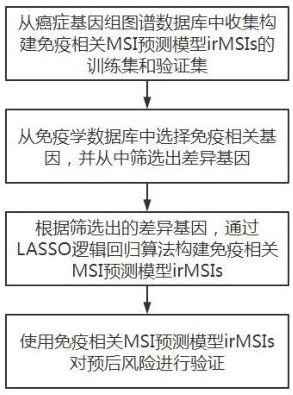
[0041] The present invention is realized through the following technical solutions, see figure 1 A method for constructing an MSI prediction model based on immune-related genes, comprising the following steps:
[0042] Step S1: Collect the training set and validation set for constructing the immune-related MSI prediction model irMSIs from the Cancer Genome Atlas database.
[0043] Download four cancer cohorts from the Cancer Genome Atlas database TCGA (hereinafter referred to as TCGA), including colon cancer COAD (n=551), rectal cancer READ (n=177), gastric cancer STAD (n=407) , mRNA expression profile and clinical information of esophageal carcinoma ESCA (n=173). The colon cancer COAD cohort was used as the training set for the screening of differential genes and the immune-related MSI prediction model irMSIs, and the other cohorts were used as the validation set for the immune-related MSI prediction model irMSIs.
[0044] Convert the fragments per kilobase per million (FKP...
PUM
 Login to View More
 Abstract
Description
Claims
Application Information
 Login to View More