
Millimeter wave super-regeneration receiver with high data rate
A super-regenerative receiver and high data rate technology, applied in electrical components, transmission systems, etc., can solve the problems of damping oscillation residue, difficulty in achieving phase restoration, and affecting demodulation, etc., to amplify the dynamic range of the signal and suppress the problem of residue , the effect of preventing spectrum leakage
- Summary
- Abstract
- Description
- Claims
- Application Information
AI Technical Summary
Problems solved by technology
Method used
Image

Examples
Embodiment Construction
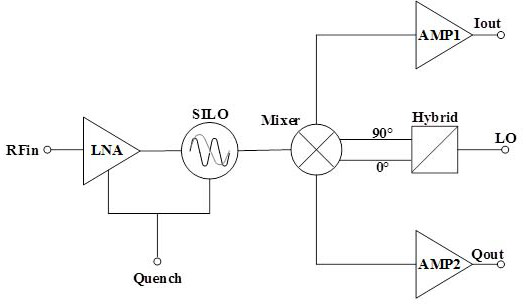
[0098] Such as figure 2 As shown, a high data rate millimeter-wave super-regenerative receiver of the present invention includes a low-noise amplifier LNA, a super-regenerative oscillator SILO, an IQ dual-way mixer Mixer, a first intermediate frequency amplifier AMP1, and a second intermediate frequency amplifier AMP2 and Quadrature Coupler Hybrid.
[0099] The radio frequency input signal RFin is connected to the signal input terminal of the low noise amplifier LNA. The two-phase output terminals of the low noise amplifier LNA are respectively connected to the two-phase input terminals of the super regenerative oscillator SILO. The quadrature coupler Hybrid couples the local oscillator input signal LO to generate mutually orthogonal IQ local oscillator signals. The IQ two-way mixer Mixer mixes the signal output by the super-regenerative oscillator SILO and the IQ local oscillator signal output by the quadrature coupler Hybrid to obtain an I-channel intermediate frequency s...
PUM
 Login to View More
 Abstract
Description
Claims
Application Information
 Login to View More