Methods for Alzheimer's Disease treatment and cognitive enhancement

a technology of alzheimer's disease and treatment methods, applied in the direction of antinoxious agents, drug compositions, metabolic disorders, etc., can solve the problems of not addressing the progression of the disease, ineffective clinical use and other types of cognition disorders, and improving symptomatic and transient cognition

a technology of alzheimer's disease and treatment methods, applied in the direction of antinoxious agents, drug compositions, metabolic disorders, etc., can solve the problems of not addressing the progression of the disease, ineffective clinical use and other types of cognition disorders, and improving symptomatic and transient cognition

US20050037984A1Inactive Publication Date: 2005-02-17ETCHEBERRIGARAY RENE +1

Image

Smart Image Click on the blue labels to locate them in the text.
Viewing Examples
Smart Image
  • Methods for Alzheimer's Disease treatment and cognitive enhancement
  • Methods for Alzheimer's Disease treatment and cognitive enhancement
  • Methods for Alzheimer's Disease treatment and cognitive enhancement

Examples

Experimental program
Comparison scheme
Effect test

example i

[0085] Materials And Methods

[0086] Cell Culture

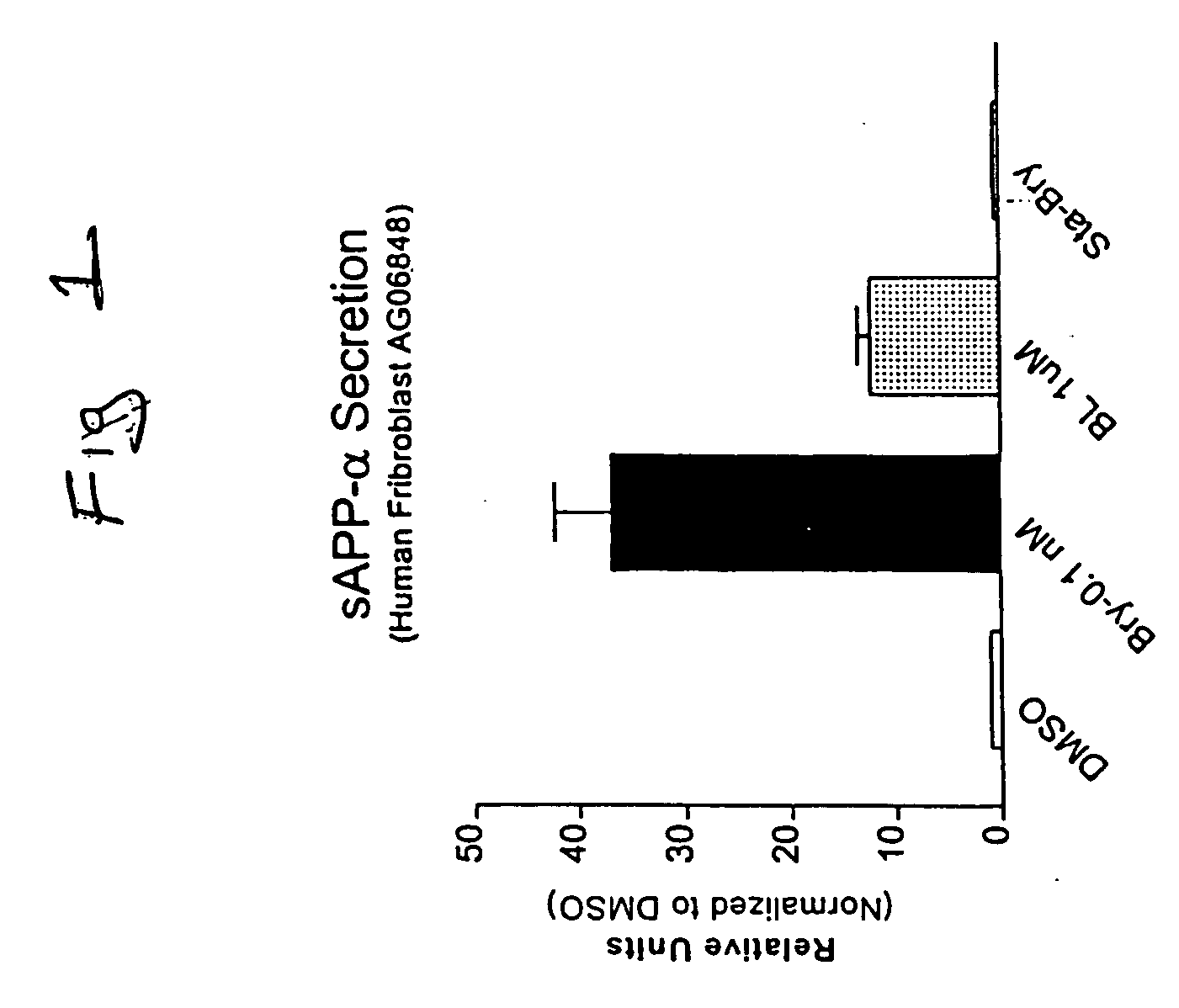
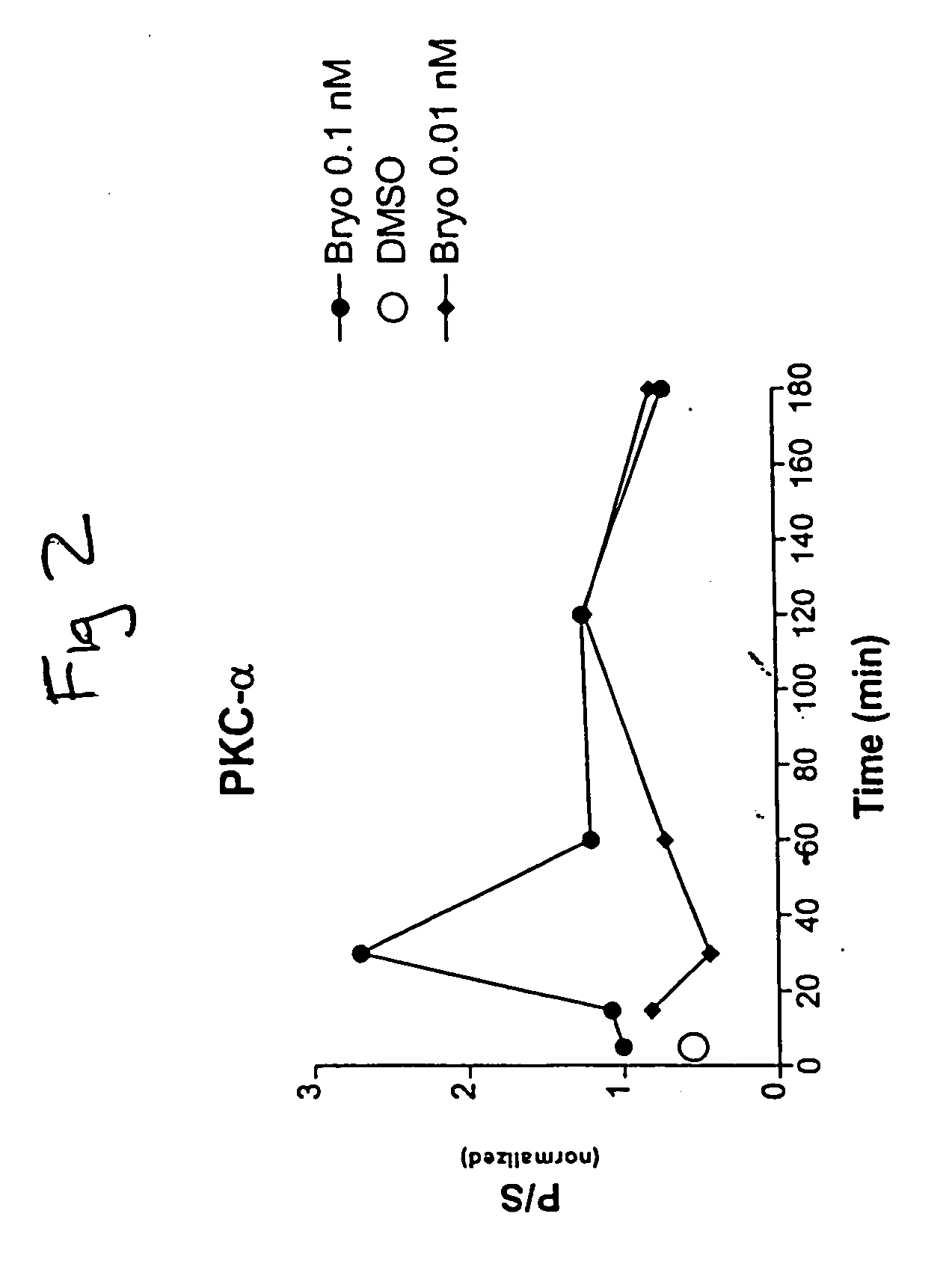
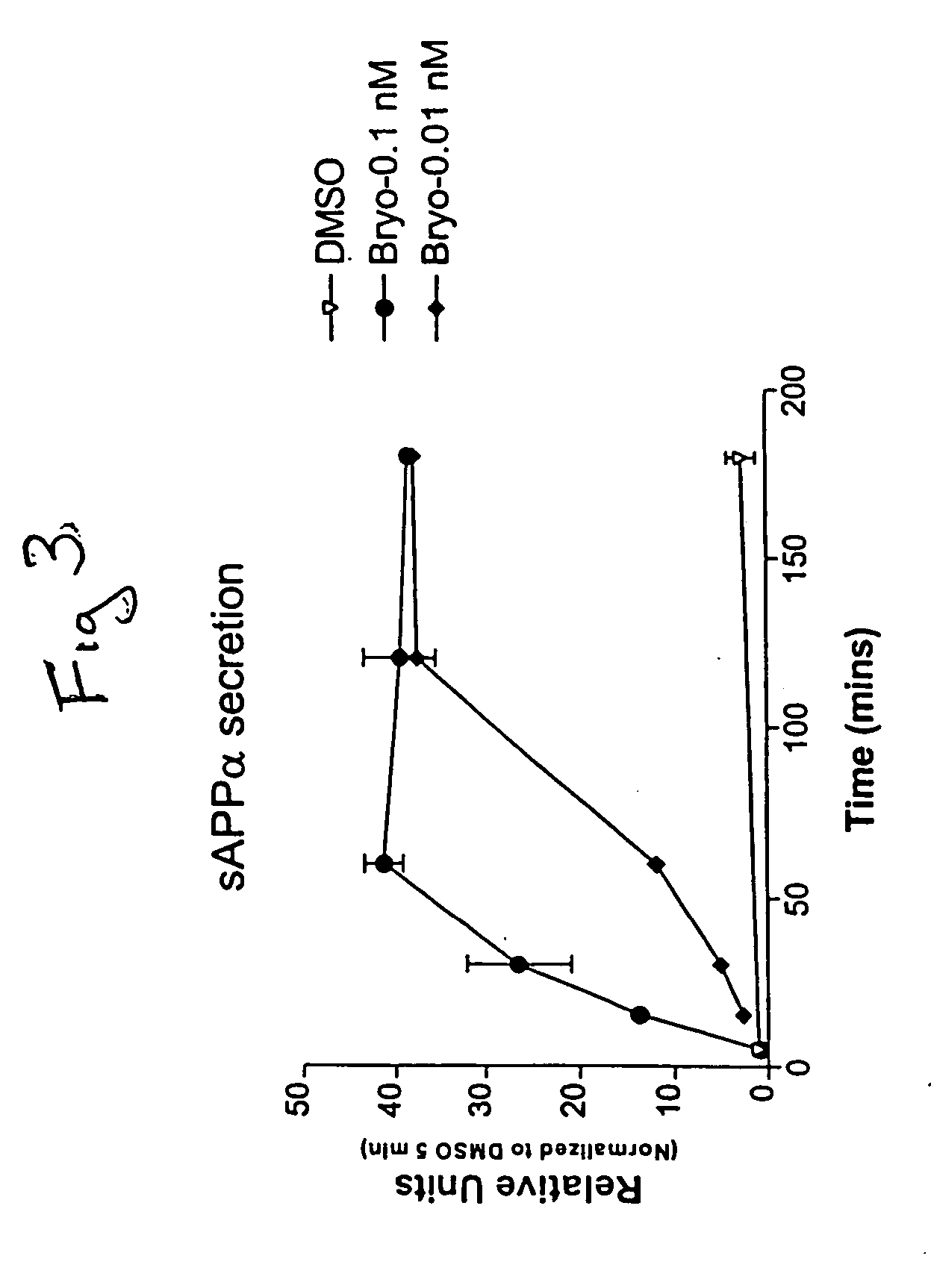
[0087] Cultured skin fibroblasts were obtained from the Coriell Cell Repositories and grown using the general guidelines established for their culture with slight modifications (Cristofalo & Carptentier, 1988; Hirashima et al., 1996). The culture medium in which cells were grown was Dulbecco's modified Eagle's medium (GIBCO) supplemented with 10% fetal calf serum (Biofluids, Inc.). Fibroblasts from control cell lines (AC), cases AG07141 and AG06241, and a familial AD (FAD) case (AG06848) were utilized.

[0088] PKC Activators

[0089] The different tissue distributions, the apparently distinctive roles of different isozymes, and the differential involvement in pathology make it important to use pharmacological tools that are capable of preferentially targeting specific isozymes (Kozikowski et al., 1997; Hofmann, 1997). Recent research in the medicinal chemistry field has resulted in the development of several PKC activators, for instance ...

example ii

[0101] The effect of PKC activators on cognition was demonstrated by the Morris Water Maze paradigm. In the present example, rats were injected intraventricularly with bryostatin-1 and trained for 4 days (following standard protocols). Retention was assessed on the 5th day. Learning was measured as the reduction of escape latency from trial to trial, which was significantly lower in the treated animals. Acquisition of memory was measured as time spent in the relevant quadrant (5th day). Memory or retention was significantly enhanced in treated animals, compared to sham injection animals (see FIGS. 4 through 5(a)-5(c)). The rats treated with bryostatin-1 showed improved cognition over control rats within 2 days of treatment (see FIG. 4). Bryostatin-1 is capable of being used at concentrations to improve cognition that are 300 to 300,000 times lower than the concentration used to treat tumors. The above example further shows that cognitive ability can be improved in non-diseased subje...

the structure of the environmentally friendly knitted fabric provided by the present invention; figure 2 Flow chart of the yarn wrapping machine for environmentally friendly knitted fabrics and storage devices; image 3 Is the parameter map of the yarn covering machine
Login to View More

PUM

PropertyMeasurementUnit
diameteraaaaaaaaaa
pHaaaaaaaaaa
pHaaaaaaaaaa
Login to View More

Abstract

The present invention relates to compositions and methods to modulate α-secretase and / or to improve cognitive ability. The invention further relates the improved / enhanced cognitive ability in diseased individuals, particularly Alzheimer's Disease patients, and treatment thereof through increased sAPP production. Macrocyclic lactones (i.e. bryostatin class and neristatin class) are compounds preferred for use with the present composition. The present invention also provides methods for increasing the generation of non-amyloidogenic soluble APP comprising the activation of protein kinase C (PKC) by administering an effective amount of PKC activator(s).

Description

PRIORITY OF INVENTION [0001] This application claims priority to U.S. Provisional Applications No. 60 / 362,080 filed Mar. 7, 2002.BACKGROUND OF THE INVENTION [0002] (i) Field of the Invention [0003] The present invention relates to the modulation of α-secretase and cognitive enhancement. The invention further relates to compounds for treatment of conditions associated with amyloid processing such as Alzheimer's Disease and compositions for the treatment of such conditions. [0004] (ii) Background of the Invention [0005] Various disorders and diseases exist which affect cognition. Cognition can be generally described as including at least three different components: attention, learning, and memory. Each of these components and their respective levels affect the overall level of a subject's cognitive ability. For instance, while Alzheimer's Disease patients suffer from a loss of overall cognition and thus deterioration of each of these characteristics, it is the loss of memory that is m...

Claims

the structure of the environmentally friendly knitted fabric provided by the present invention; figure 2 Flow chart of the yarn wrapping machine for environmentally friendly knitted fabrics and storage devices; image 3 Is the parameter map of the yarn covering machine
Login to View More

Application Information

Patent Timeline
17 Feb 2005
Publication
US20050037984A1
IPC
A61K45/00; A61K31/00; A61K31/365; A61K31/7048; A61P3/02; A61P3/08; A61P23/00; A61P25/00; A61P25/08; A61P25/14; A61P25/16; A61P25/28; A61P35/00; A61P39/02; A61P43/00
CPC
A61K31/366; A61K31/00; A61K31/365; A61P3/02; A61P3/08; A61P23/00; A61P25/00; A61P25/08
Inventors
ETCHEBERRIGARAY, RENE; ALKON, DANIEL L.