
Method for fast network re-optimization
a network optimization and network technology, applied in the field of communication networks, can solve the problems of limited global network information, unoptimized network resource allocation, and inability to optimize the current resource allocation for the remaining sessions,
- Summary
- Abstract
- Description
- Claims
- Application Information
AI Technical Summary
Benefits of technology
Problems solved by technology
Method used
Image

Examples
Embodiment Construction
[0013] Although various embodiments of the present invention herein are being described with respect to edge routers, it should be noted that the edge routers are provided as a working environment for specific embodiments of the present invention and should not be treated as limiting the scope of the invention. It will be appreciated by one skilled in the art informed by the teachings of the present invention that the concepts of the present invention may be applied in substantially any edge element or off-line network element to be used for the optimization of networks.
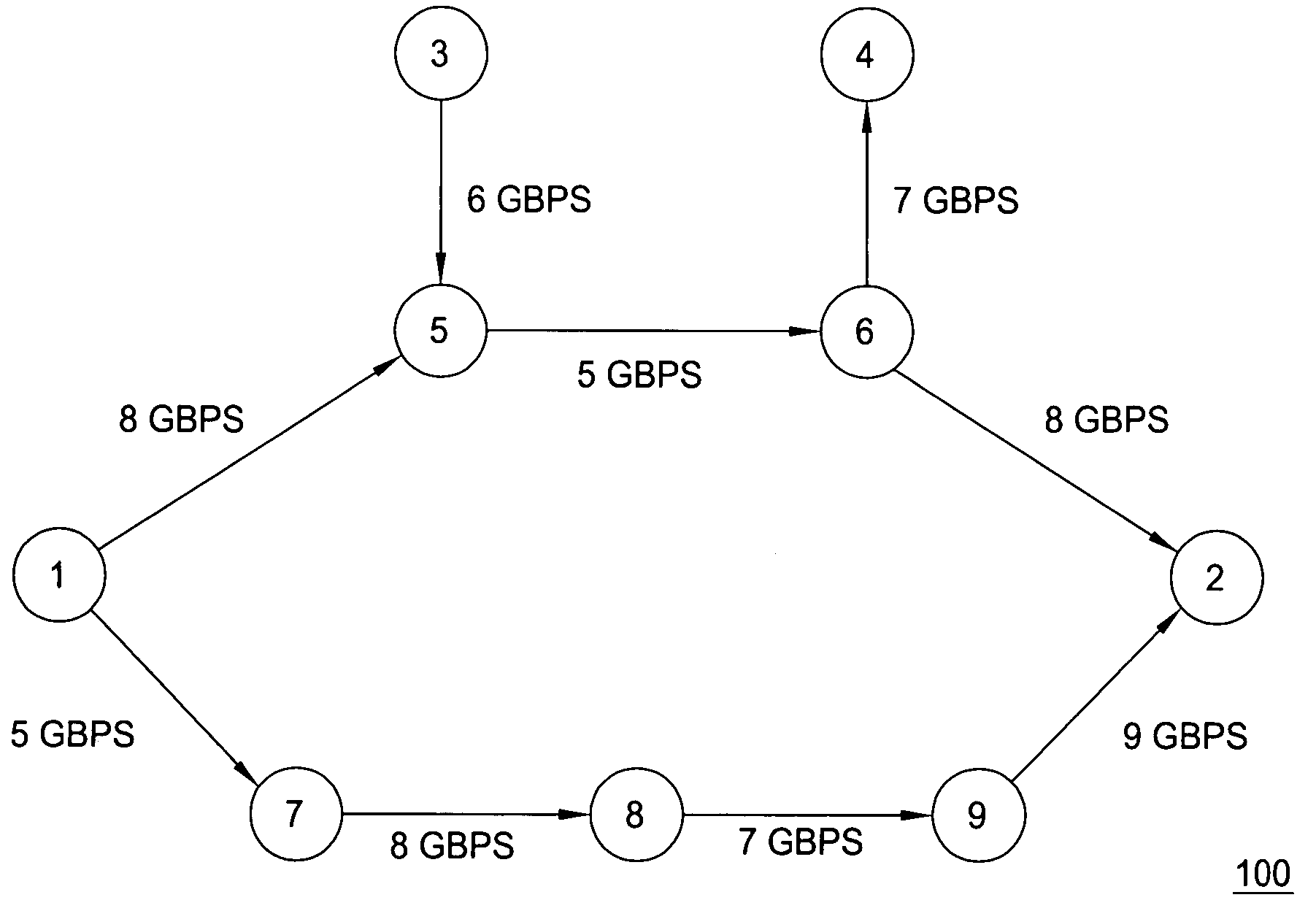
[0014] Session-oriented networks that use online routing tend to get unbalanced over time resulting in uneven load distribution. This may lead to some links getting congested that are “critical” for carrying some future demands. Re-optimization involves balancing the load on the links such that network congestion is alleviated. For example, FIG. 1 depicts a high level block diagram of a network 100 wherein an embodi...
PUM
 Login to View More
 Abstract
Description
Claims
Application Information
 Login to View More