[0009] It is therefore an object of the present invention to improve the data
throughput of an automatic repeat request
system in the presence of severe inter-symbol interference and channel
noise.
[0010] The present invention adapts a signaling
constellation while code-combining decisions from a decoder to overcome the effects of the channel interference. The present invention allows an
estimation of the correct
signal constellation to code-combine efficiently even when
noise conditions are dynamic. An
algorithm of the present invention correctly increases the degree of the constellation and coding scheme when channel conditions improve, while still allowing the soft-decisions from various constellations to be code-combined together. The present invention automatically adapts the code-combining
system to the
noise level present on the channel but also can be supplied with channel information for quicker
adaptation.
[0011] An uncoded waveform sends alternate phases of the
encoder state (systematic or non-systematic codes). Code-combining works until the fundamental uncoded transport
wave form reaches an uncoded bit-rate of 0.5 in one aspect of the present invention. Below this point in the
signal-to-noise ratio, no additional coding or repetition can be combined to clear the packet. As the
operation point approaches an uncoded bit-error rate of 0.5 of the underlying waveform, the worst code combining performs. More combinations are necessary the closer to the uncoded bit-error rate of 0.5 than were necessary above this point. Resending forward transmissions is not free and time is spent sending the ACK /
NAK signaling status over the
back channel, which increases the packet delivery time. Therefore, the present invention changes the underlying signaling constellation when code-combining degrades. The high-rate data waveform is coupled with control information using a low-rate robust signaling. Data is interleaved over an entire packet to improve performance for channels that experience
fading.
[0012] In accordance with the present invention, a method reduces
data error in an automatic repeat request (ARQ) communication system by code-combining data in a communications session that uses the ARQ protocol by sending alternate phases of an
encoder state and changing the underlying signaling constellation when code-combining performance degrades. An optimal signaling constellation and
code rate can be determined from a previous packet acknowledgment (ACK) status or from a look-up table of previously determined values. A signaling constellation,
code rate and packets to be transmitted are encoded and transmitted in a control burst to a
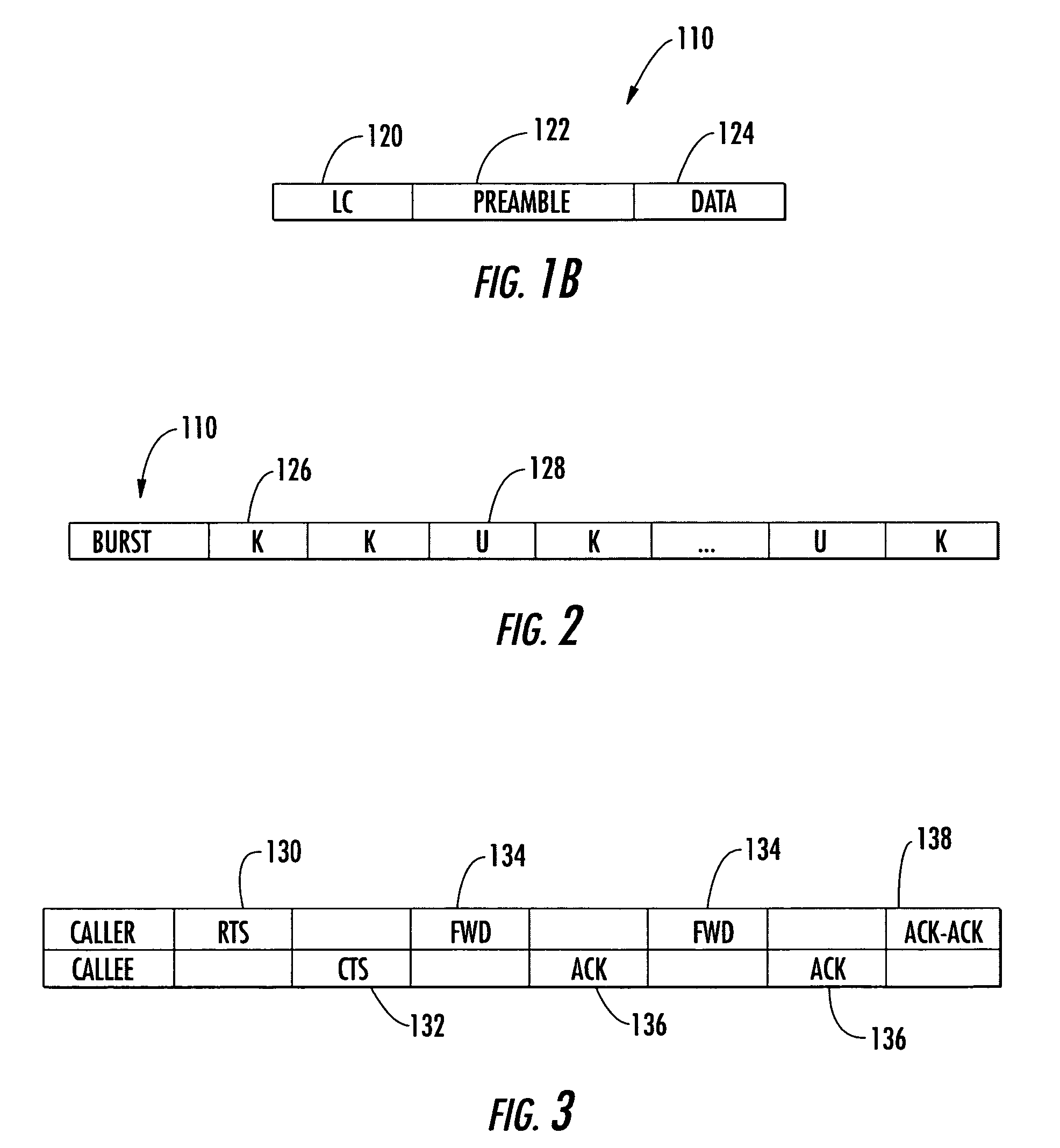
receiver. Training data and a fixed number of unknown blocks of symbols can also be transmitted after transmitting the control burst. Data packets can be mapped to an integer number of unknown blocks. Packets can be cleared from the communications channel and an ACK-ACK burst transmitted to indicate that a
file transfer has been completed. A puncture pattern of a
convolution code can be varied to achieve a desired code rate. The code rate can be formed as R=1, R=0.75 and R=0.5. Data can also be interleaved over an entire packet to be transmitted to improve the
viterbi decoder performance to burst errors.
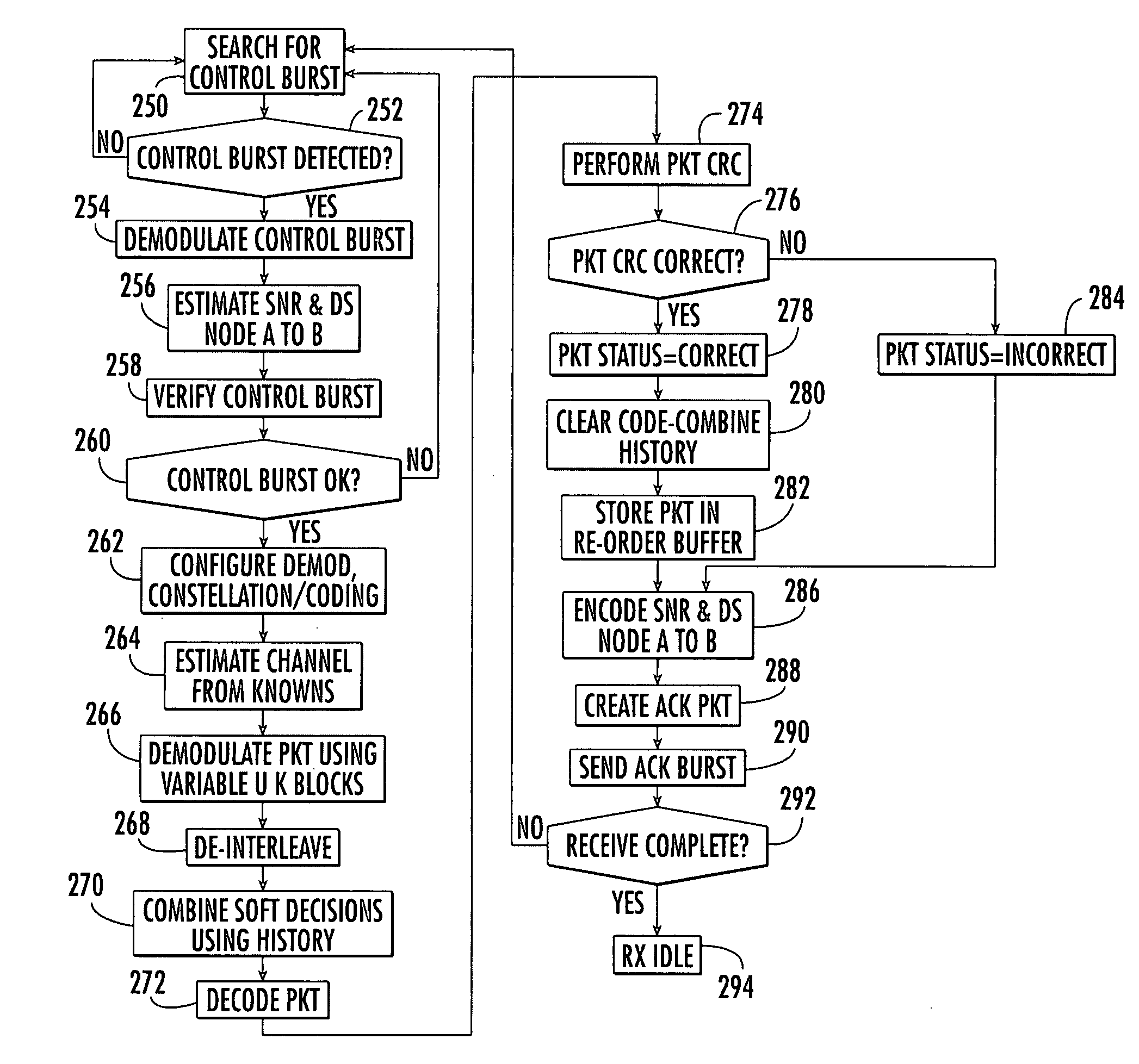
[0013] A method of the present invention also reduces data errors and encodes a signaling constellation, code rate and packet to be transmitted based on an optimal signaling constellation and code rate. The encoded signaling constellation, code rate, and packets are transmitted in a control burst through a
receiver. The encoded information is decoded at the receiver and information about the
signal-to-noise ratio and
Doppler spread are estimated. Information on the signal-to-noise ratio and
Doppler spread are encoded and the encoded information transmitted in an ACK burst along with a current packet decode status.



 Login to View More
  Login to View More