
Method for recovering information from channel-coded data streams
a channel-coded data and information technology, applied in the field of channel-coded data recovery methods, can solve the problems of small computing complexity of decoding methods and only slightly increasing computing complexity, and achieve the effect of reducing the character error floor of turbo codes, increasing computing power, and broadening the application of turbo codes
- Summary
- Abstract
- Description
- Claims
- Application Information
AI Technical Summary
Benefits of technology
Problems solved by technology
Method used
Image


Examples
Embodiment Construction
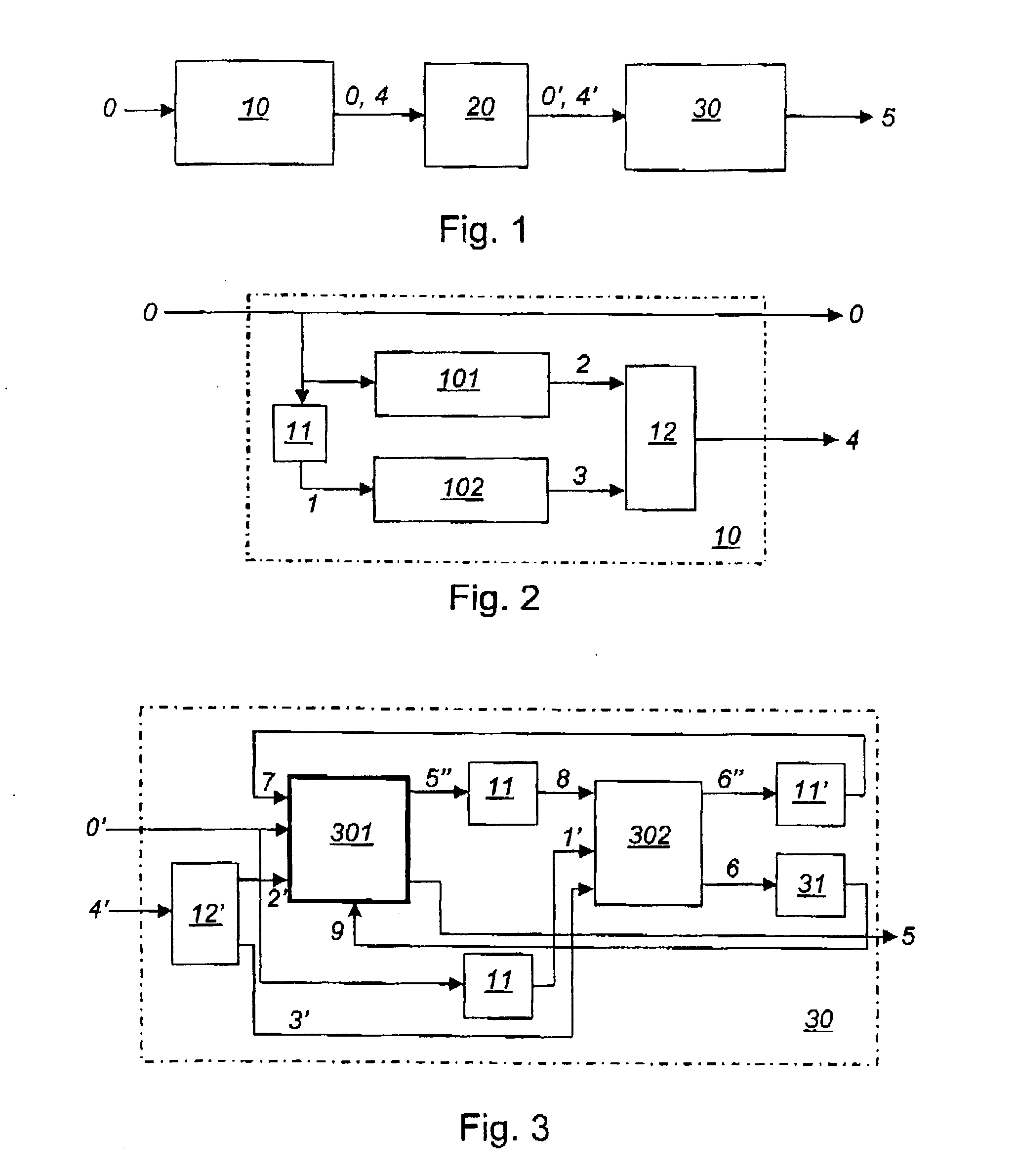
[0022] Throughout all the Figures, same or corresponding elements are generally indicated by same reference numerals. These depicted embodiments are to be understood as illustrative of the invention and not as limiting in any way. It should also be understood that the drawings are not necessarily to scale and that the embodiments are sometimes illustrated by graphic symbols, phantom lines, diagrammatic representations and fragmentary views. In certain instances, details which are not necessary for an understanding of the present invention or which render other details difficult to perceive may have been omitted.
[0023] Turning now to the drawing, and in particular to FIG. 1, there is shown in form of a schematic block diagram a communication system with an encoder 10, a transmission channel 20 and a decoder 30. The encoder 10 receives a data stream 0 and encodes the data steam 0 into an un-encoded bit stream 0 (useful data) and a parity stream 4. The un-encoded bit stream 0 and the ...
PUM
 Login to View More
 Abstract
Description
Claims
Application Information
 Login to View More