
Improvement on the uniformity of fluid flow rate for interconnecting plate for planar solid oxide fuel cell
a solid oxide fuel cell and fluid flow rate technology, applied in the direction of fuel cell details, transportation and packaging, electric generators, etc., can solve the problems of increasing the cost of fossil fuel, increasing the cost, and increasing the cost of manufacturing, so as to reduce the pressure drop within the channel, reduce the width of the channel, and reduce the expense of manufacturing.
- Summary
- Abstract
- Description
- Claims
- Application Information
AI Technical Summary
Benefits of technology
Problems solved by technology
Method used
Image

Examples
first embodiment
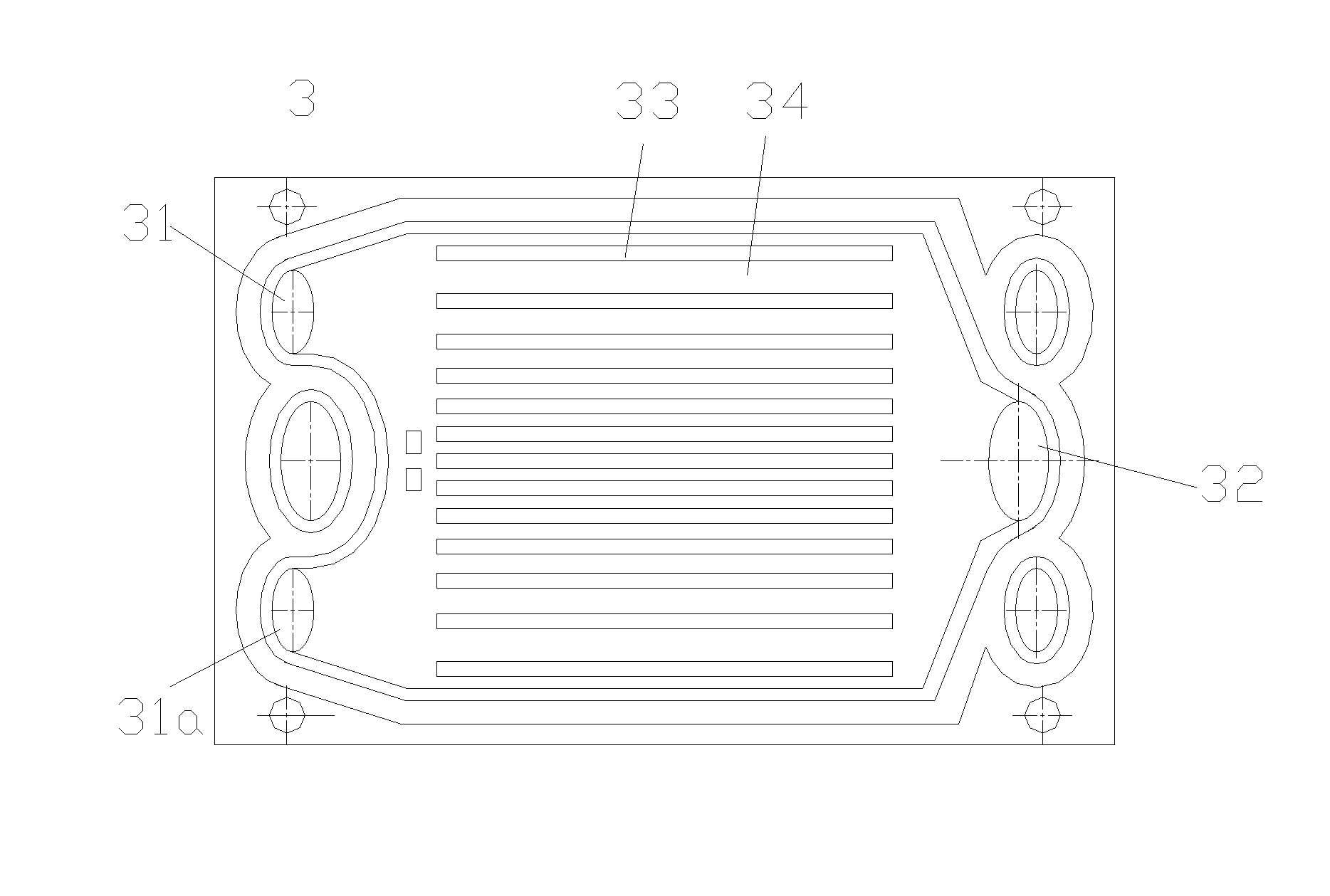
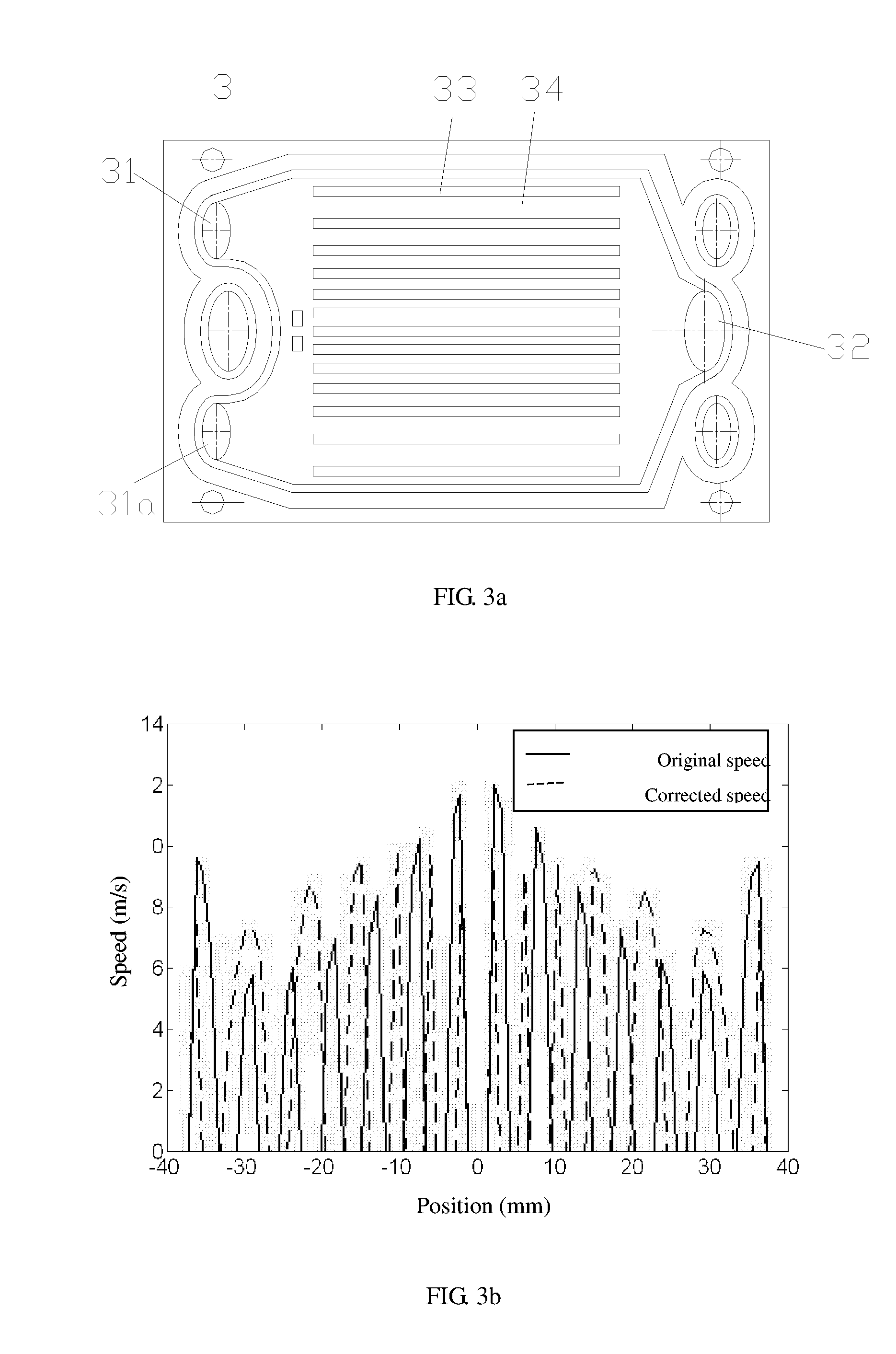
[0026] In FIG. 3a, it illustrates fuel cell connecting plate design 3 of the present invention having two inlets 31, 31a and one outlet 32, a series of long ribs 33 furnished between the inlets 31, 31a and outlet 32, and grooves 34 formed by spaces between ribs 33, wherein the width between spaces are reduced in sequence from the edges of the connecting plate to the center area.
[0027] In FIG. 3b, it illustrates a fluid flow rate calculation and comparison between the fuel cell connecting plate design 3 of FIG. 3a and prior art, wherein the fluid flow rate in the outside portion of grooves 34 of the connecting plate 3 is significantly enhanced while the fluid flow rate in the center portion is restricted, as a result, the uniformity of fluid flow rate (dotted lines) in the grooves with width reduced in sequence from edges to center of the connecting plate is better than the base case with equal width of grooves (solid lines).
third embodiment
[0028] In FIG. 4a, it illustrates fuel cell connecting plate design 4 of the present invention having two inlets 41, 41a and one outlet 42, a plurality of long ribs 43 furnished between the inlets 41, 41a and outlet 42, and grooves 44 formed by spaces between ribs 43, wherein the lengths of the ribs 43 vary in accordance with the variation of the edge at proximity of fluid inlets 41, 41a, and / or provide a plurality of fluid guide plates 45 in parallel at the middle of two fluid inlets 41, 41a.
[0029] In FIG. 4b, it illustrates a fluid flow rate calculation and comparison between the fuel cell connecting plate design 4 of FIG. 4a and prior art, wherein the evenness of fluid flow rate in the grooves 44 of the connecting plate 4 is significantly improved. It is noted that the change in length of ribs, while maintaining the contact area between the connecting plate and PEN on the frame unchanged, doesn't affect the amount of area of electricity generation in fuel cell.
[0030] In FIG. 5a...
PUM
| Property | Measurement | Unit |
|---|---|---|
| operating temperature | aaaaa | aaaaa |
| fluid flow rate | aaaaa | aaaaa |
| lengths | aaaaa | aaaaa |
Abstract
Description
Claims
Application Information
 Login to View More