
Apparatus and method for mitigation of cross correlation in GPS system
a technology of gps and applicability, applied in the field of applicability and method for cross correlation caused by the limited dynamic range of gps gold codes, is significant, and achieves the effects of reducing the effectiveness of the method, reducing false acquisition, and reducing the effect of cross correlation
- Summary
- Abstract
- Description
- Claims
- Application Information
AI Technical Summary
Benefits of technology
Problems solved by technology
Method used
Image

Examples
examples
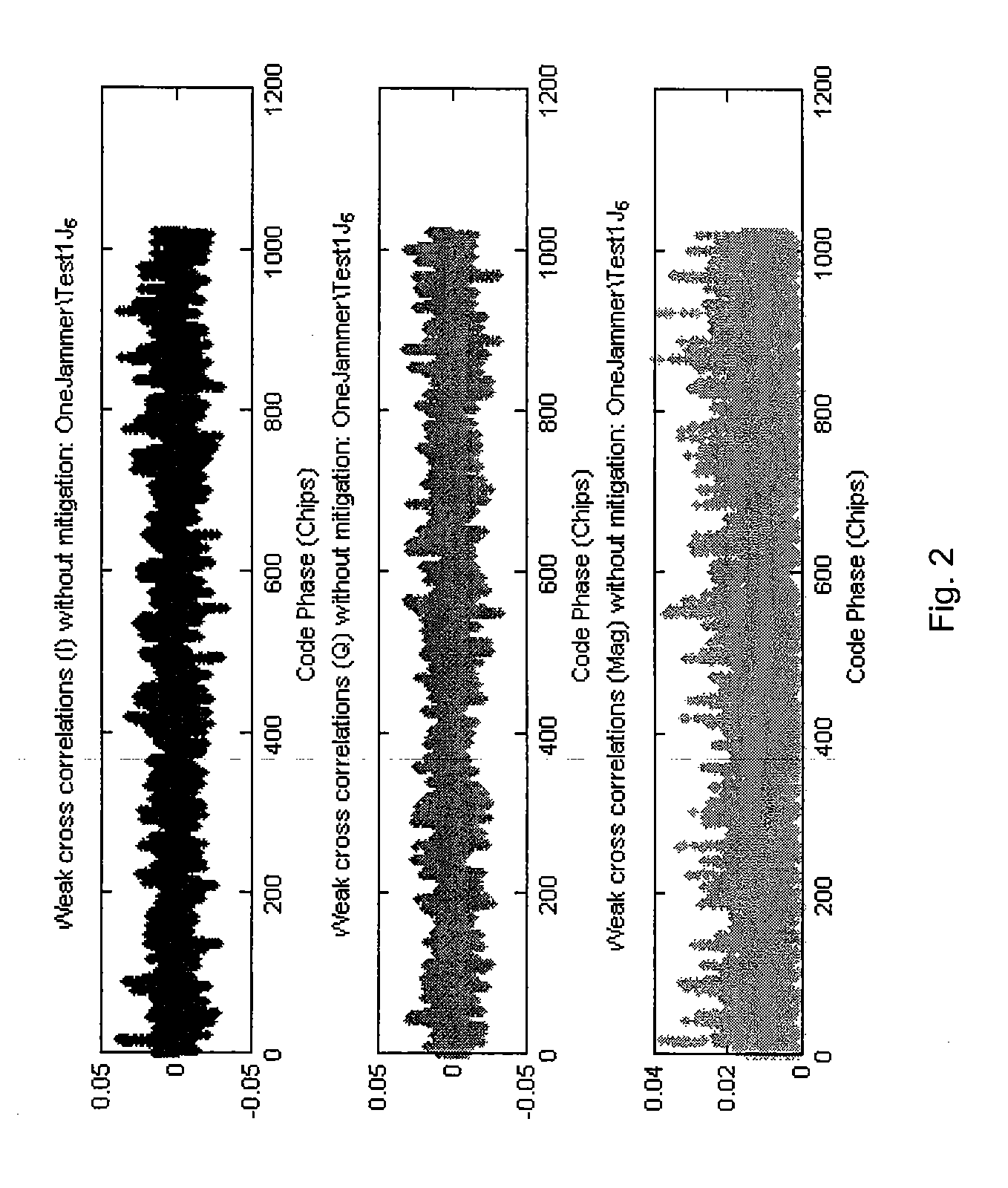
[0049] To confirm that the proposed techniques are effective in enhancing the observability of weak signals in the presence of strong signals, a MATLAB simulation was created. The use of MATLAB has a number of advantages ranging from having exact truth data of the input signals which are directly specified, through to being able to examine a range of intermediate quantities thereby significantly simplifying the debugging process. Unfortunately MATLAB is not as fast as a native C level software receiver so it is not useful for practical systems. The simulation consists of two steps. The first step consists of the generation of a single epoch (one millisecond) of intermediate frequency (IF) data for all of the specified satellites with specified amplitude, Doppler frequency, carrier phase and code phase. Since only a single epoch of data was generated, these simulations do not consider the effect of data-bit transitions. A single epoch of data is also not sufficient to detect very wea...
PUM
 Login to View More
 Abstract
Description
Claims
Application Information
 Login to View More