This helps you quickly interpret patents by identifying the three key elements:
Problems solved by technology
Method used
Benefits of technology
Benefits of technology
[0013] It is an object of the present invention to provide novel compounds having excellent cell adhesion inhibitory action and cell infiltration inhibitory action, which are useful as therapeutic or prophylactic agents for various inflammatory diseases and autoimmu
Problems solved by technology
However, the patent application discloses only its use as an anti-obesity agent and diabetes treatment based on the melanocortin receptor agonistic activity o
Method used
the structure of the environmentally friendly knitted fabric provided by the present invention; figure 2 Flow chart of the yarn wrapping machine for environmentally friendly knitted fabrics and storage devices; image 3 Is the parameter map of the yarn covering machine
View more
Image
Smart Image Click on the blue labels to locate them in the text.
Viewing Examples
Smart Image
Click on the blue label to locate the original text in one second.
Reading with bidirectional positioning of images and text.
[0766] A mixture of lithium bis(trimethylsilyl)amide (1M solution in tetrahydrofuran, 172 mL, 172 mmol) and anhydrous tetrahydrofuran (400 mL) was stirred, and then cooled to below −70° C. in a dry ice-acetone bath under a nitrogen atmosphere. A solution of 4,4-dimethylcyclohexanone (18 g, 143 mmol) in anhydrous tetrahydrofuran (100 mL) was added dropwise to the solution over 30 minutes. After stirring for 2 hours and 10 minutes under the same conditions, N-phenyl bis(trifluoromethanesulfonimide) (54 g, 150 mmol) was added to the reaction mixture, and stirring was continued for 16 hours while slowly warmed to room temperature.
[0767] Saturated aqueous ammonium chloride was ad...
[0803] A solution of diisopropylamine (22 mL, 0.157 mol) in anhydrous tetrahydrofuran (500 mL) was cooled to below −70° C. in a dry ice-acetone bath under a nitrogen atmosphere. n-Butyllithium (1.56 M solution in hexane, 100 mL, 0.156 mol) was slowly added dropwise to the stirred solution over 15 minutes. The reaction mixture was then warmed to −10° C. and then cooled to below −70° C. again. After stirring for 10 minutes, a solution of 4-t-butylcyclohexanone (20.05 g, 0.13 mol) in anhydrous tetrahydrofuran (100 mL) was gradually added dropwise to the reaction mixture over 15 minutes. After stirring for 30 minutes, a solution of N-phenyl bis(trifluoromethanesulfonimide) (51.09 g, 0.143 mol) in anhydrous tetrahydrofuran (200 mL) was gradually added dropwise to the reaction mixture over 15 minutes and the mixture was stirred for 30...
[0839] To a solution of 2-nitrophenylboronic acid (14.2 g, 85.19 mmol) in toluene (250 mL)-ethanol (125 mL) were added trifluoromethanesulfonic acid 4,4-dimethylcyclohex-1-enyl ester (20 g, 77.44 mmol) prepared in Example (1a), tetrakis(triphenylphosphine)palladium(0) (4.5 g, 3.87 mmol) and 2N aqueous sodium carbonate (128 mL, 256 mmol). The mixture was stirred at an external temperature of 100° C. for 1 hour and 45 minutes under a nitrogen atmosphere.
[0840] After air-cooling the reaction mixture to room temperature, it was passed through Celite and insoluble matters were filtered off. Ethyl acetate and water were added to the resultant filtrate and the filtrate was extracted with ethyl acetate.
[0841] The collected organic layer was washed with water and brine in that order and then dried over anhydrous magnesium sulfate...
the structure of the environmentally friendly knitted fabric provided by the present invention; figure 2 Flow chart of the yarn wrapping machine for environmentally friendly knitted fabrics and storage devices; image 3 Is the parameter map of the yarn covering machine
Login to View More
PUM
Property
Measurement
Unit
Adhesion strength
aaaaa
aaaaa
Therapeutic
aaaaa
aaaaa
Login to View More
Abstract
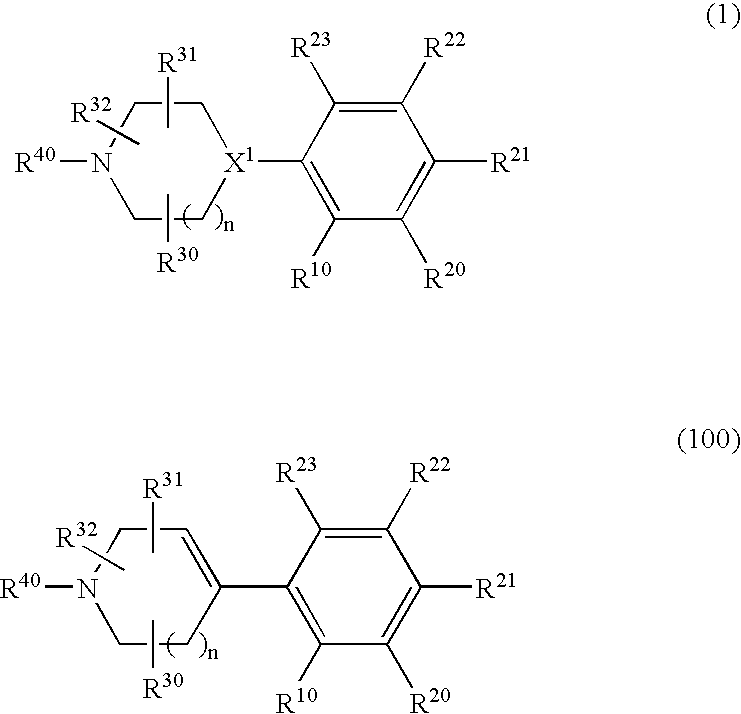
A compound represented by the following general formula (1) or (100), a salt thereof or a hydrate of the foregoing has excellent cell adhesion inhibitory action or cell infiltration inhibitory action, and is useful as a therapeutic or prophylactic agent for various inflammatory diseases and autoimmune diseases associated with adhesion and infiltration of leukocytes, such as inflammatory bowel disease (particularly ulcerative colitis or Crohn's disease), irritable bowel syndrome, rheumatoid arthritis, psoriasis, multiple sclerosis, asthma and atopic dermatitis.
TECHNICAL FIELD [0001] The present invention relates to 1,2-di(cyclic)substituted benzene compounds which are useful as cell adhesion inhibitors or cell infiltration inhibitors, as well as to their salts and to hydrates of the foregoing. [0002] The present invention relates to 1,2-di(cyclic)substituted benzene compounds which are useful as therapeutic or prophylactic agents for inflammatory diseases and autoimmune diseases, as well as to their salts and to hydrates of the foregoing. [0003] The invention further relates to 1,2-di(cyclic)substituted benzene compounds which are useful as therapeutic or prophylactic agents for various diseases associated with adhesion and infiltration of leukocyte, such as inflammatory bowel disease (particularly ulcerative colitis or Crohn's disease), irritable bowel syndrome, rheumatoid arthritis, psoriasis, multiple sclerosis, asthma and atopic dermatitis, as well as to their salts and to hydrates of the foregoing. BACKGROUND ART [0004] Inflammatory ...
Claims
the structure of the environmentally friendly knitted fabric provided by the present invention; figure 2 Flow chart of the yarn wrapping machine for environmentally friendly knitted fabrics and storage devices; image 3 Is the parameter map of the yarn covering machine
Login to View More
Application Information
Patent Timeline
Application Date:The date an application was filed.
Publication Date:The date a patent or application was officially published.
First Publication Date:The earliest publication date of a patent with the same application number.
Issue Date:Publication date of the patent grant document.
PCT Entry Date:The Entry date of PCT National Phase.
Estimated Expiry Date:The statutory expiry date of a patent right according to the Patent Law, and it is the longest term of protection that the patent right can achieve without the termination of the patent right due to other reasons(Term extension factor has been taken into account ).
Invalid Date:Actual expiry date is based on effective date or publication date of legal transaction data of invalid patent.



 Login to View More