Stabilized elongate implantable vascular access device

a vascular access device and stabilization technology, applied in the field of implantable medical devices, can solve the problems of port stability within the body after being placed, affecting the stability of the port, and causing the propensity to flip, so as to facilitate the finding and delivering of medications, reliably and repeatedly, the effect of easy finding and delivering

US20080249509A1Inactive Publication Date: 2008-10-09STEALTH THERAPEUTICS
99 Cites 30 Cited by

Patent Information

Authority / Receiving Office
US · United States
Patent Type
Applications(United States)
Current Assignee / Owner
Publication Date
2008-10-09
Estimated Expiration
Not applicable · inactive patent

Smart Images

  • Figure 1
    Figure 1
  • Figure 2
    Figure 2
  • Figure 3
    Figure 3
Patent Text Reader

Abstract

A vascular access port is described that is elongate in form. A distal end is coupled to a tube which leads into a body lumen. A proximal end has a head thereon with a septum which can be repeatedly penetrated by a needle and reseal, for repeated administration of medications or other compositions through the port and into the body of the patient. A wing is attached to the body that has two positions including a streamlined first position for implantation and a wider second position for stabilization of the port after implantation. A stay is preferably also provided to abut the wing when in the second position to keep the wing in the second position when fully deployed.
Need to check novelty before this filing date? Find Prior Art

Description

CROSS-REFERENCE TO RELATED APPLICATIONS

[0001] This application claims benefit under Title 35, United States Code §119(e) of U.S. Provisional Application No. 60 / 907,526 filed on Apr. 5, 2007.FIELD OF THE INVENTION

[0002] The following invention relates to implantable medical devices which are implanted subcutaneously and which interface with a body lumen, such as a vascular structure, and which can be themselves accessed by a needle through the skin for delivery of medications and other preparations into the vascular system of the patient. More particularly, this invention relates to vascular access devices, also referred to as ports, which are implanted subcutaneously and which include structures to help maintain the port in a stable position at the subcutaneous implantation site.BACKGROUND OF THE INVENTION

[0003] Subcutaneously implanted vascular access devices, or ports, have been used for many years to provide long term vascular access in patients that require frequent or periodic the...

Examples

Embodiment Construction

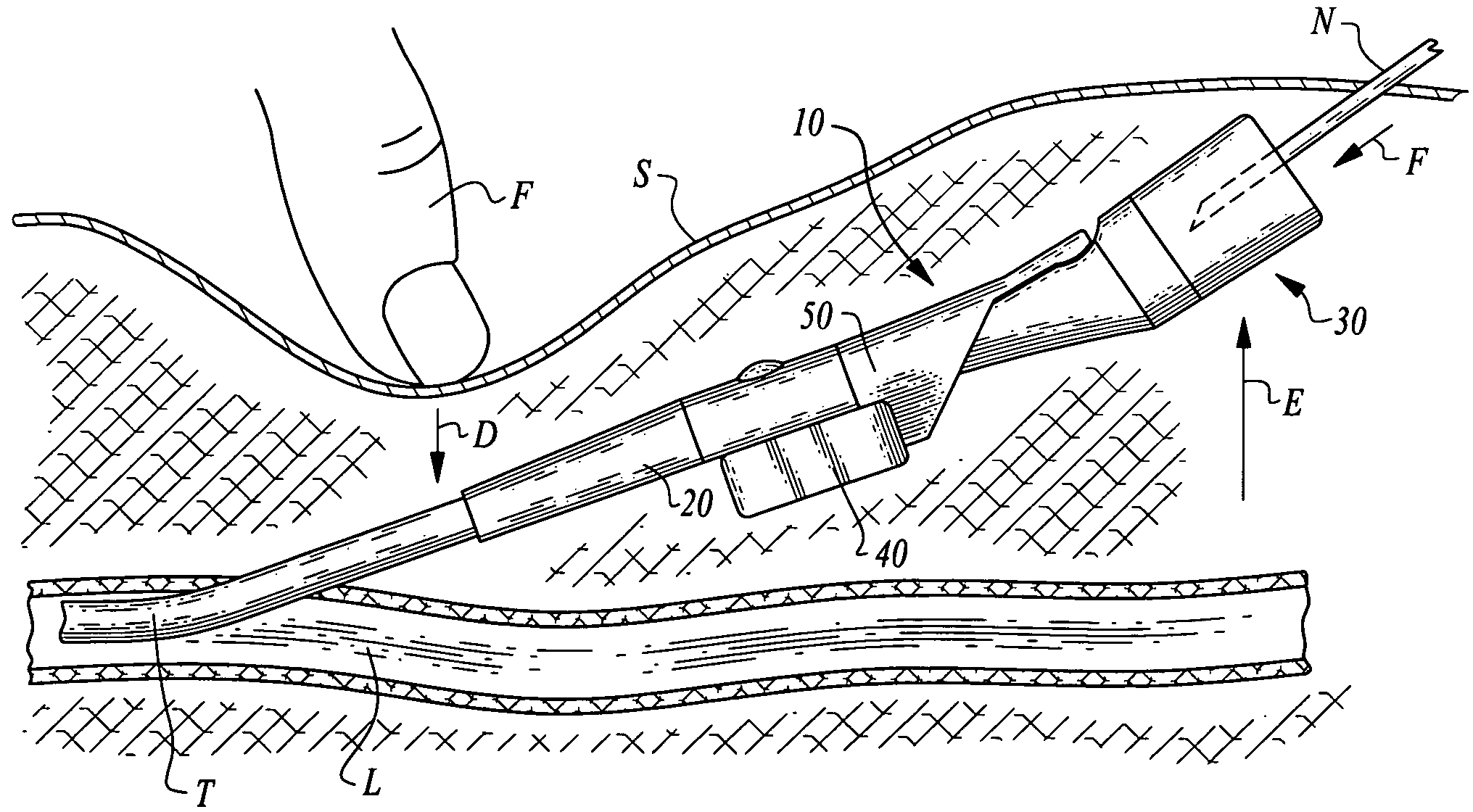
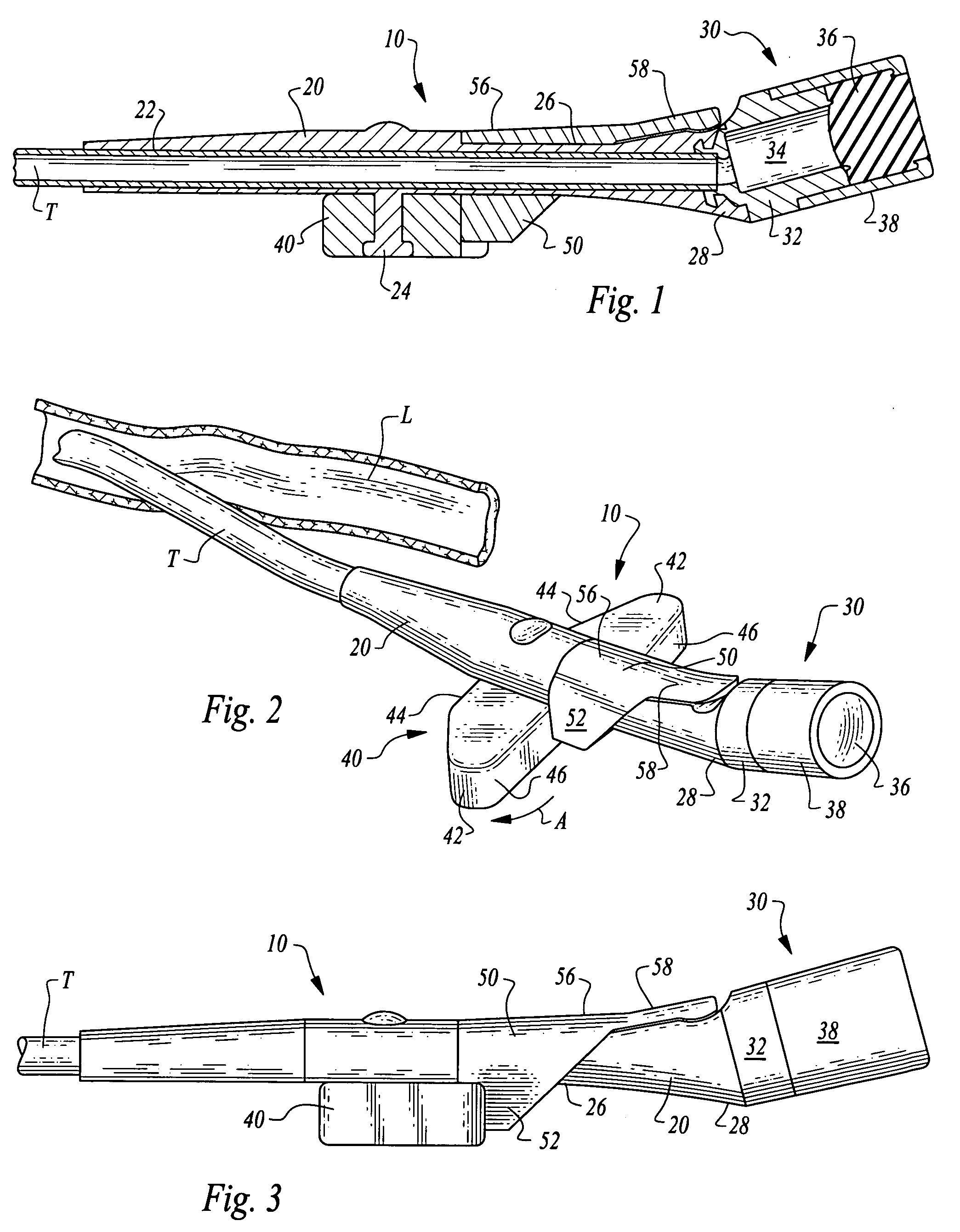
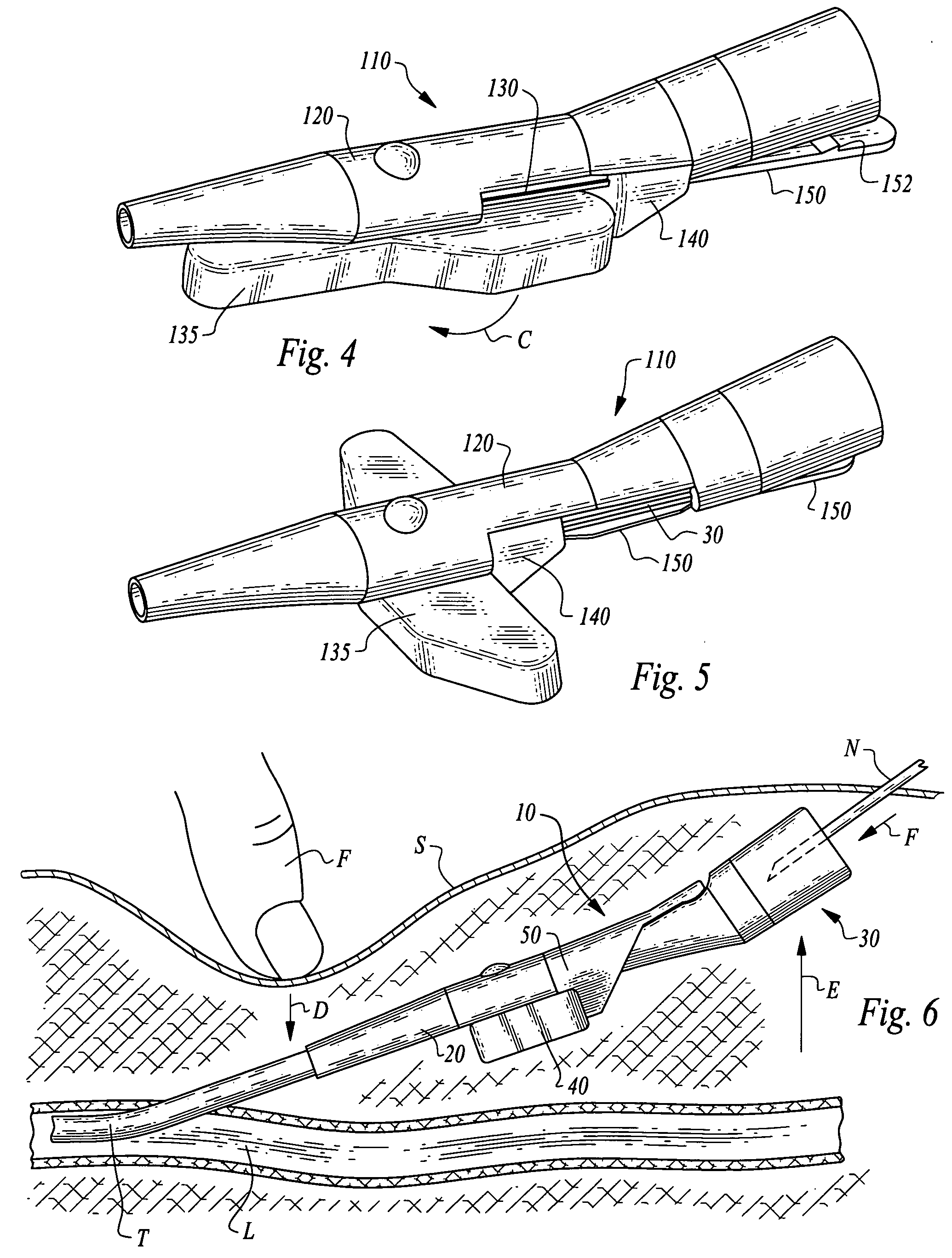
[0027]Referring to the drawings, wherein like reference numerals represent like parts throughout the various drawing figures, reference numeral 10 is directed to a vascular access port which can be implanted subcutaneously (FIG. 6) with a tube T or other structure accessing a body lumen L, such as a vascular structure. The port 10 can then be accessed through the skin S, such as by a needle N, for delivery of medications or other compositions into the various internal structures of the patient. This invention is directed to variations on a vascular access port described in U.S. patent application Ser. No. 11 / 651,770, filed on Jan. 9, 2007, the contents of which are incorporated herein by reference in their entirety.

[0028]In essence, and with particular reference to FIGS. 1-3 and 7, basic details of this invention are described, according to a preferred embodiment. The port 10 includes an elongate body 20 having a hollow conduit 22 within an interior thereof extending between ends of...