
2-aminopyridine analogs as glucokinase activators
a technology of glucokinase and aminopyridine, which is applied in the direction of metabolism disorder, extracellular fluid disorder, immunological disorder, etc., can solve the problems of insufficient insulin secretion of the pancreas, insufficient amounts to overcome intrinsic insulin resistance, and change in carbohydrate, lipid and protein metabolism
- Summary
- Abstract
- Description
- Claims
- Application Information
AI Technical Summary
Problems solved by technology
Method used
Image

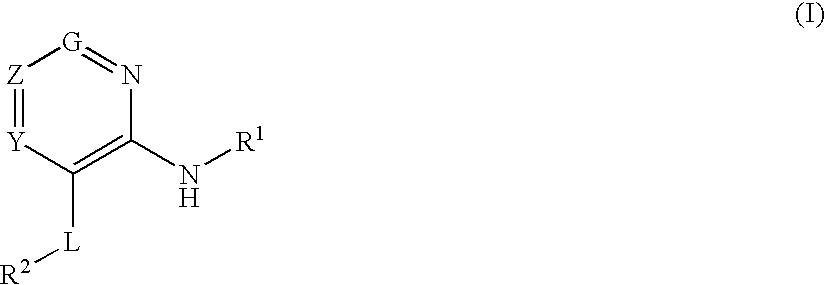
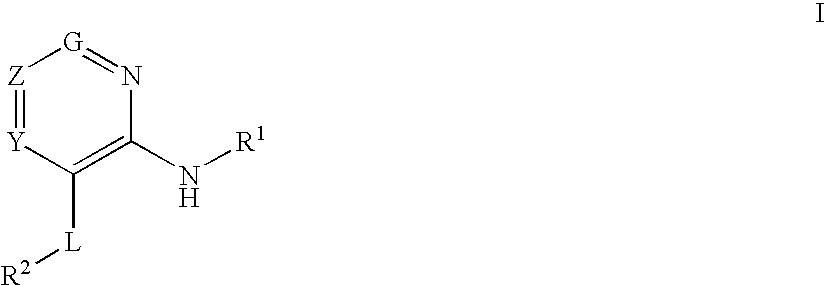
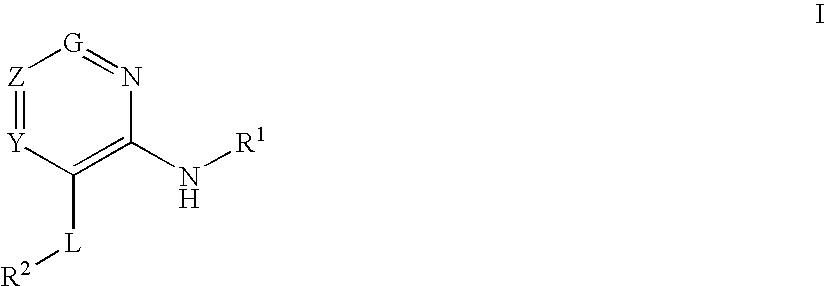
Examples
example 1
2-(2-(4-Methylthiazol-2-ylamino)pyridin-3-yloxy)benzonitrile
[0399]
[0400]Step A: 2-(2-chloropyridin-3-yloxy)benzonitrile: A 50 mLround bottom flask was charged with 2-chloropyridin-3-ol (2.5 g, 19 mmol), 2-fluorobenzonitrile (2.6 g, 21 mmol) and potassium carbonate (6.7 g, 48 mmol) in DMF (10 mL) and heated at 90° C. for 1.5 days. Water was added water, and the reaction mixture was extracted with ethyl acetate, dried over magnesium sulfate, filtered and concentrated. The residue was purified by silica gel column chromatography using 10-20% ethyl acetate in hexanes as eluent to afford the title compound as an off white solid (2.1 g, 47% yield).
[0401]Step B: 2-(2-(4-methylthiazol-2-ylamino)pyridin-3-yloxy)benzonitrile: A 50 mLround bottom flask was charged with 2-(2-chloropyridin-3-yloxy)benzonitrile (0.667 g, 2.89 mmol), 4-methylthiazol-2-amine (0.300 g, 2.63 mmol), potassium phosphate (0.614 g, 2.89 mmol) and toluene (7 mL). The reaction mixture was degassed with nitrogen. Tris(diben...
example 2
4-(2-(4-Methylthiazol-2-ylamino)pyridin-3-yloxy)benzonitrile
[0402]
[0403]Prepared according to the method of Example 1, starting with 4-(2-chloropyridin-3-yloxy)benzonitrile. 1H NMR (CDCl3) δ 8.19 (dd, 1H), 7.62 (m, 1H), 7.59 (m, 1H), 7.21 (dd, 1H), 7.02 (m, 1H), 7.00 (m, 1H), 6.87 (dd, 1H), 6.39 (m, 1H), 2.28 (d, 3H); Mass spectrum (esi) m / z=309 (100).
example 3
2-(2-(3-Methyl-1,2,4-thiadiazol-5-ylamino)pyridin-3-yloxy)benzonitrile
[0404]
[0405]Prepared according to the method of Example 1, Step B, starting with 2-(2-chloropyridin-3-yloxy)benzonitrile. 1H NMR (CDCl3) δ 9.14 (bs, 1H), 8.28 (dd, 1H), 7.73 (dd, 1H), 7.56 (m, 1H), 7.24-7.29 (m, 2H), 7.00 (dd, 1H), 6.94 (d, 1H) 2.52 (s, 3H); Mass spectrum (esi) m / z=310 (100).
PUM
 Login to View More
 Abstract
Description
Claims
Application Information
 Login to View More