
Time synchronization method and frequency offset estimation method using the same in OFDM network
a time synchronization and frequency offset estimation technology, applied in multi-frequency code systems, digital transmission, amplitude demodulation, etc., can solve problems such as inefficiency in satellite communication networks, method increase due to vector space calculation, and conventional time/frequency synchronization methods considering terrestrial mobile communication environments, etc., to prevent performance degradation, accurate time synchronization, and margin in transmission power limitations
- Summary
- Abstract
- Description
- Claims
- Application Information
AI Technical Summary
Benefits of technology
Problems solved by technology
Method used
Image

Examples
second embodiment
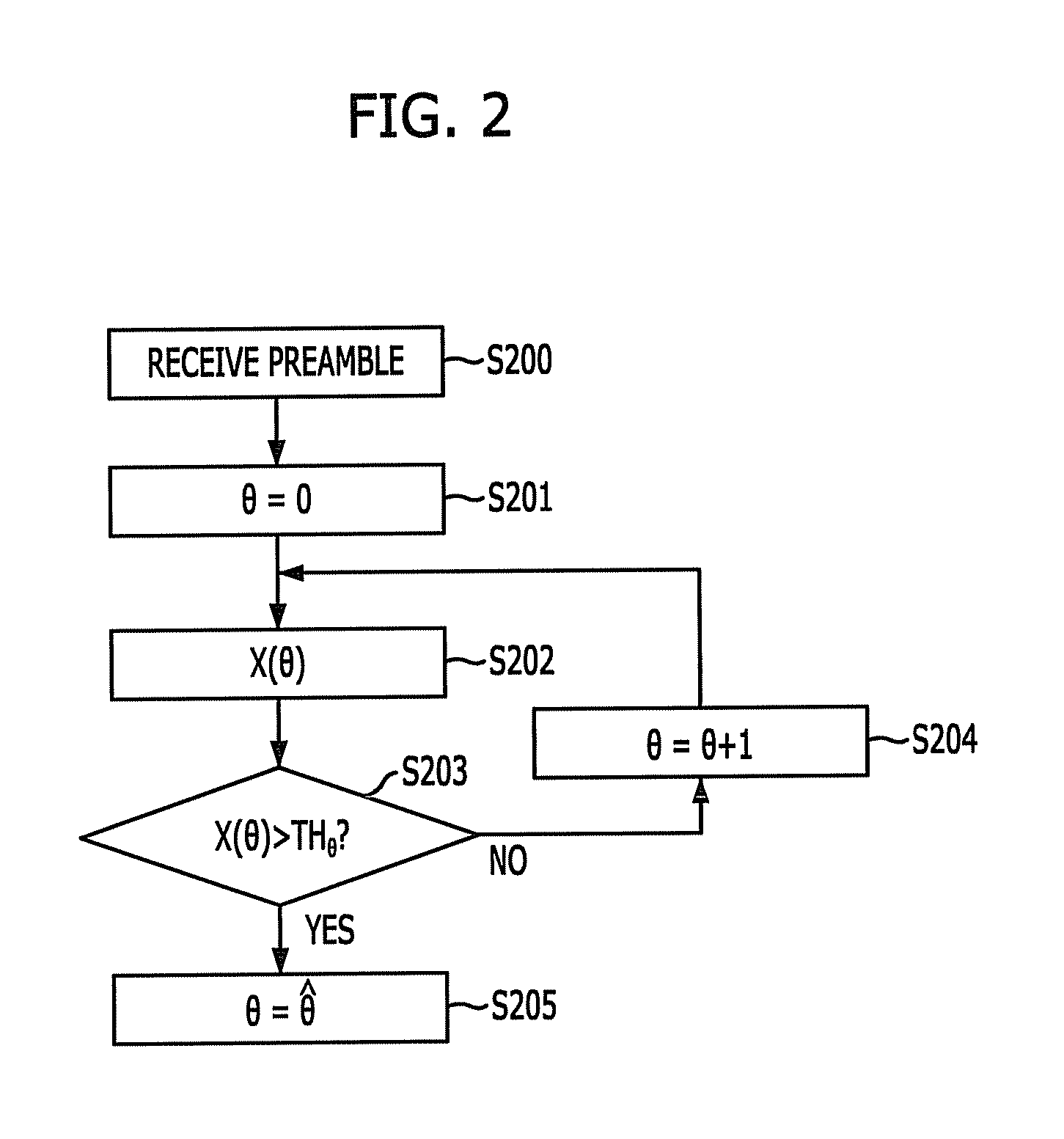
[0062]Meanwhile, the time synchronization process in accordance with the present invention is illustrated in FIG. 2.
first embodiment
[0063]As described above, the time synchronization method in accordance with the present invention can easily acquire the time synchronization by finding maximum value of the moving sum X(θ). However, in the case of a low-performance terminal, a load is increased due to the moving sum process and it takes much time to find the location θ.
[0064]Hereinafter, the time synchronization method in accordance with the second embodiment of the present invention will be described.
[0065]Referring to FIG. 2, in step S200, the receiver receives a preamble from the transmitter. In steps S201 to S205, while θ increases from zero by “1”, the moving sum X(θ) is calculated using the equations of the time synchronization processes in accordance with the first embodiment of the present invention. Specifically, when the moving sum X(θ) is greater than a preset threshold value THθ the moving sum process is stopped and the corresponding location θ is estimated as a parameter {circumflex over (θ)}.
[0066]Th...
third embodiment
[0077]The frequency offset estimation method in accordance with the present invention has the following effects.
[0078]In the related art, only the decimal part of the frequency offset in the time domain can be estimated, and the received signal must be converted into the frequency-domain signal through the FFT and then signal-processed in order to estimate the integer part of the frequency offset.
[0079]On the contrary, as can be seen from Eq. 9, the frequency offset estimation method in accordance with the third embodiment of the present invention can estimate both the decimal part and the integer part of the frequency offset in a range of −N / 2<ε
[0080]The performance of the frequency offset estimation method in accordance with the third embodiment of the present invention may be slightly degraded due to the estimation theory that the estimation error increases when the estimation range is widened. The frequency offset estimation method that can solve the problem in accordance w...
PUM
 Login to View More
 Abstract
Description
Claims
Application Information
 Login to View More