
Projector
a projector and light source technology, applied in the field of projectors, can solve the problems of disadvantageous increase of power consumption of the projector, disadvantageous increase of the intensity of the light from the light source, and disadvantageous increase of the electrode wear of the discharge lamp, so as to reduce the amount of wear of the electrodes of the discharge lamp and reduce the brightness of the discharge lamp
- Summary
- Abstract
- Description
- Claims
- Application Information
AI Technical Summary
Benefits of technology
Problems solved by technology
Method used
Image

Examples
experimental example
2. Experimental Example
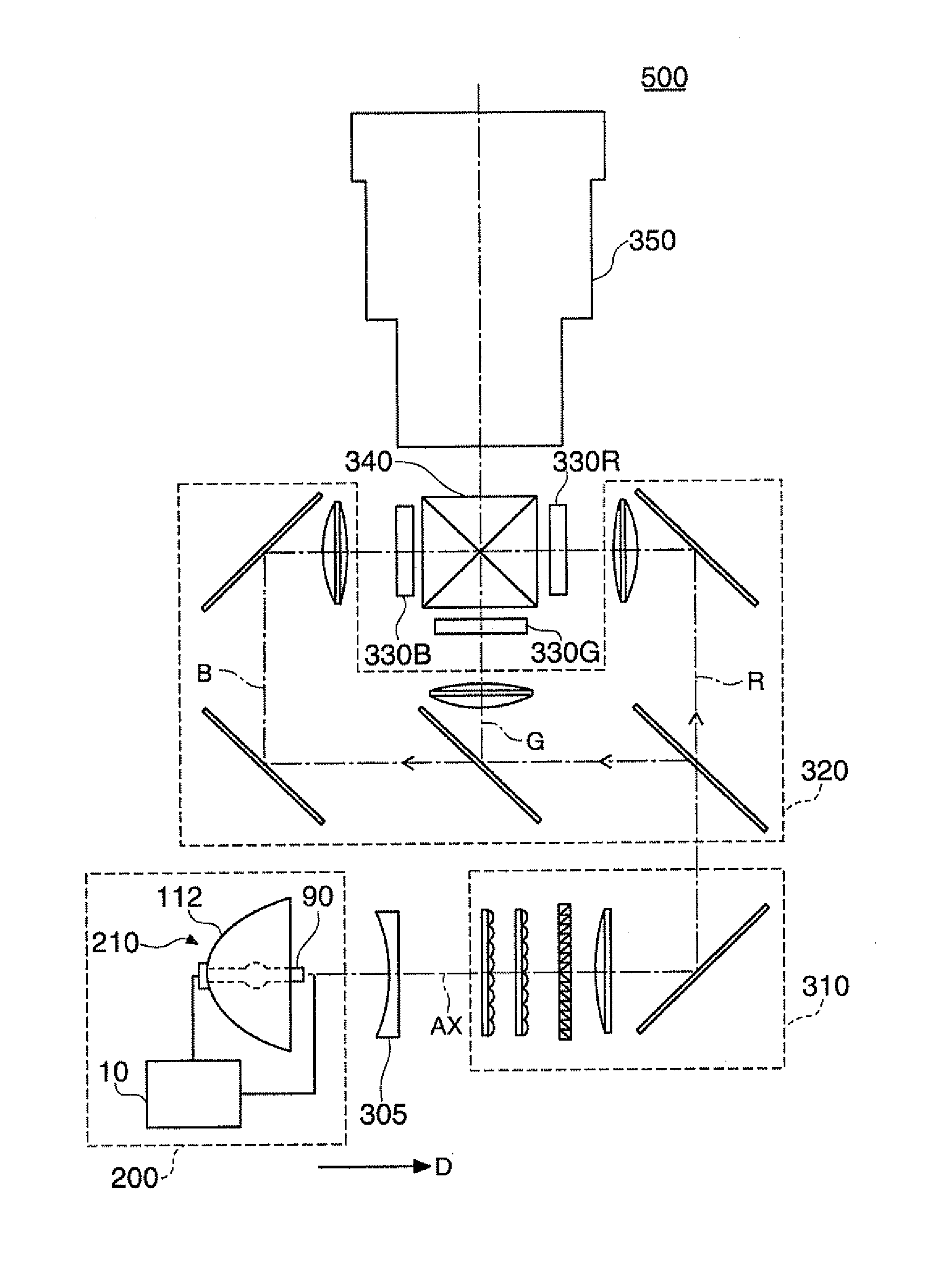
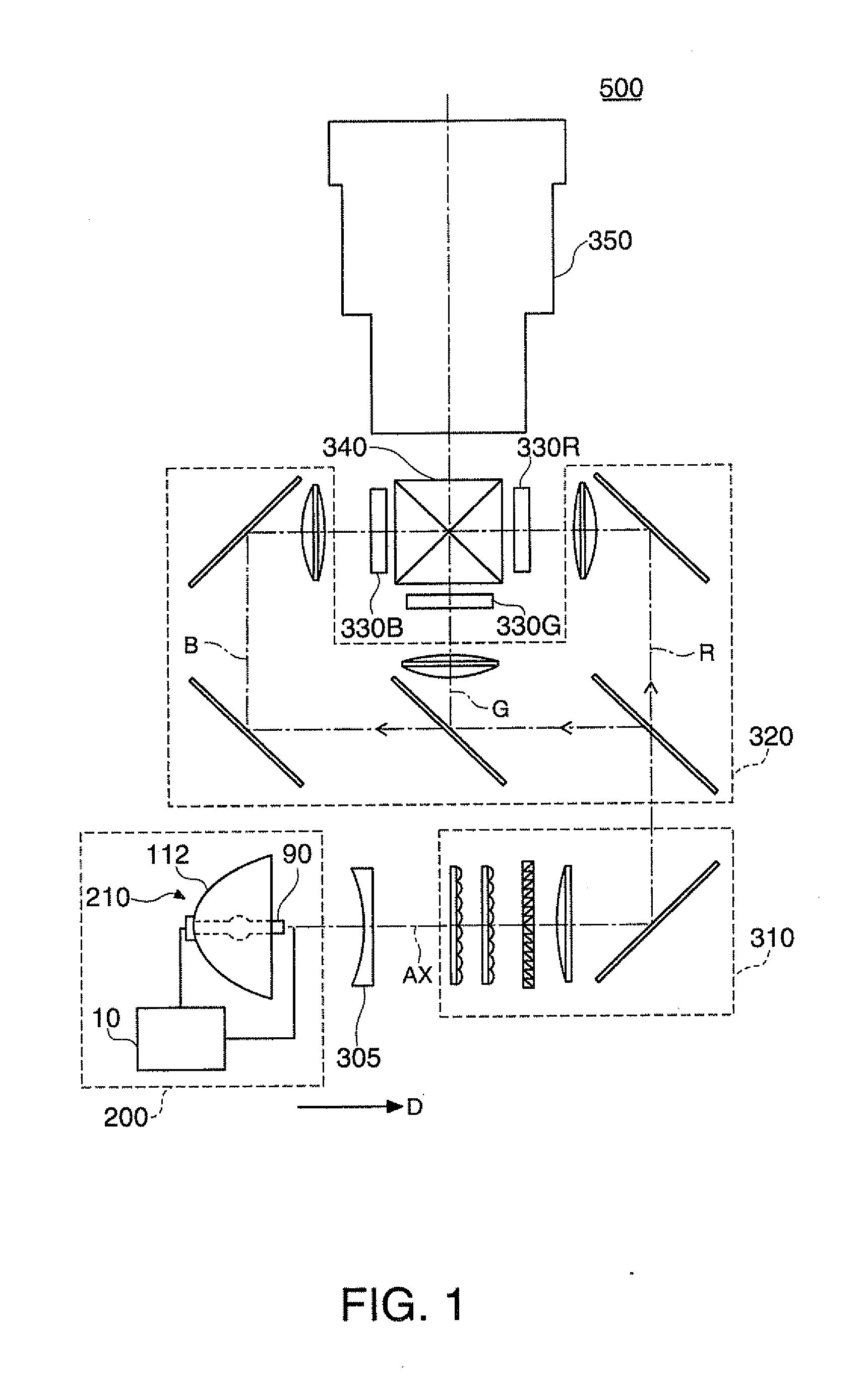
[0143]A description will next be made of an experimental example using the projector 500 according to Variation 1 of the present embodiment.
[0144]In the present experiment using a discharge lamp driven at a drive voltage of 70 V in an initial state, the experiment was so conducted that the electrodes of the discharge lamp wore to a point where the drive voltage for driving the discharge lamp increased to 110 V. Further, in the present experiment, the shapes of the electrodes of the discharge lamp were estimated and evaluated based on variation in the drive voltage for driving the discharge lamp and the brightness thereof obtained when the first and second control processes were carried out at certain drive electric power. Table 1 shows evaluation results obtained in the present experiment.
TABLE 1Shapes of protrusionsDrive electricFirst controlSecond controlpowerprocessprocess200 Wbadfair210 Wfairgood220 Wfairgood230 Wgoodgood
[0145]In Table 1, “good” indicates ...
PUM
 Login to View More
 Abstract
Description
Claims
Application Information
 Login to View More